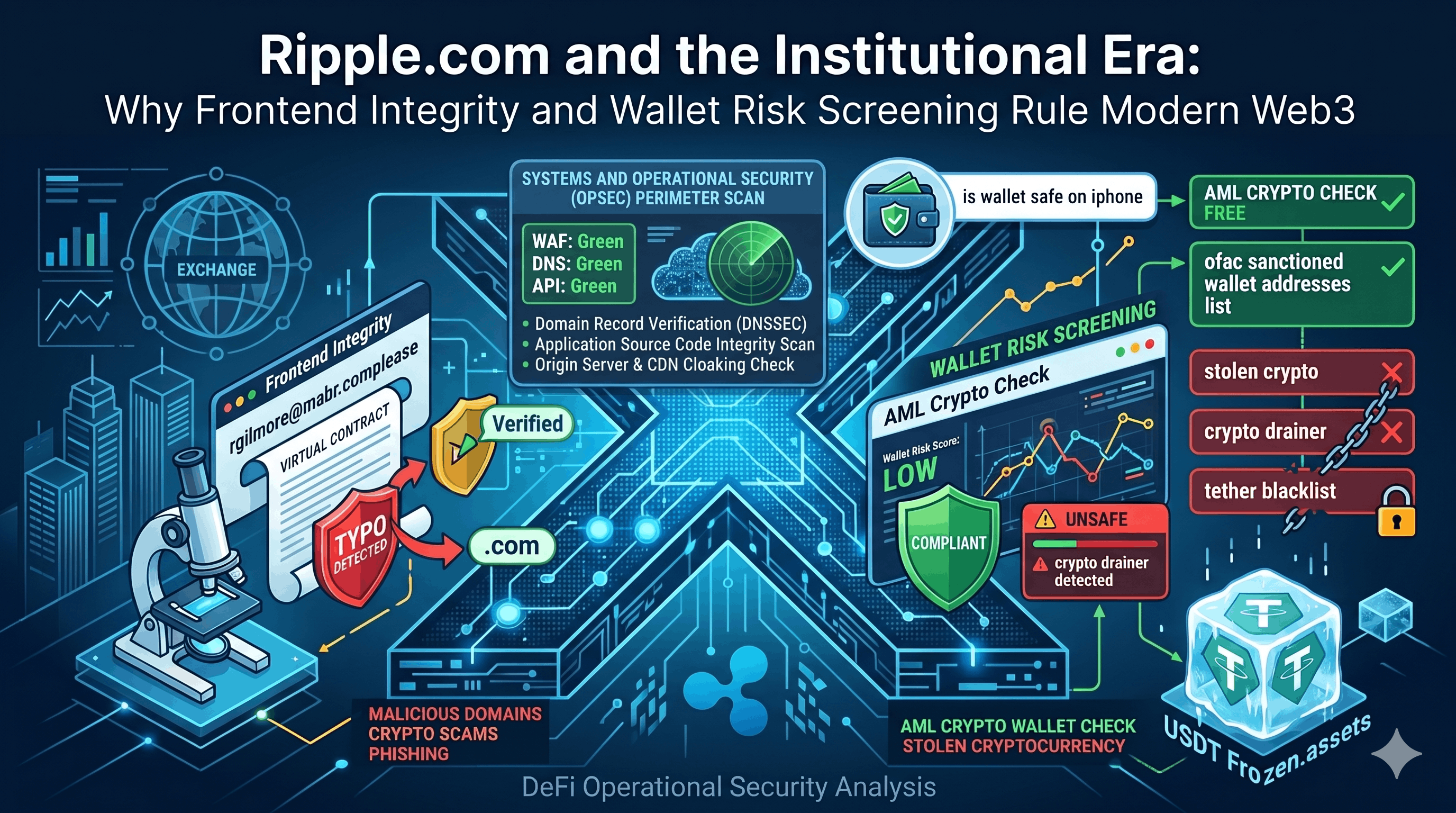
Ripple.com and the Institutional Era
As digital assets move from retail speculation to enterprise adoption, the question banks and fintechs ask is no longer "is crypto legitimate?" — it is "can I prove this counterparty, this domain, and this wallet are safe before I move capital?" Infrastructure providers like Ripple sit at the center of that shift, marketing payment settlement, digital-asset custody, and a compliance-first stablecoin (RLUSD) to regulated institutions. But as on-chain protocols harden, the attack surface migrates to the web applications fronting them — and that is where a modern verification stack earns its keep.
To make this concrete, we ran ripple.com through TrustSniffer. The result is what you would expect from a genuine institutional operator — and it also surfaces a small lesson about how even a flawless-looking site carries micro-anomalies.
ripple.com — TrustSniffer verdict
  Trust score ........ 91.68 / 100   (HIGH_TRUST)
  Domain age ......... 28.3 years     (created 1998-03-13, MarkMonitor registrar)
  Hosting ............ AS16509 AMAZON-02 (US), edge IP 76.76.21.21
  TLS ................ valid, 71 days remaining, Google Trust Services (DV)
  Blacklist / GSB / VT  no hits
A 28-year domain on hardened infrastructure with a clean reputation is the signature of a real enterprise. Yet the same scan also flagged a soft identity inconsistency — and that is the most instructive part of the whole report.
1. Frontend Integrity: The Micro-Anomaly Most Scanners Miss
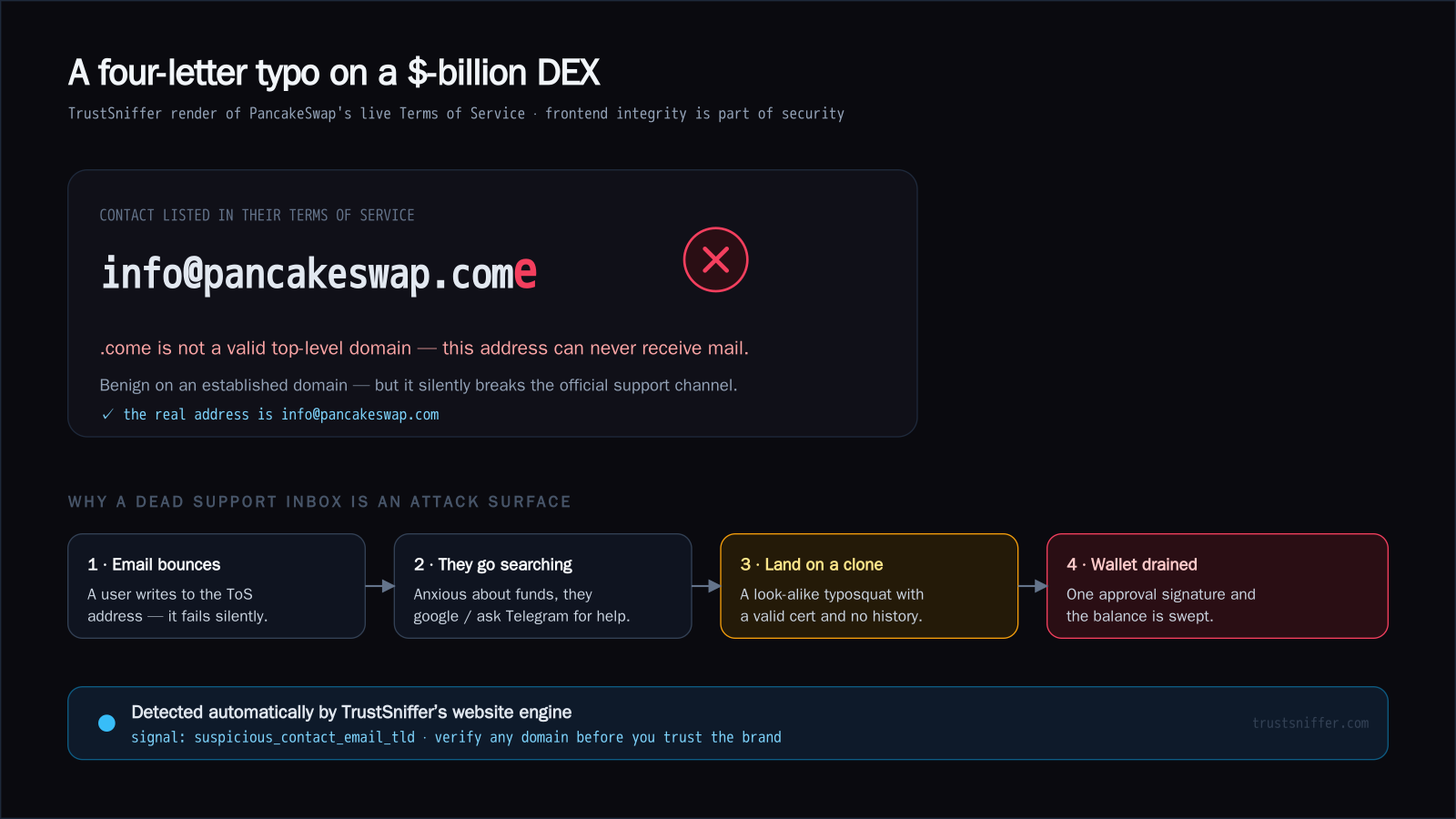
Buried in Ripple's legal pages, our page module flagged a published contact string — rgilmore@mabr.complease — under the rule suspicious_contact_email_tld: a contact address whose top-level domain (.complease) does not exist. In Ripple's case this is almost certainly a benign rendering artifact — a law-firm contact line where the email and the next word ("…@mabr.com Please…") were concatenated without a space. It is not evidence of compromise, and a 91.68 HIGH_TRUST verdict reflects that.
So why does it matter? Because the exact same signal is lethal on a clone. Threat actors scrape trusted sites to build mirrors, then publish a contact address on a typo'd TLD — .cm, .come, .org-support — to route victims to an attacker-controlled inbox. The job of a serious crypto website checker is not to panic over every anomaly, but to detect the pattern, then weigh its severity against the domain's whole profile. On a 1998 domain with clean reputation, it's noise. On a three-week-old look-alike with no archive history, it's a smoking gun.
[ Target Domain ]
      │
      ├─► Domain & TLS integrity   (age, registrar, certificate origin)
      ├─► Reputation cross-check    (threat-intel lists, Safe Browsing, multi-engine)
      └─► Frontend anomaly scan     (typo'd contact TLDs, impersonation, hidden forms)
                                          │
                                  weighted against domain history → verdict
The takeaway for institutions: verify the perimeter before you trust the protocol. A real-vs-fake comparison takes seconds and prevents the most common onboarding mistake — engaging a convincing impostor of a brand you already trust.
2. Wallet Risk Scoring and Drainer Defenses
Once a domain is trusted, the next exposure is the wallet that connects to it. The dominant threat today is not private-key theft — it is the approval drainer: a malicious dApp that never asks for your seed phrase. It asks for a token allowance, and the moment you sign, it sweeps the balance.
User signs "approve" ─► allowance set to unlimited ─► drainer transfers the full balanceThese scripts are widely distributed through social engineering — most often a fake airdrop prompt that pressures the user to "claim" before a deadline. The defense is procedural, not heroic:
- Score before you sign. Run a wallet risk score check on the dApp's deployer and on any high-value contract before granting allowances.
- Baseline your own address. A periodic wallet-risk check tells you whether your public keys have already touched a flagged contract.
- Revoke by default. Treat unlimited allowances as temporary; set them to the exact amount and revoke after use.
For an institutional desk, this becomes policy: no treasury wallet interacts with an unscored contract, and every counterparty address is screened on the way in.
3. AML and OFAC Sanctions Screening
For a compliance-first provider operating under real jurisdictional licenses, address screening is mandatory, not optional. An incoming transfer cannot be assumed clean — it must be matched against enforcement data before settlement.
The anchor list is the U.S. Treasury's OFAC sanctioned wallet addresses. Routing capital to or from a designated address — or one that sits a short hop away through a mixer — exposes an organization to asset seizure and structural blacklisting.
- Sanctions matching vs. the OFAC crypto address list — Is this wallet, or its close counterparties, government-designated?
- Taint / proximity scoring — How many hops separate this address from a known illicit cluster?
- Source-of-funds review — Does the address's history support the stated origin of the capital?
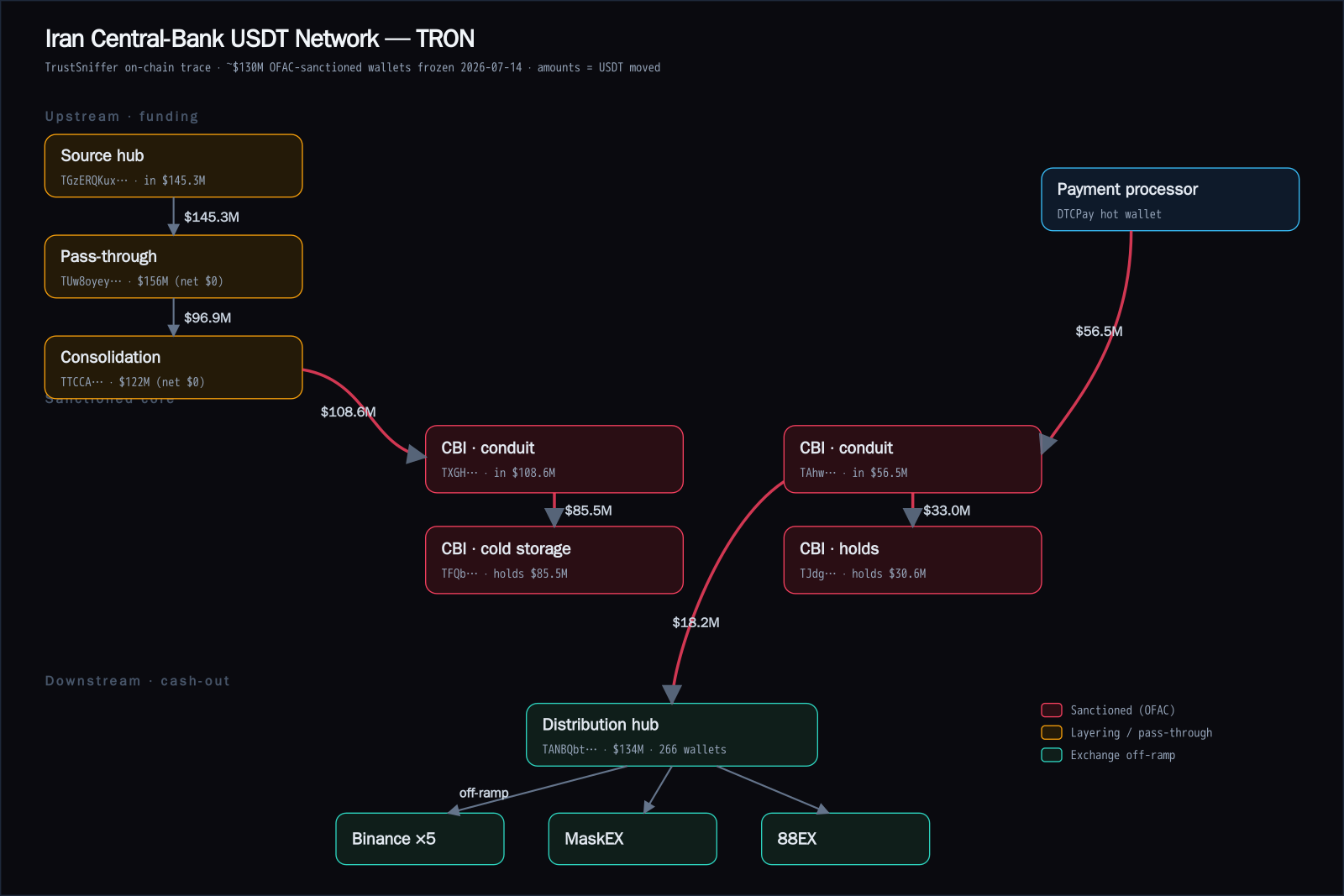
This is the core of an AML crypto check: not a single yes/no, but a graph of exposure. TrustSniffer's wallet engine does exactly this — propagating taint forward from sanctioned and scam roots and tracing backward from a target address to surface hidden connections to flagged actors.
4. The Anatomy of a Stablecoin Freeze
Institutions tracking RLUSD and other fiat-backed assets on registries like DeFiLlama must understand a structural reality of centralized stablecoins: the issuer can freeze them. The common question — can USDT be frozen? — has a definitive answer: yes. Tether maintains a blacklist and can render specific addresses unable to move their balance, typically in response to law-enforcement requests tied to a hack or sanctioned actor.
Address linked to illicit activity ─► issuer adds it to the blacklist ─► balance is immobilizedThe risk is contagion. If your corporate wallet accepts a transfer from a soon-to-be-frozen address, you can inherit the contamination. This is why threat-intelligence teams monitor USDT frozen addresses continuously: the goal is to refuse tainted inflows before they land, not to litigate a freeze afterward. Even stable, pegged capital is only as clean as its last counterparty.
5. Post-Exploit Reality: Stolen-Crypto Recovery
When the perimeter fails — a user skips a scam-site check, signs a malicious approval, or trusts a clone — the result is a drained wallet. Here, honesty matters more than hope.
The advertisements promising instant stolen-crypto recovery are, overwhelmingly, a second scam targeting victims of the first. Genuine recovery is slow, partial, and institutional: it requires on-chain forensic tracing, cooperation from the exchanges where funds attempt to off-ramp, and law-enforcement action to seize them. There is no software button that reverses a signed transaction.
Theft ─► forensic graph tracing ─► exchange / off-ramp interdiction ─► seizure (sometimes)