A Fake Mod Download Is Rarely Just One File
Minecraft mod malware is malicious code packaged to look like a mod, mod pack, texture pack or mod loader for the game. It reaches a player through a download rather than an app store review process, so the file that actually arrives is whatever the page behind the link decided to send, whether or not it matches what was promised.
The trick rarely stops at one file. A typical chain starts with something that looks like the mod itself, a compressed archive, an installer, or a script, and ends with a second piece of software fetched after the first one runs. The first file is often small and unremarkable on purpose, since anything that looks too complex or too large draws more scrutiny before someone double-clicks it.
What we found in 36 sites we analysed
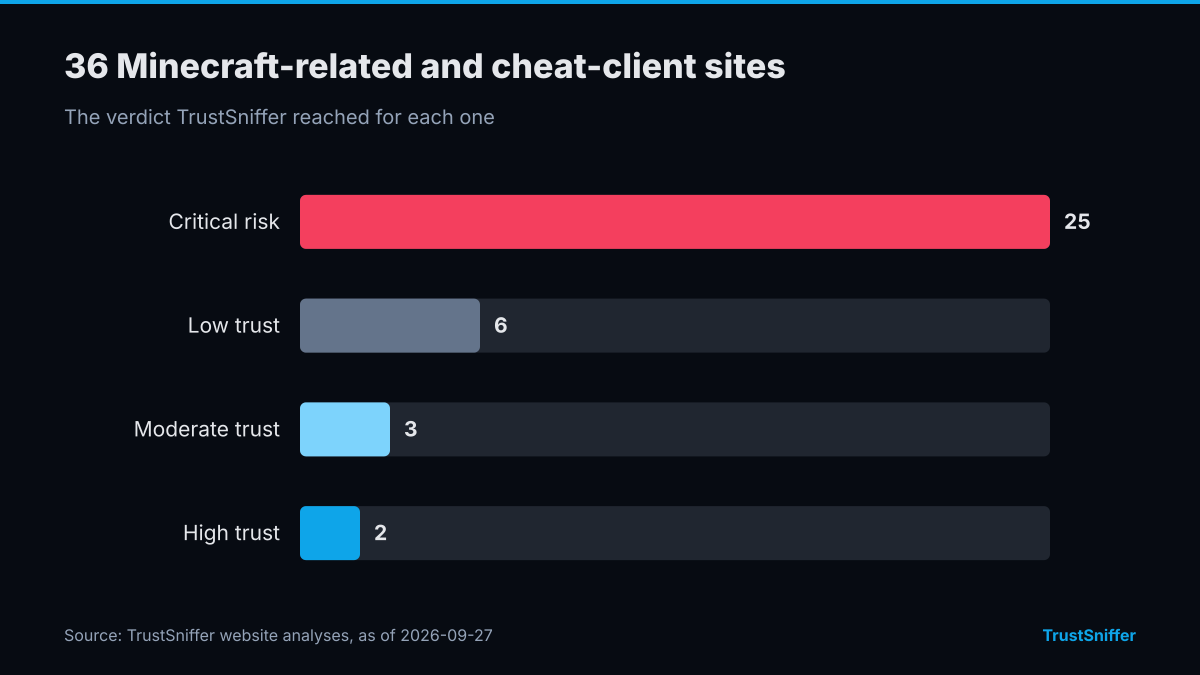
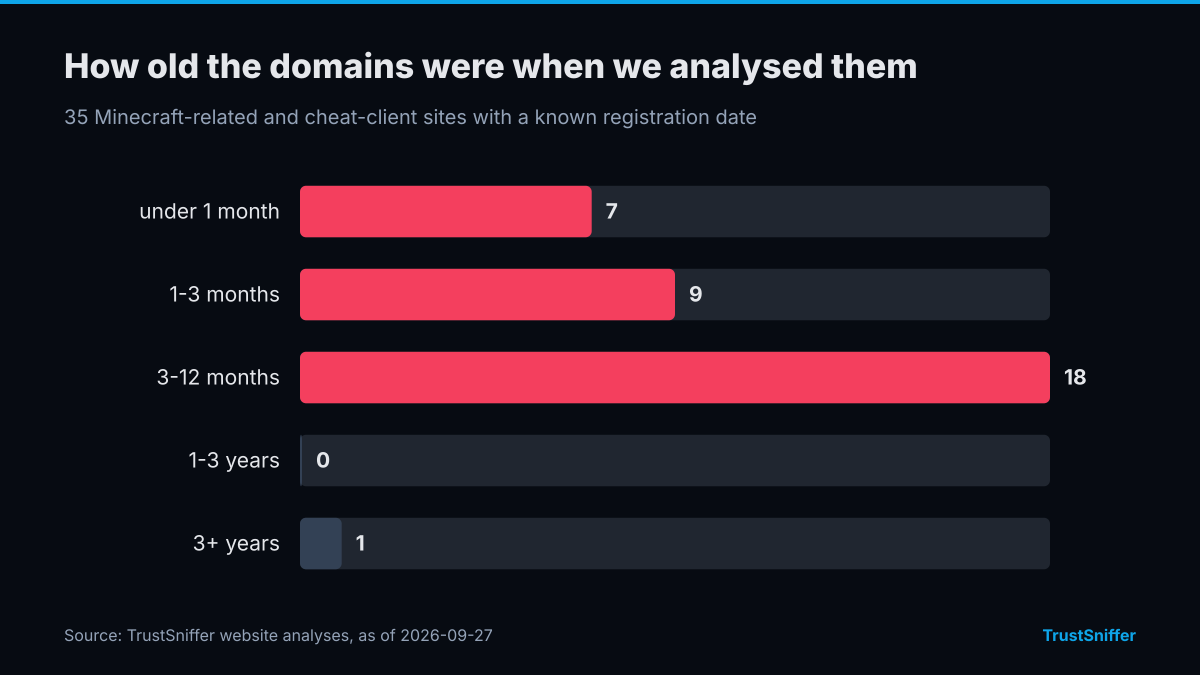
TrustSniffer has analysed 36 Minecraft-related and cheat-client sites. 31 of them (86%) were rated critical risk or low trust: 25 critical risk, 6 low trust, 3 moderate trust, 2 high trust. 34 of the 35 with a known registration date (97%) had a domain under a year old when we analysed it, and the median age was 4 months.
22 of them were registered through Web Commerce Communications Limited / WebNic. The networks they most often resolved to were FEMO IT SOLUTIONS LIMITED (13) and Cloudflare, Inc. (13). 26 of 36 (72%) were already flagged by at least one VirusTotal engine when we checked.
Some of the sites we analysed, each linked to its full report:
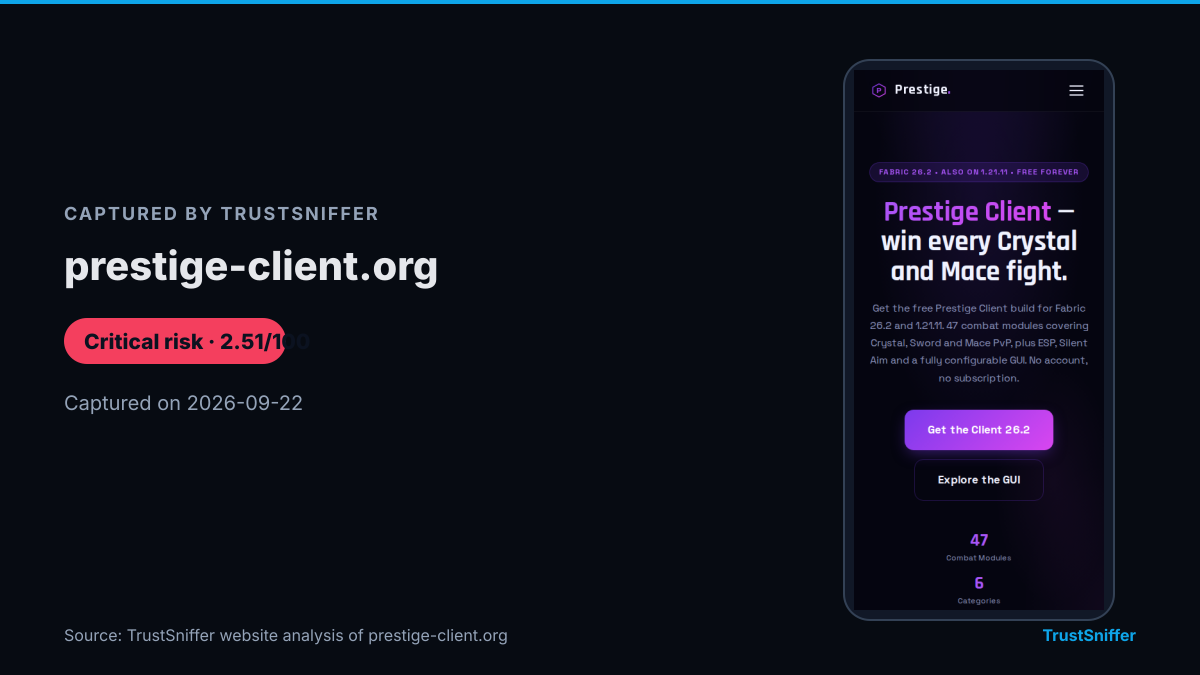
- prestige-client.org: rated critical risk (3/100), domain 1 month old when analysed.
- meteorclients.com: rated critical risk (5/100), domain 6 months old when analysed.
- cheetoclient.com: rated critical risk (0/100), domain 5 months old when analysed.
- breezeclient.com: rated critical risk (0/100), domain 5 months old when analysed.
The Archive, the Password and the Second-Stage Script
Two techniques show up often enough to be worth naming. The first is the password-protected archive: the file is zipped and locked, with the password sitting in a text file, a comment, or the page itself. A scanner that cannot open the archive cannot inspect what is inside it, so the file passes checks that would otherwise catch it. The password does no harm on its own; it just keeps the contents unreadable until a person, not a scanner, opens them by hand.
The second is the script dropper: a short script, sometimes given a mod-sounding file name, that does not contain the malicious payload itself but downloads it once it runs. Splitting the attack into a harmless-looking launcher and a payload fetched afterward means the file a person downloads and the file that actually causes damage are never the same file at the same time, which is the entire point of building it that way.
Why the Download Page Disappears a Week Later
The page hosting the download rarely looks permanent, because it is not meant to. Building a page costs little to nothing, and abandoning one costs even less, so a page can go up, collect a batch of visitors from a forum link or a search result, and disappear before it accumulates enough reports to get flagged anywhere. A domain that is only days old, sits on a generic extension, or lacks the kind of history an established site accrues over years is a page built to be disposable.
This is also why checking a domain against a blacklist alone falls short: a blacklist only lists what has already been reported, and a page built to be replaced can simply reappear at a new address once the old one gets flagged. The pattern matters more than any single address, because the address is the part that changes fastest.
Who Actually Clicks: Players, Admins and Mobile Users
The people most exposed are the ones searching for something specific: a particular mod not distributed through the game's own channels, a mod pack promising features the base game does not have, or server plugins an admin needs in a hurry. Anyone asking 'is this Minecraft mod safe' before running a file has already spotted the right question; the harder part is knowing what to check to answer it.
Mobile players face a related version of the same problem. Where a desktop mod usually arrives as a compressed file or a script, a phone user chasing a Minecraft companion app or mod manager may be asked to sideload an APK outside the app store's own review, which removes the one screening step a phone install normally has.
Checks Worth Running Before You Open a Mod File
None of this requires specialised tools to catch. A few habits stop most of it before a file is ever opened.
TrustSniffer's own dataset comes from the same kind of evidence gathering: analysis covering 5,300 websites and separate assessments of 17,419 cryptocurrency wallet addresses. Running a mod page through the website checker applies that same process to the specific link in front of you, rather than asking you to trust a description on a forum post. If the address has already drawn attention elsewhere, it may also turn up in the sanctions directory, which is worth a quick look before you decide.
- Match the download page to the mod's own listing rather than a link from a search ad or a forum comment; a copy built to imitate the real page rarely matches it exactly.
- Treat a password on an archive as a reason to slow down, not a normal step; a scanner cannot see inside a locked file, so a locked mod is a mod nobody but you has actually inspected.
- Be suspicious of a mod that arrives as a script or an executable installer instead of a plain file the game's own mod loader can read directly.
- Check how new the domain looks and how little history it carries; an address only just registered has had no time to earn the trust an older one has.