Key findings
- 2,545 of 2,620 addresses on free developer platforms (97%) were rated Critical by our analysis. All 2,620 were collected by TrustSniffer Radar from public threat feeds.
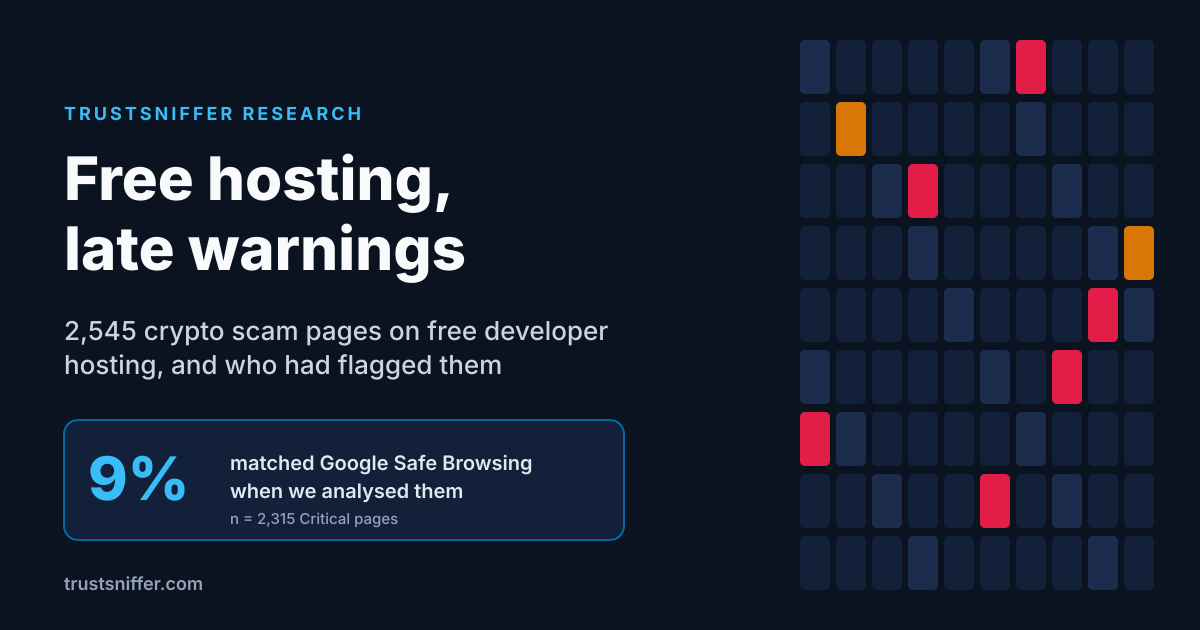
- 9.2% of the 2,315 Critical pages where both checks returned a result (213) matched Google Safe Browsing at the moment we analysed them. 54% had reached our "confirmed" VirusTotal level and 94.5% had at least one VirusTotal engine flagging them.
- 1,001 of 1,664 Critical pages on Cloudflare Pages (60%) were already behind Cloudflare's own "Suspected Phishing" warning when we arrived. On Netlify, 286 of 418 had already been removed.
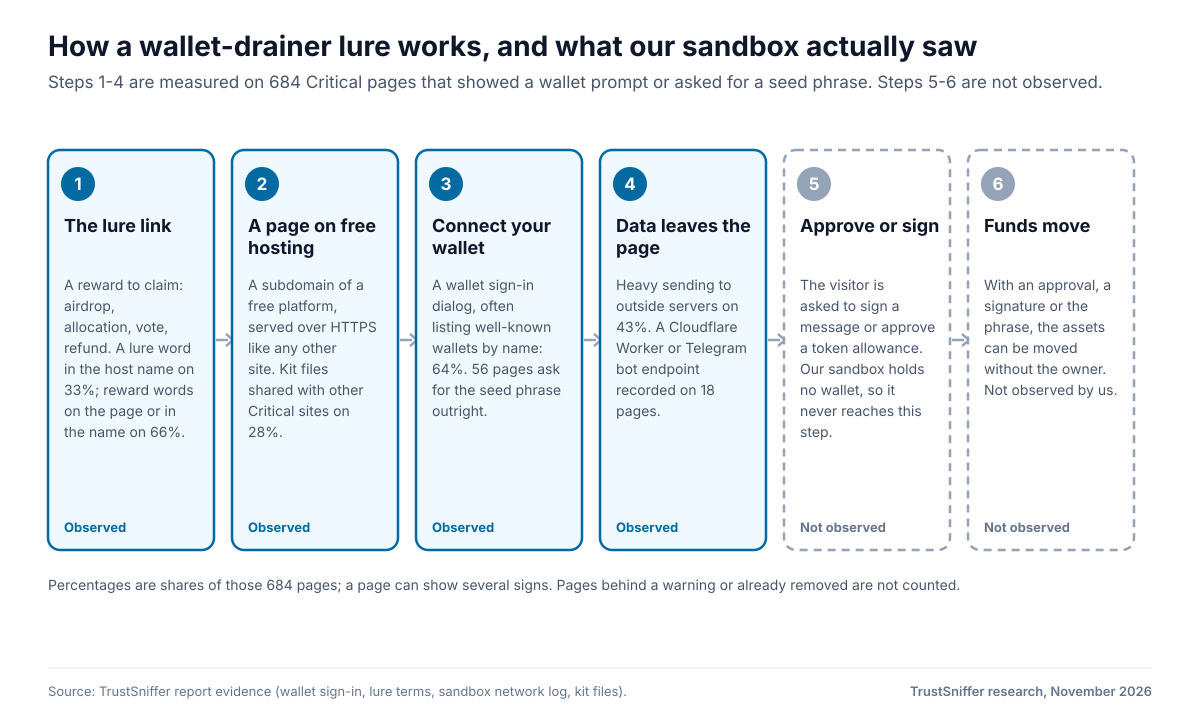
- 54% of the Critical pages whose content we could see (628 of 1,167) showed or described a connect-wallet prompt; 56 more asked for the wallet's seed phrase outright.
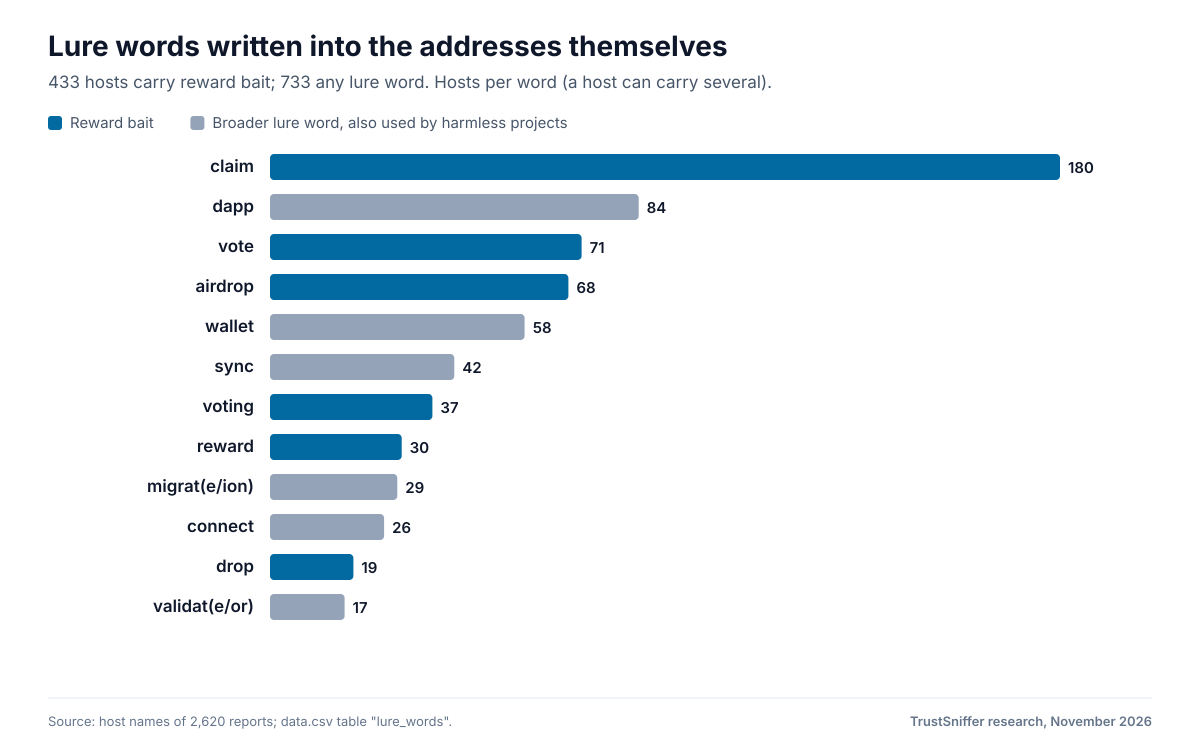
- 433 addresses carry reward bait in the name itself (claim, airdrop, vote, reward, allocation, refund and similar); 733 carry a broader set of lure words that also includes wallet, dapp, sync and migrate.
- 206 of the addresses fall into 49 groups linked by identical kit files or the same collection endpoint; 12 of those groups span two or more platforms.
- 36% of the addresses still answered with a normal page (no platform error or warning) when we checked again on the night of 27 November 2026 (UTC).
What we looked at
Free developer platforms let anyone publish a website in minutes on a subdomain such as name.pages.dev, with HTTPS included. Almost all of what they host is legitimate. Scam operators use them for the same reasons: a fresh address costs nothing and can be replaced the moment it is blocked.
Among the free-platform addresses reported to TrustSniffer, what were the pages built to do, who had already flagged them when we looked, and how long do they last?
- Wallet drainer
- A scam web page that gets a crypto wallet owner to connect the wallet and then sign a message, approve a token allowance or type the seed phrase, so that the operator can move the funds.
How we did it
Data source. Each TrustSniffer website report is a full analysis of one address: page capture and screenshots, a behaviour sandbox that loads the page three times and records its traffic, SHA-256 fingerprints of the files it serves, archive history, and reputation from Google Safe Browsing and VirusTotal. From the 11,748 reports published on 28 November 2026 we took every subdomain of ten hosting domains run by nine free services (listed under About the data): 2,620 addresses, captured between 17 September and 27 November 2026.
How they reached us. Read this first. These addresses were not sampled from the platforms. TrustSniffer Radar collected them from public threat feeds. Those feeds specialise in crypto wallet scams, so this set is overwhelmingly about crypto. Every number below describes sites reported to us, never the share of all sites on a platform; the platform ranking mirrors the feed, not how much abuse each platform hosts. Part of the intake is an archive sweep that only admits addresses that still answer, so long-lived pages are over-represented.
Definitions.
- Critical: our published trust band, below 25 out of 100. 615 of the 2,545 Critical ratings carry an active threat listing from our own intelligence feed, which caps the score by rule.
- Content visible: our capture saw the site itself, not Cloudflare's phishing warning and not a platform error page ("Site not found", 404, "deployment disabled"). A Critical rating on a page we could not see, and largely on the 367 visible pages with crypto content but no collection mechanism, rests on the listing and external evidence rather than on anything we watched it do.
- What a page was built to do: one class per page, in this order: asks for a seed phrase; shows a connect-wallet dialog; shows a login form; describes a trading or investment platform; offers a download; other crypto content; unclear. Sandbox signals decide where they exist (a wallet sign-in was detected on 435 pages); otherwise the report's model-written description of the capture does.
- Flagged at capture: Safe Browsing's Lookup API matched the URL; VirusTotal had at least one engine calling it malicious, or reached our "confirmed" level (10 engines, or 5 including a top-tier vendor); or Cloudflare's warning was served. Values are from the original capture, even where a report was re-scored later.
Limits. Safe Browsing was queried for the exact address; an entry for a deeper path, or browsers' extra real-time checks, would not show here, so browser users may have been better protected than 9% suggests. Safe Browsing can also drop entries for pages that are gone, which is why we also quote it for visible pages. Some VirusTotal vendors may draw on the same blocklists that reported these pages, so "at least one engine" partly echoes the feed; the confirmed level is the safer number. Archive first-seen dates are a lower bound on age and could, rarely, belong to an earlier user of the same name. Scripts and queries are in the methods log.
Finding 1: on two of the four big platforms, most pages had already been warned on or removed
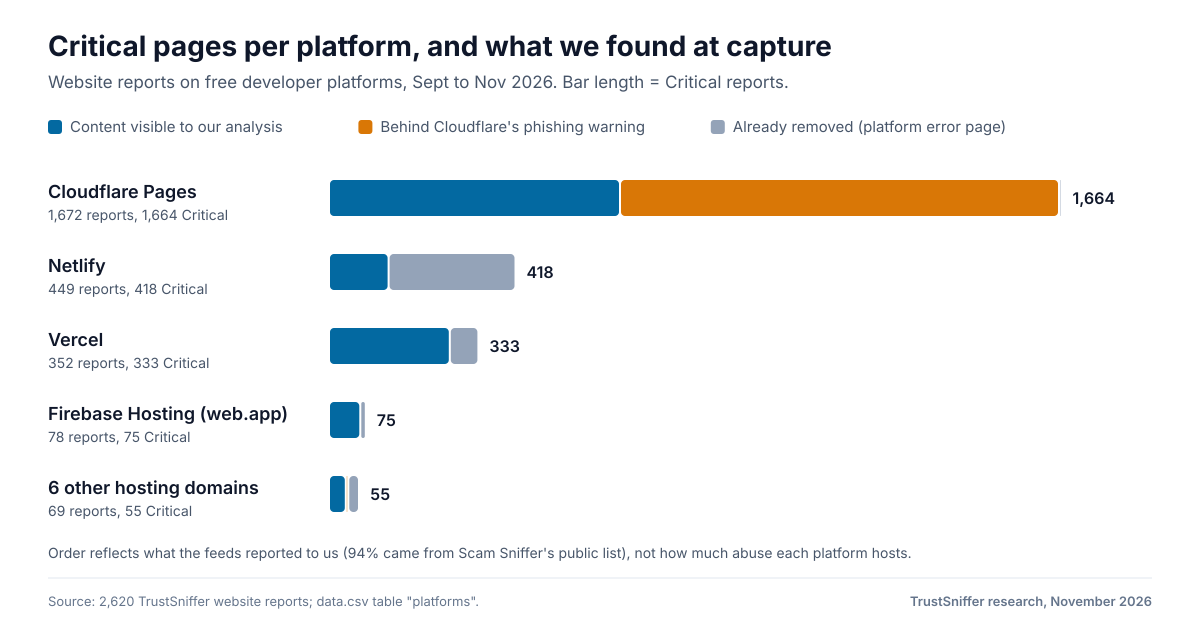
The platforms are not standing still. On Cloudflare Pages, 1,001 of 1,664 Critical addresses (60%) were already behind Cloudflare's "Suspected Phishing" interstitial when our analysis arrived. On Netlify, 286 of 418 Critical addresses (68%) answered with the platform's own "Site not found" page. Vercel had removed or disabled 61 of 333. Across all platforms, 1,378 of the 2,545 Critical pages (54%) were behind a warning or already gone when we arrived; on Vercel it was 18% and on Firebase's web.app 11%.
Cloudflare's warning is a click-through: it carries a button to continue. On the pages we could see, no takedown had happened yet; that window is what this study is about.
Finding 2: more than half the visible pages wanted a wallet connection
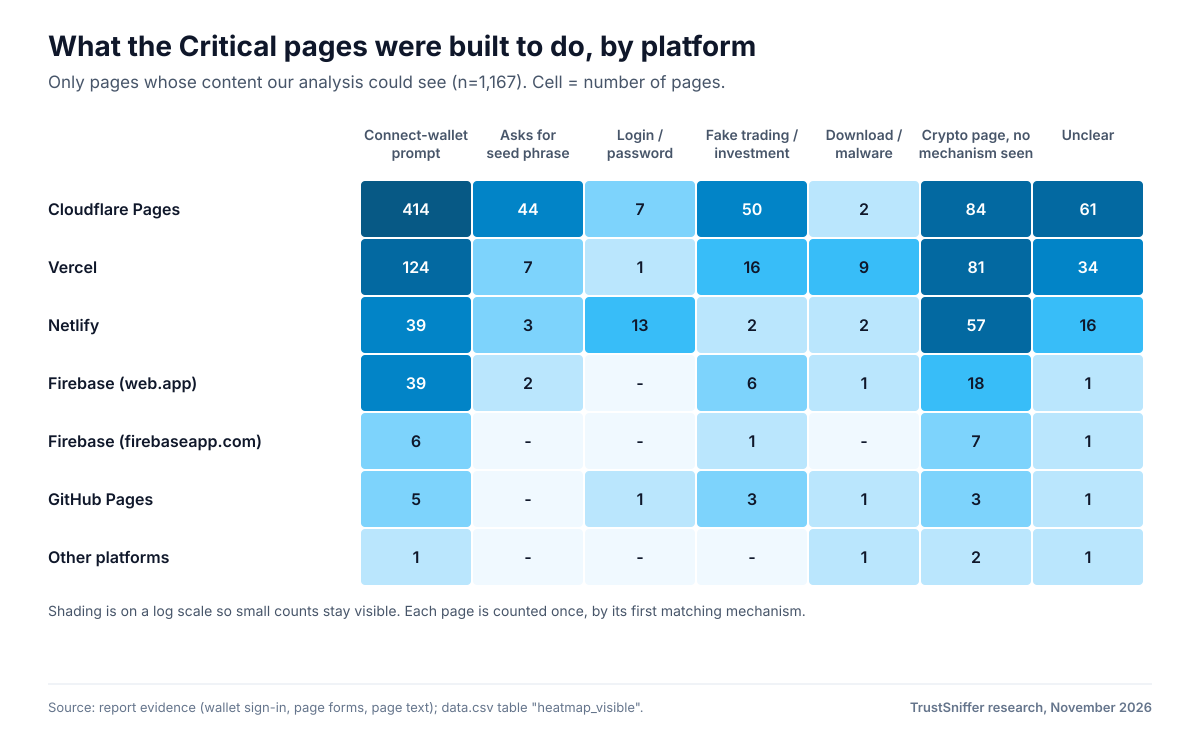
Of the 1,167 Critical pages whose content was visible, 628 (54%) showed or described a wallet sign-in dialog, and 56 more asked directly for the 12- or 24-word seed phrase that controls a wallet. Login and password phishing was rare in this set (22 pages), a product of what TrustSniffer Radar's feeds report. Fake trading or investment platforms accounted for 78 pages and download lures for 16.
The dialogs name real wallets to look familiar. Across the 454 reports where a wallet list was recorded: WalletConnect (352), MetaMask (137), Ledger (78), Exodus and Trust Wallet (69 each). That is what the page offers to connect, not evidence that the makers are involved. Brand names in the address itself are a different signal: Trust Wallet appears in 18 addresses, OpenSea in 14, MetaMask and Uniswap in 6 each, Binance in 5.
The lure is often written into the address. 433 of the 2,620 hosts carry reward bait in the name (claim, airdrop, vote, reward, allocation, refund, presale, whitelist and similar), 430 of them Critical; "claim" alone appears in 180. Counting broader lure words such as "dapp", "wallet", "sync" and "migrate", which also occur in harmless project names, the figure is 733.
Finding 3: most pages had no Safe Browsing match when we looked
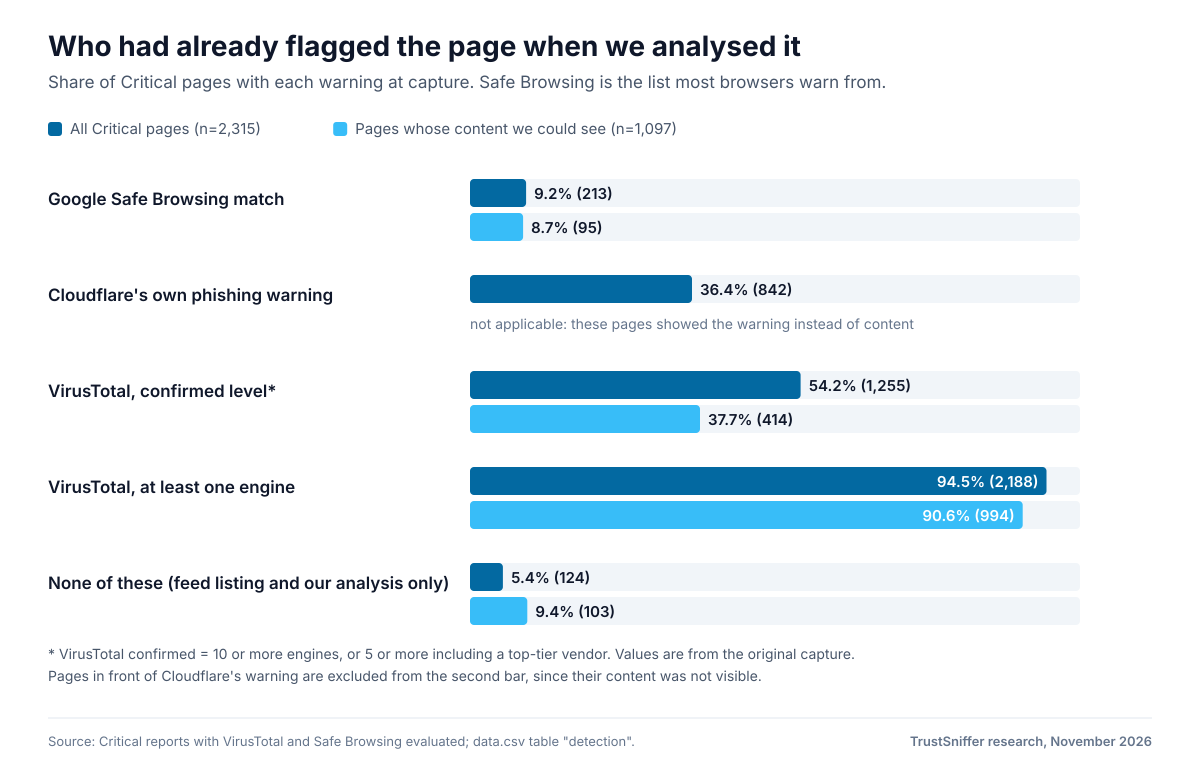
This is the central result. Of the 2,315 Critical pages where both Safe Browsing and VirusTotal returned a result, 213 (9.2%) matched Safe Browsing at capture. Among the 1,097 of those whose content we could see, it was 8.7%, and among the 634 wallet and seed-phrase pages, 9.5%. On Firebase Hosting's web.app domain, none of the 60 visible Critical pages matched. (Cloudflare's warning covers 842 pages in this set; the 1,001 above also counts pages without a VirusTotal result.)
At the same moment, 54% had reached our confirmed VirusTotal level and 94.5% had at least one engine flagging them. A median of 11 days had passed since our collector first saw these addresses on a public blocklist; that is our own collector's lag, and the listing itself may be older. For 124 pages (5.4%) there was no external warning at all: they were Critical on the feed listing and on what our own analysis found.
What this shows: while public lists and many vendors already flagged these pages, the list most browsers consult had no match for the address in nine cases out of ten. What it does not show: whether Safe Browsing matched them later, what browsers' real-time checks would have done, or how many people visited.
Finding 4: they are built from shared kits and shared servers
Our reports link two sites that serve two or more distinctive files byte for byte, or share an identifier such as a collection endpoint; files also seen on sites we do not rate as risky never count. Taking only the strongest links (identical kit files, the same Cloudflare Worker or Telegram bot, the same payment wallet), 206 of the 2,620 addresses fall into 49 groups; 12 groups span two or more platforms and 11 mix free-platform pages with standalone domains. Adding the weaker "same outside server" links that our reports also show, 348 addresses sit in 55 networks.
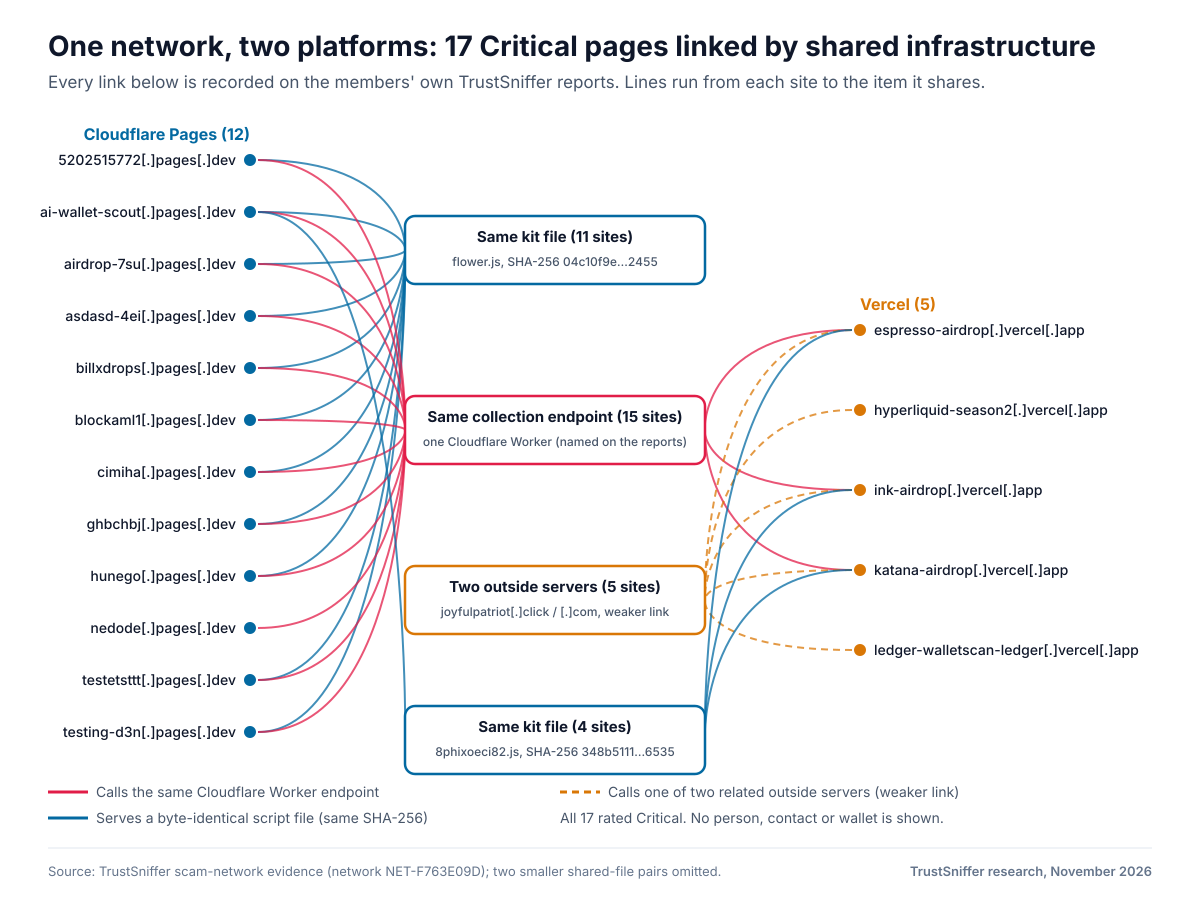
The network in Figure 5 is a clean example. Fifteen of its seventeen pages call the same Cloudflare Worker endpoint (named on the public reports). Eleven serve the identical 90 KB flower.js (SHA-256 04c10f9e3fa16c775133790941b2db949883acf5ad7d4c47fd81fc569f432455). Four, three of them on Vercel, share another script (SHA-256 348b5111017a62ad16be1e54454e824979fbe96981c6b618caf5394fcf056094). Two more Vercel pages join only through a weaker link: each calls one of two related outside domains (joyfulpatriot[.]click and joyfulpatriot[.]com) that one or two other members also call. Changing platform did not change the kit.
Across the 684 Critical wallet and seed-phrase pages, the same pattern repeats. Figure 6 shows what our analysis recorded, and where the sandbox stopped.
Finding 5: they live long, and many still answer
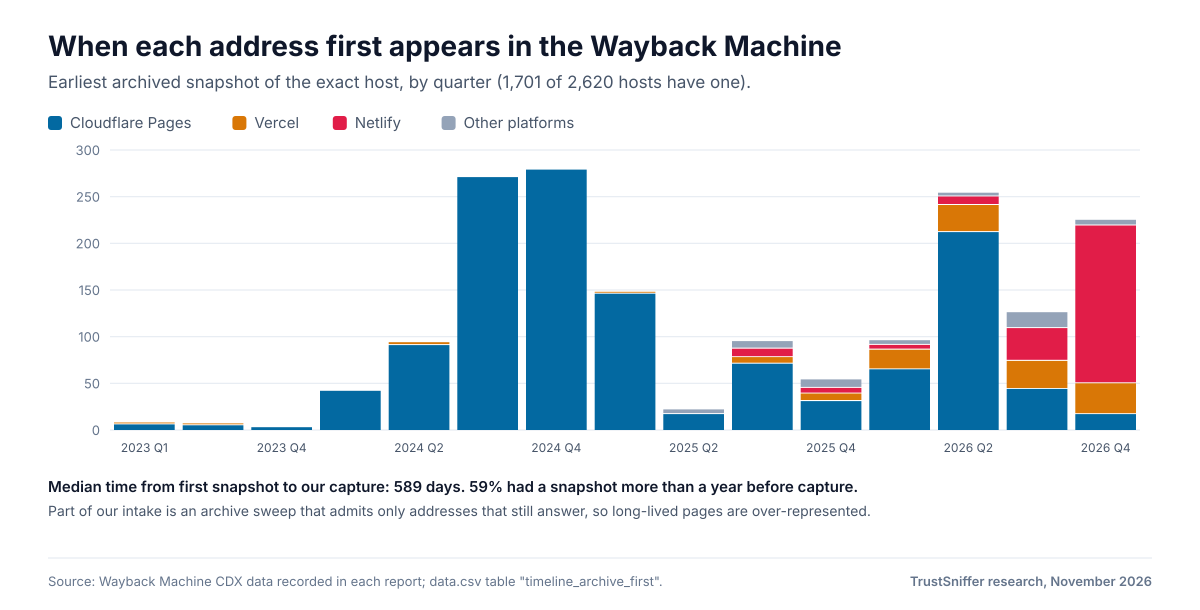
For the 1,701 addresses with an archived snapshot, the median time from the first snapshot to our capture was 589 days, and 59% had been archived more than a year earlier. By hand: the earliest snapshot of lens-protocol[.]pages[.]dev, from September 2024, already shows the "799" airdrop lure we captured in November 2026. The long lives are mostly on Cloudflare Pages (median 687 days; Netlify 15, Vercel 150). Our intake favours survivors, so this is not a typical lifetime, but some of these pages stay up for well over a year.
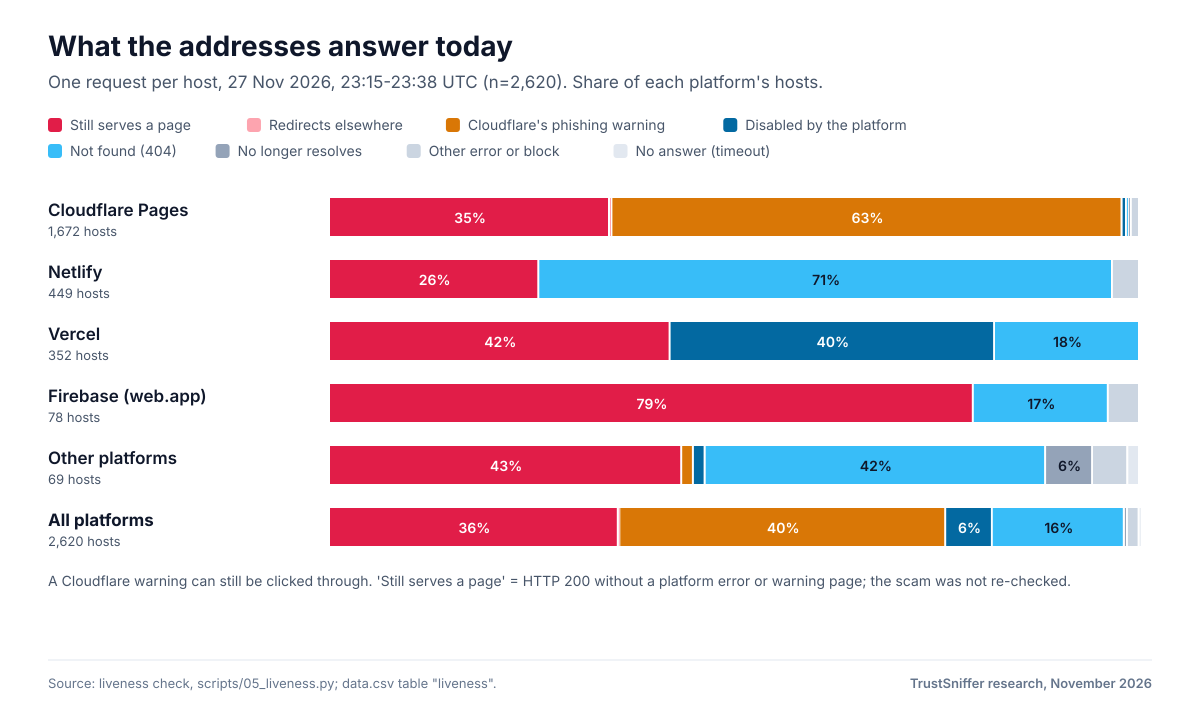
One request to each address on 27 November 2026: 934 (36%) still answered with a normal page, without a platform error or warning. On Cloudflare Pages, 1,053 (63%) now show Cloudflare's phishing warning. Vercel has disabled 141 deployments and 63 more are gone; Netlify returns "Site not found" for 318 of 449. Firebase stands out the other way: 62 of 78 web.app addresses still serve a page, and none of its 75 Critical ones had matched Safe Browsing at capture. A page that answers is not necessarily still the same scam: each request was one page load, with no re-analysis.
Five pages, up close
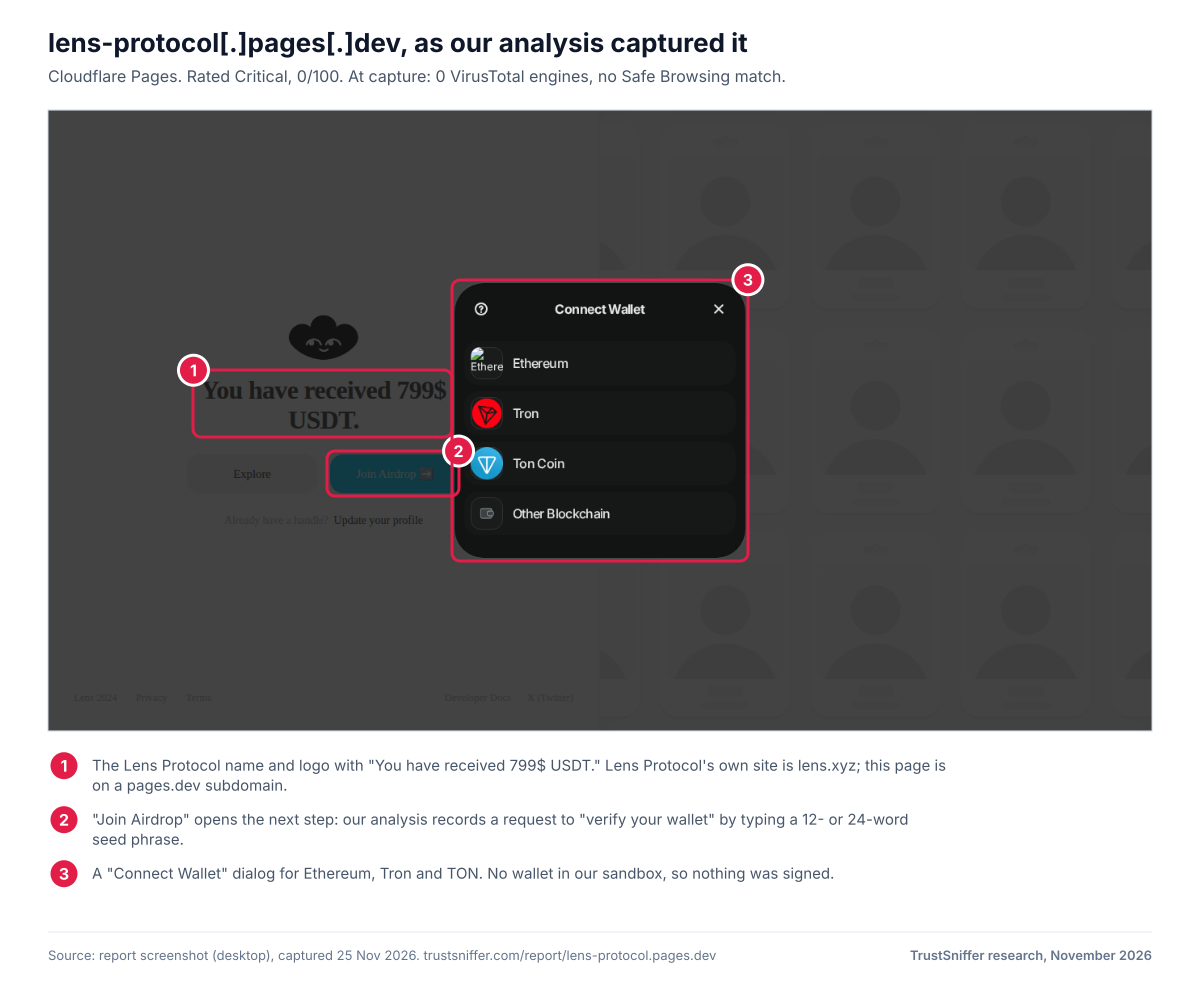
1. lens-protocol[.]pages[.]dev (Cloudflare Pages), Critical, 0/100. A page styled as Lens Protocol (whose own site is lens.xyz) says "You have received 799$ USDT", offers "Join Airdrop" and a connect-wallet dialog, and then asks the visitor to "verify your wallet" with a 12- or 24-word seed phrase. Our analysis confirmed the brand impersonation and recorded it calling an outside server, datapulseprotocol[.]me, that 20 other Critical pages in our data also call, on three platforms. At capture on 25 November: no VirusTotal engine, no Safe Browsing match. Report
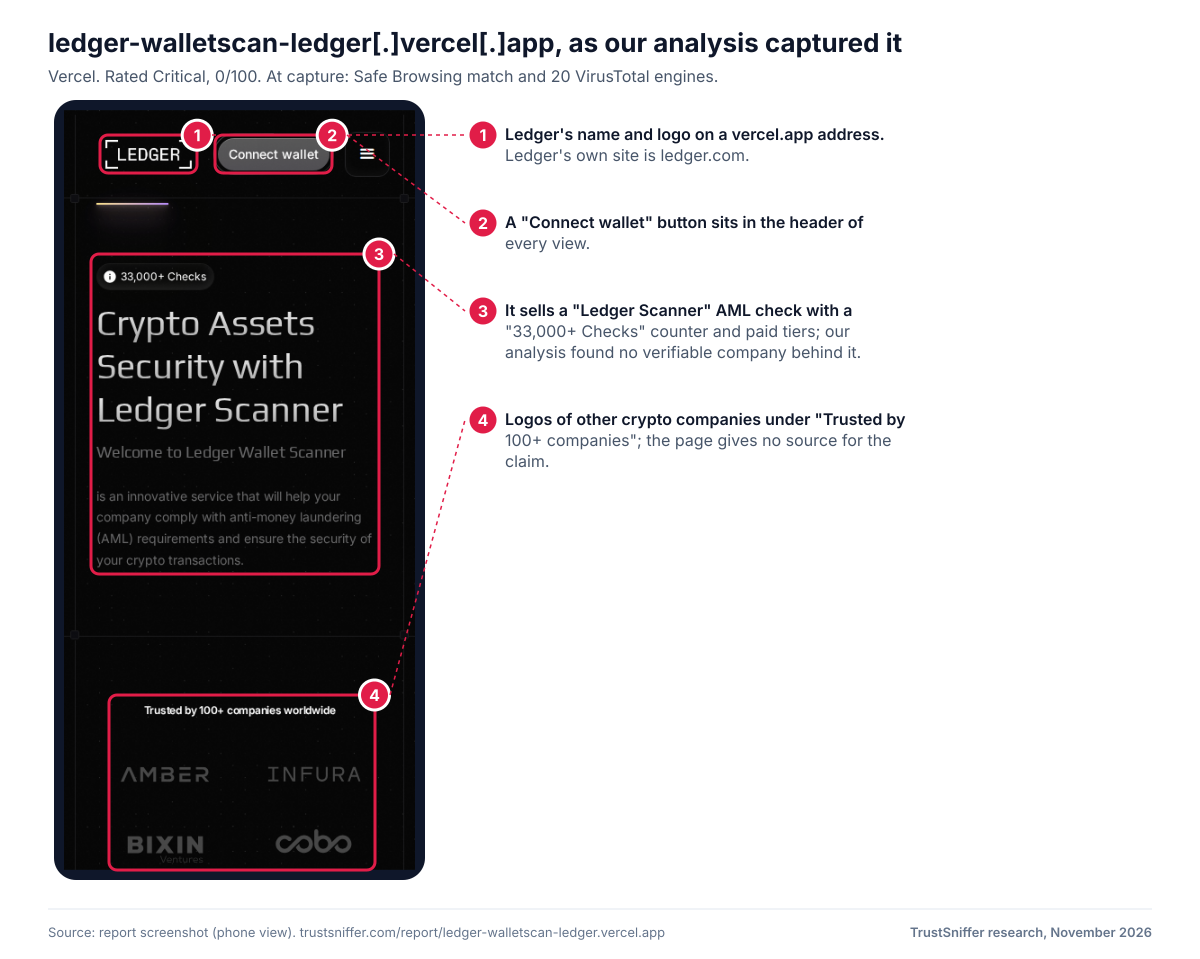
2. ledger-walletscan-ledger[.]vercel[.]app (Vercel), Critical, 0/100. Ledger's name and a Ledger wordmark on a "Ledger Scanner" page selling AML wallet checks at $24 to $149 a month, with a "Connect wallet" button and no verifiable company. Ledger's own site is ledger.com, which tells customers it "will never ask for the 24 words of your recovery phrase". It joins the network in Figure 5 through the weakest link in it: an outside domain that one other member also calls. At capture: Safe Browsing match, 20 VirusTotal engines. Report
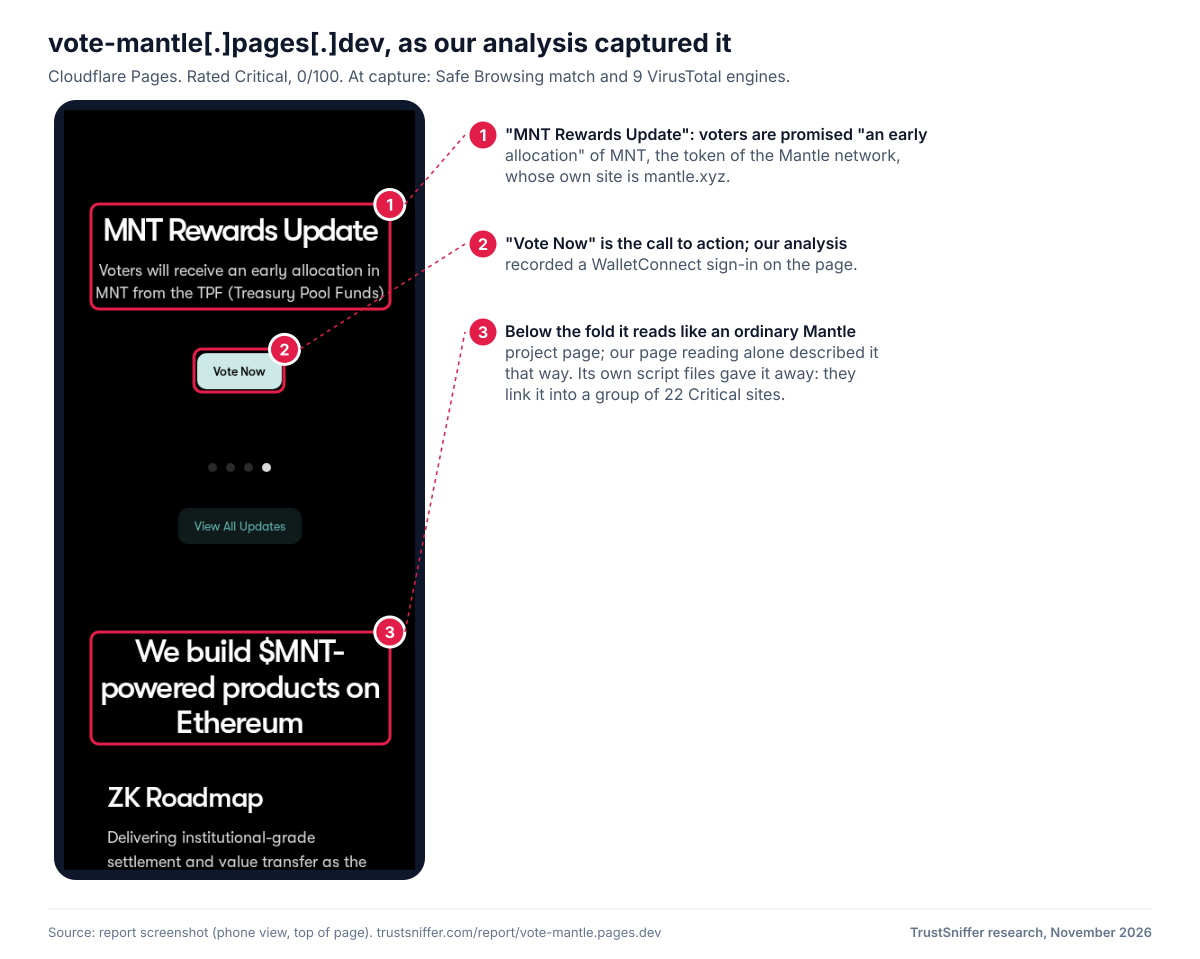
3. vote-mantle[.]pages[.]dev (Cloudflare Pages), Critical, 0/100. "MNT Rewards Update: Voters will receive an early allocation in MNT", with a "Vote Now" button and a WalletConnect sign-in. Mantle's own site is mantle.xyz. Below the fold it reads like an ordinary Mantle page, and our text reading alone described it so. Its own script files gave it away: they link it into a group of 22 Critical sites, about a third of them "vote" pages. At capture: Safe Browsing match, 9 VirusTotal engines. Report
4. gastoken-refund[.]web[.]app (Firebase Hosting), Critical, 0/100. A "gas fee reward" token attributed to the Ethereum Foundation (whose site is ethereum.foundation), with a dialog asking for the seed phrase. It calls the same outside server as the Lens page above. A shared server is a weaker link than shared files: a lead, not proof of one operator. At capture: no Safe Browsing match, 9 VirusTotal engines. Report
5. xrp-bonus[.]github[.]io (GitHub Pages), Critical, 0/100. A Ripple-branded "double your XRP" giveaway that tells visitors to send XRP to a fixed address and invokes Ripple's chief executive. Ripple's own site is ripple.com. Its code holds a Telegram bot endpoint, a common way for kits to collect what visitors type. At capture: Safe Browsing match, 8 VirusTotal engines. Report
What you can do
- Treat a reward you did not earn as a warning. "You have received", "claim your allocation", "vote to receive": reward language was on the page or in the address of 66% of the wallet and seed-phrase pages we saw.
- Check the address, not the logo. A project's site does not live on
pages.dev,vercel.app,netlify.app,web.apporgithub.iounless the project says so on its own domain. - Never type a seed phrase into a website. No wallet maker, exchange or airdrop needs it. Ledger says so on its own homepage.
- Read what you sign. The danger is the signature or token approval that follows a connect request. If you signed, revoke the approval (for example with revoke.cash); if you typed the phrase, move funds to a new wallet.
- Check before you connect. Paste the address into the website checker or look it up in the scam directory; check a counterparty wallet with the wallet checker. New threats appear on the scam radar.
- Report it. To Google Safe Browsing and to the platform (links below).
What platforms and wallet providers could do
The platforms already act (Figure 1). The data points at three gaps:
- Before the takedown. Reward bait in the subdomain name (433 cases here) combined with a wallet sign-in on a brand-new deployment is a cheap signal at publish time; either alone would catch harmless projects too.
- The kit, not the page. A takedown removes one address; the files and endpoints in Figure 5 carry on. Sharing hashes and endpoints between providers would let one report remove a family.
- The warning list. Faster exchange between public crypto blocklists and the lists browsers consult would close the gap in Finding 3.
Wallet makers can warn on connect or approval requests from a fresh free-platform subdomain whose name carries reward bait.
To report abuse: Cloudflare (reporting page, category "Phishing & Malware"), Vercel, Netlify (support), GitHub (reporting abuse or spam), Google Cloud, including Firebase (abuse form).
Frequently asked questions
Are Cloudflare, Netlify, Vercel or Google to blame?
Does 97% Critical mean almost every pages.dev site is a scam?
Is connecting a wallet enough to lose money?
Why did so few match Safe Browsing if VirusTotal already flagged them?
About the data
2,620 published TrustSniffer website reports on subdomains of pages.dev and r2.dev (Cloudflare), netlify.app, vercel.app, web.app and firebaseapp.com (Firebase), github.io, onrender.com, trycloudflare.com and edgeone.dev (Tencent EdgeOne), captured 17 September to 27 November 2026; liveness checked on 27 November 2026 (23:15 to 23:38 UTC) with one request per address. Aggregate tables, scripts and the methods log are available to journalists and researchers. No personal data is included; malicious addresses are defanged and not linked. Network evidence is the same as on each site's public report. More in our Risk Index.


