Overview of the Exploit
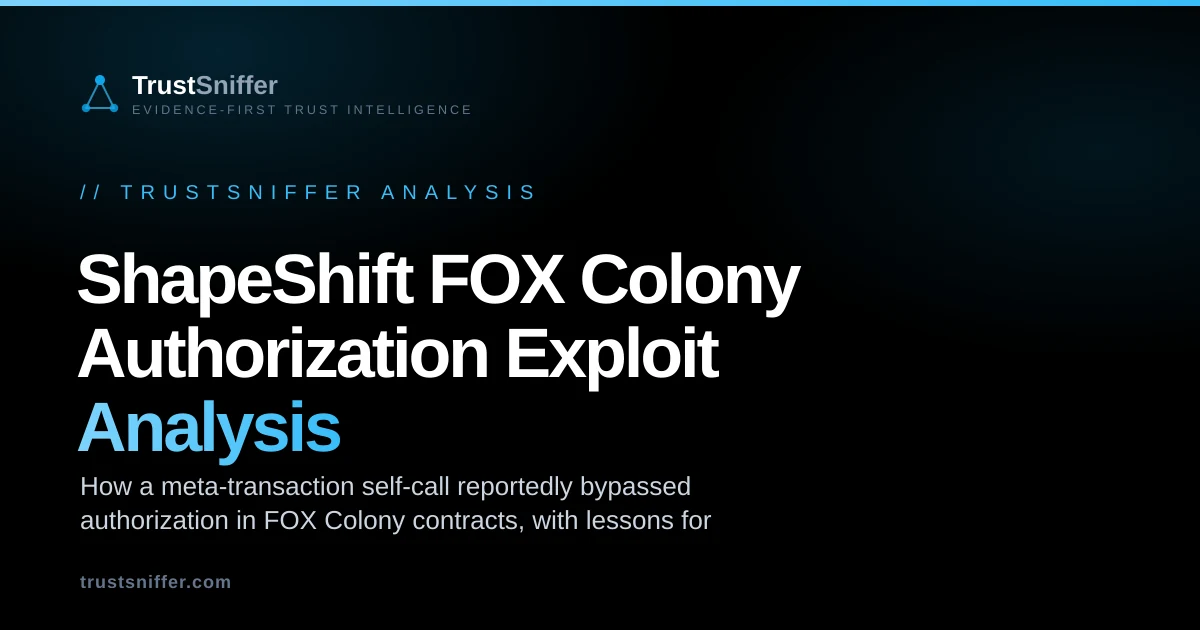
In May 2026, the ShapeShift FOX Colony project experienced a severe security breach due to flaws in its EtherRouterCreate3 contract deployed on the Arbitrum network. An attacker exploited the contract's meta-transaction mechanism, specifically the 'arbitrary self-call' capability, to bypass authorization controls and replace the contract's core routing component with a malicious version.
On-Chain Evidence of the Attack
The exploit was executed through a series of steps that involved manipulating the contract's functions. The attacker utilized the executeMetaTransaction function, which allowed them to perform a self-call without filtering sensitive function selectors. This oversight enabled the attacker to call setResolver with a malicious address, effectively hijacking the contract's resolver.
Once the resolver was compromised, the attacker could invoke any function selector, leading to the execution of a drain function that transferred all ERC20 assets from the victim contract to the attacker's address. The total amount drained included 132,704.591501 USDC and other intermediary tokens, which were subsequently swapped for WETH.
- The attacker sent a meta-transaction through executeMetaTransaction, which let the contract call itself.
- Because sensitive function selectors were not filtered, that self-call reached setResolver.
- The resolver was pointed at a malicious address, which handed routing control to the attacker.
- With the routing component replaced, any function selector could be invoked, including a drain function.
- ERC20 assets left the victim contract, including 132,704.591501 USDC and intermediary tokens that were later swapped for WETH.
Implications and Recommendations
This incident underscores the critical need for robust security practices in smart contract development. The combination of arbitrary self-calls and automatic authorization for self-calls created a privilege bypass that was exploited. Developers must implement strict controls on sensitive function calls and maintain a denylist of prohibited selectors within meta-transaction mechanisms.
- Do not let an internal caller inherit administrative rights simply because the call came from the contract itself.
- Keep a denylist of prohibited selectors so a meta-transaction cannot reach administrative setters.
- Give routing and upgrade entry points extra scrutiny, since replacing one of them can expose every downstream call.
- Commission an external audit before deployment, with attention to the semantic conflicts that appear when two individually safe features are combined.
Furthermore, comprehensive external security audits are essential before deploying smart contracts to identify and mitigate potential vulnerabilities. The SlowMist security team emphasizes the importance of understanding the semantic conflicts that can arise when integrating various contract functionalities.
The account above follows the SlowMist analysis listed in the sources, and the evidence suggests the failure came from two mechanisms that each looked reasonable on their own. At assessment time the reporting covers the EtherRouterCreate3 deployment on Arbitrum, so other contracts in the project, and deployments on other networks, would need their own review before anyone draws a wider conclusion. Readers following addresses from the drain can use the checks linked below and treat any label as a screening signal rather than proof.
The core lesson of this attack is that when a contract simultaneously supports both 'arbitrary self-calls through meta-transactions' and 'automatic authorization for self-calls,' the two semantics together form a complete privilege bypass chain.— SlowMist
- Authorization trust-chain flaw
- A security failure in which one trusted internal mechanism unintentionally satisfies another component’s access-control assumptions.
For address-level context, use TrustSniffer’s wallet-risk checker and treat the result as a screening signal rather than proof of ownership, intent, or wrongdoing.
Known public risk labels can also be reviewed in the TrustSniffer sanctions directory, with the original authority checked before a decision is made.