Verdict
The site's own pages showed several warning signs that deceptive sites commonly use, and together with the other checks they put it in the critical-risk band. Do not pay, sign in, or share personal details with this site.
banklogstore.mp shows critical-risk indicators.
- Sensitive Interaction Risk: The overall risk is high enough that entering private details here (a password, card number or wallet recovery phrase) could be unsafe.
| How the site describes itself | A marketplace page selling stolen bank logs, credit cards, fullz, BINs and CVVs, listed under many named banks and gated by registration and login forms. |
|---|
Evidence status and limitations
Evidence completeness: PartialThis says whether every check on the site was recorded as finished. At least one check failed or returned no result.
- The evidence was captured on 2026-11-13 and re-scored on 2026-11-15. The certificate, the registration age and the page content describe the site as it was on 2026-11-13.
- The real-world operator identity was not independently verified.
- These checks returned no result: domain registration record (WHOIS), name servers (DNS).
How to read these numbers
The trust score runs from 0 to 100, higher is safer. 2/100 rates the evidence found, not the probability that the site is a scam.
Evidence confidence (55%) measures how much of TrustSniffer's evidence set this site produced: the page reading, the browser sandbox, the web archive, the registration record and the reputation services. It falls when a check returns nothing, as listed above, and it does not change the score.
At a glance
The checks that decide most of this verdict.
| Malware engines | None flagged itVirusTotal | Clear |
|---|---|---|
| Google Safe Browsing | Not listedGoogle | Clear |
| Abuse reports on the CDN edge address | 0% confidenceAbuseIPDB, 0 reports; this is the record of the CDN edge address, not of the server behind it, which was not observed | Noted |
| Domain age | Not availableNo registration record was returned | Noted |
| Web archive | Never archivedNo public history of this site | Watch |
| Certificate | Encrypted connectionIssued by WE1 | Noted |
The page as captured
Key findings
- Automated classification: Sensitive Interaction Risk.
- No flags from the reputation services TrustSniffer consulted when the evidence was captured.
- The operator behind the site could not be independently connected to a real-world brand or person.
Full analysis
Overview
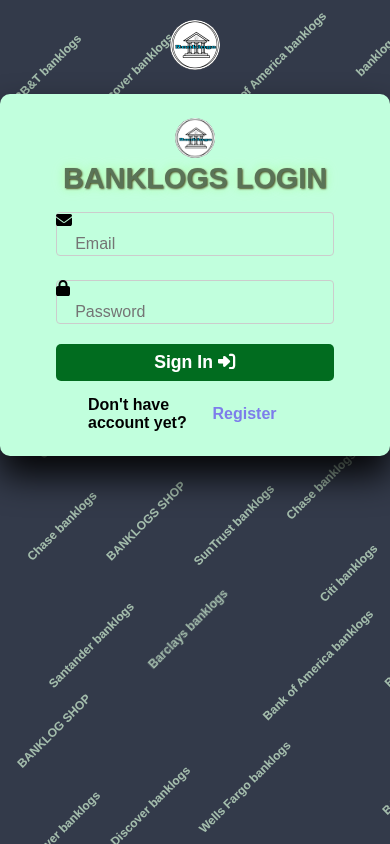
BankLog Shop is an online storefront, reached through its domain, that presents itself as selling what its own pages call stolen financial data: "bank logs", credit cards, "fullz", BINs and CVVs. The homepage presents a registration and login gateway, followed by a long run of listings organised under the names of major banks. The apparent business model, judging by the site's own text, is selling compromised banking credentials and card data to registered buyers, item by item. It does not describe any lawful product or service. The site's classification is made with moderate confidence only.
Scam/Impersonation Risk
The site's own homepage advertises the sale of stolen bank access logs and payment-card data. If those offers are genuine, that would be trafficking in compromised financial information. The page title reads "BankLog Shop - Buy Logs, CC, Fullz,BIN & CVV". Its listings are headed with phrases such as "HSBC banklogs", "Capital One banklogs", "Chase banklogs", "Bank of America banklogs" and "Discover banklogs". The bank names appear as product categories for the stolen data on offer. No impersonation of those banks' own sites was detected. Buying such goods is a crime in most jurisdictions, and shops of this kind commonly take payment and deliver nothing. A buyer would therefore face both legal exposure and a likely loss. The site's own pages also show internal inconsistency. The store name appears as BankLog Shop, BANKLOGSHOP, BANKLOGS SHOP, BANKLOGS STORE and BANKLOG SHOP. The page offers bank logs and card data behind an ordinary account registration and login flow, with no operator identity shown. In the sandbox, the page changed substantially after interaction. That pattern is consistent with content being shown differently once a visitor engages, though the sandbox runs alone do not establish intent. No external reputation-list, phishing or conflicting-legal-entity signal was observed. The critical risk assessment rests on what the site itself offers and how it behaves, not on any third-party alert.
- Homepage title and body text advertise "Buy Logs, CC, Fullz, BIN & CVV" and list stolen-data offerings under many named banks.
- Homepage structure: three forms (registration, login, password recovery) gate access to the listings, and sandbox runs recorded a strong content change after interaction.
- Homepage text uses five variants of the store name, including "banklogstore.mp" as a further self-reference, and shows no operator identity.
- VirusTotal reported no malicious or suspicious detections and Google Safe Browsing did not list the site. No outside feed therefore corroborates or contradicts the page's own content. These clean lookups do not offset the concerns drawn from the page itself.
Regulatory Verification Notes
The only page read was the homepage. On that page, no legal entity, registration or licence, regulator reference, or terms and privacy pages were found. For a business handling financial data, these are the standard disclosures expected. Their absence is consistent with the nature of the offering and does not by itself point to an oversight. The on-page disclosure position is unclear, and the site shows opaque governance and ownership. The page does show an on-site store name and a contact form. These are the site's own claims and do not link it to any verifiable real-world operator. The identity signals found (the store name, the contact form and the on-site identity) give only a partial, unconfirmed match. No third-party broker or regulatory-registry entry was matched, so there is no external reputational context either way. Operator identity remains unverified.
- Homepage: no legal entity name, licence or registration number, regulator, or terms and privacy links on the page read.
- Homepage: the identity presented is the store name and a contact form only; no address is published.
- Hosting: served from AS13335 (Cloudflare, Inc., US).
- Transport encryption: TLS certificate issued by WE1 (domain-validated, DV), valid until 2026-12-26 at the time of capture. DV validation confirms control of the domain only and says nothing about the operator.
What to Verify Next
No verification step can make this site suitable for use, so the steps below are protective. Anyone who encounters the site should not register an account or submit any email address or password to it. Re-using a password that is in use elsewhere would be especially damaging. A person who has already entered credentials should change them at the real services where they are used. An organisation whose name appears in the listings can confirm through its own official channels whether it is aware of the page. A user who suspects their own card or bank data is being sold should contact their bank or card issuer directly, using the number printed on the card or the bank's official website. The page can also be reported to the national cybercrime or fraud-reporting authority.
- Homepage: registration, login and password-recovery forms are the points at which credentials would be handed to the site.
- Homepage: listings are headed with the names of well-known banks and card networks, so those institutions are the appropriate parties to confirm any related exposure.
- Contact channel: the page offers only a contact form and no independently checkable channel.
Summary Verdict
Critical risk. The site's own content, its stated purpose and its behaviour in testing are consistent with a stolen-data marketplace. Its technical hygiene and clean external lookups do not offset that. Operator identity is unverified, and nothing on the pages read supports treating the site as a legitimate business.
Infrastructure Integrity
All four addresses observed for the site are Cloudflare edge addresses, and no separate origin address was observable. The use of a CDN is neutral. It neither adds to nor reduces the concerns above, and it says nothing about who operates the site or what it sells.
Closing Assessment
The site should not be used for any purpose involving login, credentials, payment or financial data, and nothing should be bought or submitted through it.
Written analysis generated 2026-11-15 by the TrustSniffer Analysis Engine from the evidence in this report.
What the analysis found
12 findings contributed to this verdict, raised by behaviour in a sandbox, page content, several checks together, and registration and ownership.
01 Behaviour in a sandbox
- During the sandbox session the page showed markedly different content to different visitor profiles. This can have ordinary causes such as bot defence, and it can also hide content from checks.Behaviour in a sandbox
rule:BEHAV_CLOAKING_STRONG - The page showed a password field during the sandbox session, and it could not be matched to a recognised brand's sign-in page.Behaviour in a sandbox
rule:BEHAV_PASSWORD_FORM_PRESENT
02 Page content
- The review of the page content rated it high risk.Page content
rule:PAGE_RISK_HIGH - The page shows few of the signs expected from a trustworthy operator.Page content
rule:PAGE_TRUST_QUALITY_LOW - The page content shows three or more warning signs that deceptive sites commonly use.Page content
rule:PAGE_RED_FLAGS_STRONG - The browser raised a warning while loading the page.Page content
rule:PAGE_BROWSER_FLAGS_SUSPICIOUS - The page asks visitors for sensitive information.Page content
rule:PAGE_FORM_SENSITIVE - The page has no description for search engines, which established sites usually provide.Page content
rule:PAGE_SEO_MISSING_META - The page carries none of the structured previews for search and social sharing that established sites usually provide.Page content
rule:PAGE_SEO_NO_STRUCTURED
03 Several checks together
- Several independent checks pointed to risk at the same time.Several checks together
rule:HYB_MULTIPLE_MODULES_HIGH_RISK - No external threat source confirms a listing for this site, but its own page content reads as risky.Several checks together
rule:HYB_POSITIVE_EXTERNAL_NEGATIVE_PAGE
04 Registration and ownership
- The security certificate only proves control of the domain, not who operates it.Registration and ownership
rule:KF_SSL_DV_ONLY
How related findings were counted
Some findings above describe the same underlying fact, and some are weak on their own. TrustSniffer counts each such group under one shared limit, so one fact is not counted several times and weak signals stay bounded.
- Page quality: 2 findings share one limit, because each is weak evidence on its own. Together they stayed under the limit.
- Certificate and search-engine setup: 3 findings share one limit, because none of them is a sign of fraud on its own. Together they stayed under the limit.
Identity verification
| Status | UNVERIFIED |
|---|
The operator behind the site could not be connected to a real-world brand or person. What the page shows, if anything, is listed below; none of it was independently checked.
- org:BankLog Shop
- contact:form
- on_site_identity
What TrustSniffer observed
First-party facts recorded during the assessment of banklogstore.mp.
- The request stayed on banklogstore.mp. It was not redirected to another domain. Clear
- It is hosted on CLOUDFLARENET, a network registered in US. Noted
Domain intelligence
| Registrar | Not available |
|---|---|
| Hosting | CLOUDFLARENET - Cloudflare, Inc. |
| Network registered in | US |
| Server IP | 2606:4700:3030::ac43:af31 (a CDN edge address; the server behind it was not observed) |
| Name servers | Not available |
| CDN / edge network | Detected (cloudflare) |
| Resolved IP addresses | 4 |
| Edge IP addresses | 4 |
| Likely origin IP addresses | 0 |
| SSL issuer | WE1 |
| SSL expiry | 2026-12-26 |
| Domain age | Not available (no registration date was returned) |
| Domain expiry | Not available |
| Archive first seen | Not available |
| Archive snapshots | 0 |
| Reputation | VirusTotal: 0 malicious | AbuseIPDB (CDN edge address, not the host): 0% confidence, 0 reports | Google Safe Browsing: 0 matches |
About this assessment
A trust score summarises the evidence TrustSniffer could collect about banklogstore.mp at a point in time: domain registration and age, hosting and certificate, the content the site served, and third-party reputation feeds. A high score means the signals were consistent with a legitimately operated site; a low or critical score means several risk patterns were present. It is a starting point for your own judgement, not a guarantee and not a legal finding. There is no human rating and no user review in it. A site can change after it is assessed.