Verdict
This assessment found strong scam indicators on the site itself. Do not pay, sign in, or share personal details with this site.
basiclover.pages.dev shows critical-risk indicators.
- Sensitive Interaction Risk: The overall risk is high enough that entering private details here (a password, card number or wallet recovery phrase) could be unsafe.
- Governance Risk: An ownership check raised a concern: as a site on pages.dev, this address has no registration record of its own (the platform's domain is registered, not the site), the site asks visitors to sign in while its operator could not be verified and a form asks for sensitive details and sends them to a destination that could not be verified. On its own this does not say who runs the site or that anything is wrong with it.
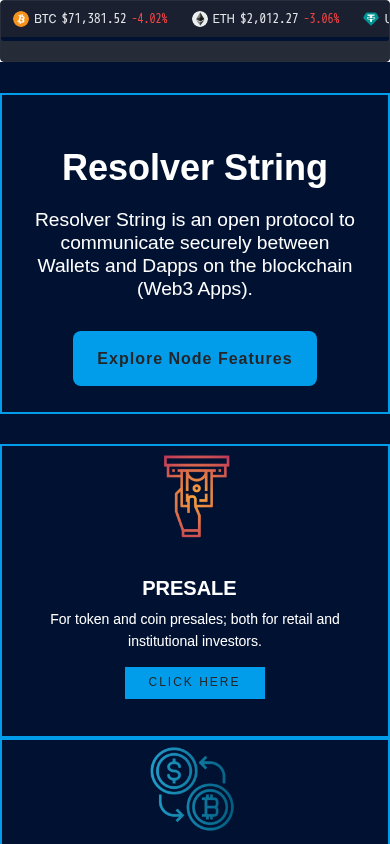
| How the site describes itself | A page branded Resolver String offers wallet support, asset recovery, token claims, presales and wallet-compromise help. Every support path leads to a "synchronize your wallet" action, and a modal asks for a 12- or 24-word seed phrase. No legal entity, contact channel, address, policy or regulator is shown. |
|---|
Evidence status and limitations
Evidence completeness: CompleteThis says whether every check on the site was recorded as finished. All of them were.
- The evidence was captured on 2026-11-12 and re-scored on 2026-11-15. The certificate, the registration age and the page content describe the site as it was on 2026-11-12.
- External threat sources confirmed a listing for this site when the evidence was captured (Google Safe Browsing, VirusTotal, a threat-intelligence listing from a feed TrustSniffer monitors (phishing, the site itself as the source, last seen 2026-10-26)). It was not re-queried for this version. On its own it would limit the score to at most 10; the score is lower because of the other findings below.
- The real-world operator identity was not independently verified.
How to read these numbers
A trust score of 0 means the risk evidence outweighed every trust signal by more than the 0 to 100 scale can show. It rates the evidence found, not the probability that the site is a scam.
Evidence confidence (75%) measures how much of TrustSniffer's evidence set this site produced: the page reading, the browser sandbox, the web archive, the registration record and the reputation services. It falls when a check returns nothing, as listed above, and it does not change the score.
At a glance
The checks that decide most of this verdict.
| What limits the score | The findings belowThe confirmed external listing ceiling (at most 10) and the threat-listing ceiling (at most 5) also apply, but the findings brought the score lower. | Watch |
|---|---|---|
| Malware engines | 11 marked it malicious, 1 suspiciousVirusTotal; Fortinet, Google, Kaspersky among the engines that flagged it | Risk |
| Google Safe Browsing | Listed as unsafeGoogle | Risk |
| Abuse reports on the CDN edge address | 0% confidenceAbuseIPDB, 0 reports; this is the record of the CDN edge address, not of the server behind it, which was not observed | Noted |
| First seen | 2.2 years before captureWeb archive; a site on pages.dev has no registration of its own | Clear |
| Web archive | Archived since 202420 snapshots | Clear |
| Certificate | Encrypted connectionIssued by WE1 | Noted |
The page as captured
Key findings
- Automated classification: Sensitive Interaction Risk, Governance Risk.
- First seen: 1 to 3 years before capture (web archive; a site on pages.dev has no registration of its own).
- Public web-archive history exists since 2024.
- At least one reputation service TrustSniffer consulted had flagged this domain when the evidence was captured.
Full analysis
Security Alert
11 VirusTotal engines, including Fortinet, Google, Kaspersky, Sophos, marked this site as malicious; independent sources confirm a listing for this site.
Overview
A single-page crypto wallet support site that presents itself as Resolver String, described as an open protocol for secure communication between wallets and decentralised apps. The page offers help with token presales, presale claims, asset recovery, swap problems, RPC rectification, "revoke cash" issues, transaction errors and wallet "validation". Every one of these routes ends in a prompt to "synchronize your wallet". A modal then asks the visitor for a 12- or 24-word seed phrase. Its apparent business model is to harvest wallet access or funds under the cover of technical support.
Scam/Impersonation Risk
The evidence points to a critical risk of wallet theft. This is a confirmed listing: Google Safe Browsing listed the address at capture, and a large group of scanning engines in VirusTotal also flagged it, including Fortinet, Google, Kaspersky and Sophos. A separate threat-intelligence listing classed the site as the actor in a phishing operation and was last seen on 26 October 2026. This is a confirmed blacklist position, and three independent sources agree on it. The score reflects the sum of the scored findings, which also include confirmed brand impersonation, a seed-phrase form that sends data to an untrusted destination, and a free platform address.
The page's own content matches that listing. Under a support heading it states "Please enter your seed phrase to continue". That request cannot serve any legitimate support purpose, because a seed phrase gives full control of a wallet. The page adds urgency with "Are you a victim of wallet hack? click the button below to synchronize your wallet and hold the transactions" and "Lost access to funds or funds is missing?". These lines target people who have already lost money and are therefore more likely to comply. The page also shows Coinbase Wallet app and browser-extension prompts while branded as Resolver String, and the site is not Coinbase. Its copyright line names no operator, only "[contact withheld]", and the notice ends in 2023 on a page that presents current services. The page loads most of its files from other domains, produced a high number of console errors, and posted data to destinations TrustSniffer does not recognise. No contradictory legal identities were found. The risk comes from the blacklisting, the impersonation of a wallet brand and the seed-phrase collection.A console error is a technical error message that the page's own code reported inside the browser while it ran. It describes how the page is built, and on its own it is not proof that the site is harmful.
- Listings at capture (12 November 2026): Google Safe Browsing match for social engineering. VirusTotal reported 11 engines malicious and 1 suspicious. The phishing listing was last seen 26 October 2026.
- Homepage: a form of the seed-phrase type sits behind the "synchronize your wallet" buttons, and the form was assessed as sensitive with an untrusted destination.
- Homepage: Coinbase Wallet prompts appear under the Resolver String brand, and the page mentions the LYX token.
- Browser behaviour: 81 requests went to other hosts, 9 of them to destinations TrustSniffer does not recognise. 78.8% of files came from other domains, and 37 console errors were logged.
Regulatory Verification Notes
On the page read, which was the homepage only, none of the disclosures expected from a financial or crypto service were present. There was no named legal entity, no registration or licence, no regulator and no terms or privacy notice. The page also publishes no contact channel or address. Its self-description as an "open protocol" is an unsupported claim, and no regulatory standing is claimed or shown. The operator's real-world identity is unverified. The only identity signal is the on-site branding "Resolver String", and nothing independent links it to a person or company. These gaps are consistent with, but separate from, the confirmed listings above.
- Homepage: none of the four expected disclosures (legal entity, registration or licence, regulator, terms or privacy) were found on the page read.
- Web archive: first seen 2024-09-13, with 20 snapshots through 2026-06-16 (a 641-day span, about 790 days before capture). The largest gap between snapshots was 351 days. The address is a subdomain on a free hosting platform, so no registration of its own exists.
- Hosting: served from AS13335 (Cloudflare, Inc., US). The host address's abuse record was checked and showed 0 reports.
- Transport encryption: TLS certificate issued by WE1 (DV), valid until 2027-01-18.A TLS certificate is what puts the padlock and https:// in your browser and encrypts the connection. "WE1" is the name of the authority that issued it. DV (domain validated) means the issuer only confirmed who controls the domain name, not which person or company runs the site.
What to Verify Next
No verification should be attempted through the page itself. Any wallet support or recovery request should go only to the wallet provider's official support channel, reached independently of this page. Anyone who has already entered a seed phrase here should treat that wallet as compromised. The remaining funds should be moved to a new wallet created with a new seed phrase on a clean device, and token approvals should be revoked through the wallet provider's own tools. Any presale or token claim promoted on the page should be checked with the project's official announcements, not with this page.
- Homepage: the seed-phrase form is the only form seen, and every support route leads to it.
- Homepage: the Coinbase Wallet prompts are the reason Coinbase's official support route is the correct place to confirm any wallet issue.
Summary Verdict
The assessment is critical risk. Independent threat listings, a seed-phrase collection mechanism and brand impersonation all point the same way. The site's own pages contain nothing that offsets them. Its technical hygiene does not alter the conclusion.
Infrastructure Integrity
The site is delivered through Cloudflare. All four observed addresses are Cloudflare edge addresses, and no separate origin server address was observed. This is neutral. It neither raises nor lowers the risk and says nothing about who operates the site. The valid transport certificate does not alter the assessment either.
Closing Assessment
The page should not be used. No seed phrase, recovery phrase or wallet connection should be entered or approved, and no funds should be sent to it. Anyone who already interacted with it should act on the wallet-protection steps above.
Written analysis generated 2026-11-15 by the TrustSniffer Analysis Engine from the evidence in this report.
What the analysis found
19 findings contributed to this verdict, raised by external reputation, page content, several checks together, behaviour in a sandbox, and registration and ownership.
01 External reputation
- Google Safe Browsing and 11 VirusTotal engines marked this domain as malicious when the evidence was captured, which TrustSniffer counts as a confirmed external listing.External reputation
rule:EXT_BLACKLIST_CRITICAL
02 Page content
- The page presents itself as a brand TrustSniffer confirmed it does not belong to.Page content
rule:PAGE_BRAND_IMPERSONATION_CONFIRMED - A form on the page submits to a destination TrustSniffer could not verify.Page content
rule:PAGE_FORM_UNTRUSTED_DEST - The review of the page content rated it high risk.Page content
rule:PAGE_RISK_HIGH - The page shows few of the signs expected from a trustworthy operator.Page content
rule:PAGE_TRUST_QUALITY_LOW - The page content shows three or more warning signs that deceptive sites commonly use.Page content
rule:PAGE_RED_FLAGS_STRONG - The page runs on a free hosting-platform address instead of a domain of its own, a setup common to short-lived phishing and claim pages.Page content
rule:PAGE_FREE_PLATFORM_ADDRESS - The browser raised a warning while loading the page.Page content
rule:PAGE_BROWSER_FLAGS_SUSPICIOUS - The page asks visitors for sensitive information.Page content
rule:PAGE_FORM_SENSITIVE - The page has no description for search engines, which established sites usually provide.Page content
rule:PAGE_SEO_MISSING_META
03 Several checks together
- Several independent checks pointed to risk at the same time.Several checks together
rule:HYB_MULTIPLE_MODULES_HIGH_RISK
04 Behaviour in a sandbox
- Most of the files the page loaded (scripts, images, fonts) came from other domains. This is about where its content is hosted, not about data being sent elsewhere.Behaviour in a sandbox
rule:BEHAV_EXTERNAL_RATIO_HIGH - The page produced an unusually high number of errors while it ran.Behaviour in a sandbox
rule:BEHAV_CONSOLE_ERRORS_HIGH - The page exchanged network traffic with destinations TrustSniffer does not recognise.Behaviour in a sandbox
rule:BEHAV_NONWHITELISTED_TRAFFIC - The page sent data to a destination TrustSniffer does not recognise.Behaviour in a sandbox
rule:BEHAV_NONWHITELISTED_POSTS - The page made background requests to destinations TrustSniffer does not recognise.Behaviour in a sandbox
rule:BEHAV_NONWHITELISTED_XHR - An automated reading of the page's network activity judged some requests unusual for this kind of page.Behaviour in a sandbox
05 Registration and ownership
- As a site on pages.dev, this address has no registration record of its own (the platform's domain is registered, not the site).Registration and ownership
rule:KF_WHOIS_INCOMPLETE - The security certificate only proves control of the domain, not who operates it.Registration and ownership
rule:KF_SSL_DV_ONLY
How related findings were counted
Some findings above describe the same underlying fact, and some are weak on their own. TrustSniffer counts each such group under one shared limit, so one fact is not counted several times and weak signals stay bounded.
- Third-party connections: 4 findings share one limit, because they all measure one fact: the page loads files from other hosts. The limit applied, so together they counted for less than their sum.
- Page quality: 2 findings share one limit, because each is weak evidence on its own. Together they stayed under the limit.
- Certificate and search-engine setup: 2 findings share one limit, because none of them is a sign of fraud on its own. Together they stayed under the limit.
Identity verification
| Status | UNVERIFIED |
|---|
The operator behind the site could not be connected to a real-world brand or person. What the page shows, if anything, is listed below; none of it was independently checked.
- org:Basiclover Pages Dev
- on_site_identity
What TrustSniffer observed
First-party facts recorded during the assessment of basiclover.pages.dev.
- The request stayed on basiclover.pages.dev. It was not redirected to another domain. Clear
- The earliest public archive of this site is from 2024-09-13. Clear
- It is hosted on CLOUDFLARENET, a network registered in US. Noted
Domain intelligence
| Registrar | Not available |
|---|---|
| Hosting | CLOUDFLARENET - Cloudflare, Inc. |
| Network registered in | US |
| Server IP | 2606:4700:310c::ac42:2c39 (a CDN edge address; the server behind it was not observed) |
| Name servers | Not available |
| CDN / edge network | Detected (cloudflare) |
| Resolved IP addresses | 4 |
| Edge IP addresses | 4 |
| Likely origin IP addresses | 0 |
| SSL issuer | WE1 |
| SSL expiry | 2027-01-18 |
| First seen (web archive) | 2.17 years before capture; a site on pages.dev has no registration of its own |
| Domain expiry | Not available |
| Archive first seen | 2024-09-13 (2.2 years before capture) |
| Archive snapshots | 20 |
| Reputation | VirusTotal: 11 malicious, 1 suspicious | AbuseIPDB (CDN edge address, not the host): 0% confidence, 0 reports | Google Safe Browsing: 1 match |
About this assessment
A trust score summarises the evidence TrustSniffer could collect about basiclover.pages.dev at a point in time: domain registration and age, hosting and certificate, the content the site served, and third-party reputation feeds. A high score means the signals were consistent with a legitimately operated site; a low or critical score means several risk patterns were present. It is a starting point for your own judgement, not a guarantee and not a legal finding. There is no human rating and no user review in it. A site can change after it is assessed.