Verdict
An external threat listing named this site as malicious when the evidence was captured. Do not pay or share personal details with this site.
claim-jewish.pages.dev shows critical-risk indicators.
- Sensitive Interaction Risk: This label is given when the overall risk is high. The captured page did not ask for a password, card number or other sensitive details; if it ever does, entering them here could be unsafe.
- Governance Risk: The governance checks raised a concern: a threat-intelligence listing limits the score; as a site on pages.dev, this address has no registration record of its own (the platform's domain is registered, not the site). The findings below give the detail.
| How the site describes itself | A Solana-based token airdrop page for '$SCAM' that asks visitors to connect a wallet, hold tokens, and follow a Twitter account to claim free tokens under a countdown timer. It gives no verifiable team, legal identity, contract address, audit, or product detail, and it uses obfuscated text and unsourced usage figures. |
|---|
Evidence status and limitations
Evidence completeness: CompleteThis says whether every check on the site was recorded as finished. All of them were.
- The real-world operator identity was not independently verified.
How to read these numbers
The trust score runs from 0 to 100, higher is safer. 5/100 rates the evidence found, not the probability that the site is a scam.
Evidence confidence (75%) measures how much of TrustSniffer's evidence set this site produced: the page reading, the browser sandbox, the web archive, the registration record and the reputation services. It falls when a check returns nothing, as listed above, and it does not change the score.
At a glance
The checks that decide most of this verdict.
| What limits the score | Threat-listing ceilingA threat-intelligence feed TrustSniffer monitors listed a file on this site as malicious when the evidence was captured, and that listing caps the score. | Risk |
|---|---|---|
| Malware engines | None flagged itVirusTotal | Clear |
| Google Safe Browsing | Not listedGoogle | Clear |
| Abuse reports on the CDN edge address | 0% confidenceAbuseIPDB, 0 reports; this is the record of the CDN edge address, not of the server behind it, which was not observed | Noted |
| First seen | 6 months before captureWeb archive; a site on pages.dev has no registration of its own | Watch |
| Web archive | Archived since 202616 snapshots | Clear |
| Certificate | Encrypted connectionIssued by YE2 | Noted |
The page as captured
Key findings
- Automated classification: Sensitive Interaction Risk, Governance Risk.
- First seen: less than 1 year before capture (web archive; a site on pages.dev has no registration of its own).
- Public web-archive history exists since 2026.
- No flags from the reputation services TrustSniffer consulted when the evidence was captured.
Full analysis
Overview
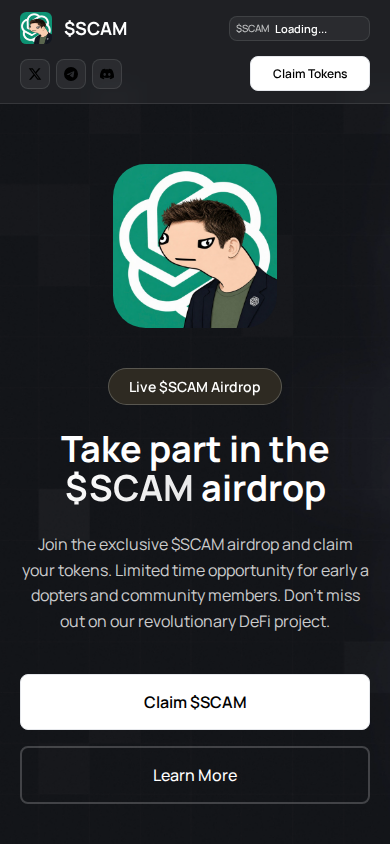
This website is a single-page landing site for a Solana-based token airdrop titled "Scam Altman | Airdrop". It invites visitors to claim free "$SCAM" tokens by connecting a crypto wallet, holding some tokens, and following the project on Twitter, all under a "7 Days Left" countdown. Its apparent purpose is to build a user base and attract wallets for an unspecified DeFi token. It describes no product, revenue source, or mechanism for distributing the tokens.
Scam/Impersonation Risk
This site carries a confirmed adverse reputation. It is on an external blacklist, and a threat-intelligence feed currently lists it as distributing phishing content. That listing attributes the activity to the site itself, not to a compromised third party, and it is the decisive factor in this assessment. It was most recently observed in late October 2026, so it is current. The page content is consistent with that listing. The only call to action is a "Connect Wallet" step, which exposes a visitor's blockchain account to a party that cannot be identified. The page supports the step with urgency ("Limited time opportunity", "Don't miss out") and with figures that cite no source: "$2.5M Total Volume", "150K+ Active Users", "50,000 Participants", "24/7 Support", and "Join millions of users". A project that had only just appeared could not plausibly have reached these figures. The text also uses invisible zero-width characters and Cyrillic look-alike letters in words such as "airdrop", "claim" and "exclusive". This is a deliberate technique for evading keyword filters and automated scanners, and legitimate projects have no reason to use it. The navigation lists Trading, Staking, Whitepaper, Tokenomics and Roadmap, but the page contains no outbound or internal links, so none of these resources can be reached. The page publishes no token contract address, audit, or team. The brand name parodies a well-known public figure, which gives the lure borrowed name recognition. Brand impersonation itself was not confirmed, and no conflicting legal identities appear, because the site names no entity at all.
- The homepage shows a "Connect Wallet" claim step, a "7 Days Left" countdown, and eligibility conditions that require holding tokens and following a Twitter account.
- The homepage shows unsourced usage statistics alongside a stated supply of 1,000,000 tokens and 50,000 participants. It shows no contract address, audit, or tokenomics detail.
- The homepage text contains zero-width characters and Cyrillic homoglyph substitutions, and its menu items link nowhere.
- The domain is about 0.5 years old (roughly 190 days). The web archive holds 16 snapshots, all from 2026 (first captured 2026-04-27, last 2026-06-16), so the site has a short history with no earlier legitimate use.
Regulatory Verification Notes
The site presents a Legal, Privacy Policy, Terms of Service, Cookie Policy and Disclaimer footer, but none of these pages is reachable. No operating company, registered address, licence, or regulator is named anywhere. The site makes no licensing claim at all, even though it solicits wallet access and promises free digital assets. Ownership opacity is present, and the page gives no way of connecting the project to an accountable person or entity. This is a disclosure gap, and it is not in itself proof of fraud. Here it adds to the listing and the content findings, because it means a victim would have no entity to hold responsible. No third-party broker or regulator record matched this site. The absence of one is neutral and neither supports nor undermines the project.
- The homepage footer lists legal and policy pages, but the page has no links to them and names no company, licence number, or regulator.
- The homepage describes the project only as a "revolutionary DeFi project". It gives no legal status, jurisdiction, or named team.
- The site is served from AS13335 (CLOUDFLARENET, Cloudflare, Inc., US) on a free-platform subdomain, not an independently registered brand domain.
- The site's transport encryption is a domain-validated (DV) certificate issued by YE2, valid to 2027-01-20. DV validation confirms control of the domain only and says nothing about the operator.
What to Verify Next
Because the site is listed as hostile, the practical steps are protective, not investigative. No wallet should be connected, and no signature or transaction approval should be given, to this site. Anyone who still wants to assess the "$SCAM" token should look for a contract address on an independent Solana blockchain explorer and check the token's holder distribution and creation date. They should treat the on-page statistics as unverified until an independent source confirms them. Any claim of affiliation with a known person or company should be checked through that party's official channels, reached offline or through a route that does not use this site. If a wallet has already been connected or a transaction signed, the connection's permissions should be revoked, remaining assets moved to a new wallet, and the incident reported to the wallet provider.
- The homepage gives no contract address, so the token cannot be matched to an on-chain record from the site itself.
- The homepage requires a wallet connection before any terms are shown, so a visitor cannot review conditions first.
- The site's own pages give no official social handle or support route that can be checked against it.
Summary Verdict
The overall posture is high risk. The site is listed by a threat-intelligence feed as an active source of phishing activity and appears on an external blacklist, and its on-page content matches the profile of a wallet-capture lure. The technical hygiene the site shows is consistent with a deliberately set-up fraudulent operation as much as with a benign one. It cannot offset these findings. The operator's real-world identity is unverified and unaccountable, and the assessment gives no basis for treating the site as legitimate.
Infrastructure Integrity
The site is served entirely through Cloudflare's CDN and web-application firewall. All four observed addresses (two IPv4 and two IPv6) are Cloudflare edge servers in the US, and the origin server was not observable. The hosting is a shared free-platform tenancy, and infrastructure of this kind can be re-published or have its content swapped quickly. Cloudflare's reputation and the valid certificate lower the likelihood of a technical compromise of the hosting itself. They are mitigating factors only, and they do not offset the active threat listing or the content findings.
Closing Assessment
The site should be limited to read-only viewing at most, if visited at all. Wallet connection, credential entry, token claims, and any payment or transfer should be avoided entirely.
Written analysis generated 2026-11-04 by the TrustSniffer Analysis Engine from the evidence in this report.
What the analysis found
6 findings contributed to this verdict, raised by governance, external reputation, page content and several checks together.
01 Governance
- A threat-intelligence feed TrustSniffer monitors listed a file on this site as malicious when the evidence was captured, and that listing caps the score.Governance
rule:gov_active_threat_listing
02 External reputation
- Two VirusTotal engines, or one leading vendor, marked this domain as malicious.External reputation
rule:EXT_BLACKLIST_MEDIUM
03 Page content
- The review of the page content rated it high risk.Page content
rule:PAGE_RISK_HIGH - The page shows few of the signs expected from a trustworthy operator.Page content
rule:PAGE_TRUST_QUALITY_LOW - The page content shows three or more warning signs that deceptive sites commonly use.Page content
rule:PAGE_RED_FLAGS_STRONG
04 Several checks together
- Several independent checks pointed to risk at the same time.Several checks together
rule:HYB_MULTIPLE_MODULES_HIGH_RISK
Identity verification
| Status | UNVERIFIED |
|---|
The operator behind the site could not be connected to a real-world brand or person. What the page shows, if anything, is listed below; none of it was independently checked.
- No contact detail, company registration number or linked social profile was extracted from the page for checking. Any operator the page names in its own words (see how the site describes itself, above) is not verified here.
What TrustSniffer observed
First-party facts recorded during the assessment of claim-jewish.pages.dev.
- The request stayed on claim-jewish.pages.dev. It was not redirected to another domain. Clear
- The earliest public archive of this site is from 2026-04-27. Clear
- It is hosted on CLOUDFLARENET, a network registered in US. Noted
Domain intelligence
| Registrar | Not available |
|---|---|
| Hosting | CLOUDFLARENET - Cloudflare, Inc. |
| Network registered in | US |
| Server IP | 2606:4700:310c::ac42:2c76 (a CDN edge address; the server behind it was not observed) |
| Name servers | Not available |
| CDN / edge network | Detected (cloudflare) |
| Resolved IP addresses | 4 |
| Edge IP addresses | 4 |
| Likely origin IP addresses | 0 |
| SSL issuer | YE2 |
| SSL expiry | 2027-01-20 |
| First seen (web archive) | 191 days before capture; a site on pages.dev has no registration of its own |
| Domain expiry | Not available |
| Archive first seen | 2026-04-27 (191 days before capture) |
| Archive snapshots | 16 |
| Reputation | VirusTotal: 0 malicious | AbuseIPDB (CDN edge address, not the host): 0% confidence, 0 reports | Google Safe Browsing: 0 matches |
About this assessment
A trust score summarises the evidence TrustSniffer could collect about claim-jewish.pages.dev at a point in time: domain registration and age, hosting and certificate, the content the site served, and third-party reputation feeds. A high score means the signals were consistent with a legitimately operated site; a low or critical score means several risk patterns were present. It is a starting point for your own judgement, not a guarantee and not a legal finding. There is no human rating and no user review in it. A site can change after it is assessed.