Verdict
An external threat listing named this site as malicious when the evidence was captured. Do not pay or share personal details with this site.
earn-satoshivm.pages.dev shows critical-risk indicators.
- Sensitive Interaction Risk: This label is given when the overall risk is high. The captured page did not ask for a password, card number or other sensitive details; if it ever does, entering them here could be unsafe.
- Governance Risk: A registration check came back incomplete: as a site on pages.dev, this address has no registration record of its own (the platform's domain is registered, not the site). That is a gap in what could be looked up, not a sign that ownership is hidden, and it does not say who runs the site.
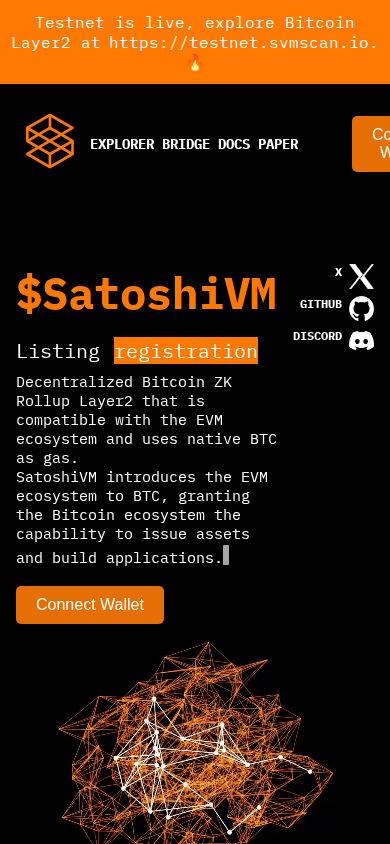
| How the site describes itself | SatoshiVM presents itself as a ZK rollup Layer 2 on Bitcoin that is EVM-compatible and uses native BTC as gas. The testnet is live, and the page links to an explorer, docs, GitHub, Discord and X, plus a $SatoshiVM token-listing registration offer. The page makes technical claims but no financial return promises, and it requests no credentials or payments. |
|---|
Evidence status and limitations
Evidence completeness: CompleteThis says whether every check on the site was recorded as finished. All of them were.
- The real-world operator identity was not independently verified.
How to read these numbers
A trust score of 0 means the risk evidence outweighed every trust signal by more than the 0 to 100 scale can show. It rates the evidence found, not the probability that the site is a scam.
Evidence confidence (75%) measures how much of TrustSniffer's evidence set this site produced: the page reading, the browser sandbox, the web archive, the registration record and the reputation services. It falls when a check returns nothing, as listed above, and it does not change the score.
At a glance
The checks that decide most of this verdict.
| Malware engines | 14 marked it maliciousVirusTotal | Risk |
|---|---|---|
| Google Safe Browsing | Not listedGoogle | Clear |
| Abuse reports on the CDN edge address | 0% confidenceAbuseIPDB, 0 reports; this is the record of the CDN edge address, not of the server behind it, which was not observed | Noted |
| First seen | 2.1 years before captureWeb archive; a site on pages.dev has no registration of its own | Clear |
| Web archive | Archived since 202420 snapshots | Clear |
| Certificate | Encrypted connectionIssued by WE1 | Noted |
The page as captured
Key findings
- Automated classification: Sensitive Interaction Risk, Governance Risk.
- First seen: 1 to 3 years before capture (web archive; a site on pages.dev has no registration of its own).
- Public web-archive history exists since 2024.
- At least one reputation service TrustSniffer consulted had flagged this domain when the evidence was captured.
Full analysis
Security Alert
Fortinet, Kaspersky, Sophos flagged this site in external intelligence checks, indicating elevated compromise/scam exposure that requires immediate caution.
Overview
SatoshiVM presents itself as a ZK-rollup Layer 2 network on Bitcoin. It is EVM-compatible and uses native BTC as gas. The page is a single-page project landing site hosted on a free tenant subdomain of a shared web-publishing platform. It advertises a live testnet with an explorer, a bridge, documentation, a paper, and links to GitHub, Discord and X. It also carries a wallet-connection button and a "$SatoshiVM listing registration" call to action. The apparent purpose is to promote a crypto infrastructure project and its native token ecosystem. The page states no direct revenue model.
Scam/Impersonation Risk
Hard contradictions are present. Several major security vendors currently flag this site as malicious, and an external blacklist listing is confirmed. That corroborated detection is the decisive factor in the assessment, and the content of the page does not offset it. The page text itself is technically themed and makes no yield or return promises. It requests no payment or credentials, and no login form, hidden form or cross-site password form was found. No wallet-draining routine, clipboard manipulation or cloaking was observed in the sandbox runs. These observations explain why the visible content looks benign, but they do not cancel the blacklist. The hostname is a free-tier tenant name that combines an "earn" prefix with the project name. It closely resembles the shared platform's own domain and could be registered by anyone. Nothing independently ties it to the genuine SatoshiVM team. The wallet-connect button, the bridge entry and the token-listing registration offer are the interaction points where this uncertainty would become financial loss. A listing offer with no stated terms, fees or counterparty is a recognised lure in token-related fraud. Under a blacklisted hostname, these features carry elevated risk. In the sandbox, the page made a heavy volume of third-party network traffic, with a large majority of requests going to external destinations. It also produced repeated console errors, and a small number of those external calls went to destinations outside the recognised-infrastructure set. The behaviour is consistent with a page that pulls in many outside resources. It does not by itself prove misconduct.A console error is a technical error message that the page's own code reported inside the browser while it ran. It describes how the page is built, and on its own it is not proof that the site is harmful.
- Homepage: the project is presented under an "earn"-prefixed tenant subdomain of a shared publishing platform, with no link back to any verified official domain.
- Homepage: a "Connect Wallet" button appears twice, alongside a bridge entry and a "$SatoshiVM listing registration" call to action that gives no terms.
- Threat reputation: more than a dozen vendors rate the hostname malicious, including several tier-one security vendors, and an external blacklist listing is active.
- Domain provenance: the hostname is about 2 years old, with 20 archive snapshots spanning 2024–2026 (3 years tracked) and no content repurposing detected.
Regulatory Verification Notes
The site names no operating company, registered address, licence, audit firm or responsible individual. It claims no regulatory authorisation of any kind. For a project that invites wallet connection and token-related registration, this leaves no accountable party who can be identified from the site. This is a disclosure gap and not, on its own, evidence of wrongdoing. Here it compounds a confirmed adverse reputation signal. The technical claims about fraud proofs, ZK proving and sequencing layers are unaudited on the page, and no audit reports are referenced. No third-party broker or regulator database entry matched this site, so no outside assessment of the project exists to rely on.
- Homepage: no company name, licence number, legal terms, privacy notice or audit reference appears on the captured page.
- Homepage: the architecture and fraud-proof claims are asserted without supporting audit or attestation material.
- Hosting: the site is served from AS13335 (Cloudflare, Inc., US).
- Transport encryption: the TLS certificate is DV-level, issued by WE1, and valid to 2027-01-20.
What to Verify Next
The first step is to obtain the project's official website address from an independent source. Suitable sources include the project's verified GitHub organisation, its verified social account, or a reputable market-data listing. That address should then be compared with this hostname. Any claim of a token listing or registration should be confirmed with the named listing venue directly, through contact details taken from that venue's own site. The project's published repositories and any independent security audit should be checked to see whether they match the claims made here. The official support channels should also be confirmed before any interaction.
- Homepage: the GitHub, Discord and X links should be cross-checked against the project's independently verified presence.
- Homepage: the listing-registration call to action should be traced to its named destination before any data is submitted.
- Homepage: the testnet explorer link is the only external destination on the page and should be confirmed as officially affiliated.
Summary Verdict
The assessment is critical. The site carries a confirmed adverse reputation that outweighs its otherwise unremarkable page content and technical hygiene. The operator is unidentified, and no independent evidence connects the site to the project it presents. It is treated as a high-risk site for any sensitive interaction.
Infrastructure Integrity
The site is delivered through Cloudflare's CDN and WAF, and every observed address is a Cloudflare edge address. The origin server is not observable. A valid certificate and a mainstream edge provider are mitigating factors only. They cannot offset the reputation findings, and edge-only visibility prevents independent verification of the hosting behind the site and can mask a rapid swap of its content.
Closing Assessment
Passive reading of the page is the only appropriate use. Wallet connection, bridging, token-listing registration, credential entry and any payment should be avoided. Use the project's official channels instead, confirmed through independent sources.
Written analysis generated 2026-11-04 by the TrustSniffer Analysis Engine from the evidence in this report.
What the analysis found
6 findings contributed to this verdict, raised by external reputation, behaviour in a sandbox, registration and ownership and page content.
01 External reputation
- A confirmed external listing marks this domain as malicious: at least five security engines including a leading vendor, ten engines, or Google Safe Browsing.External reputation
rule:EXT_BLACKLIST_CRITICAL
02 Behaviour in a sandbox
- Most of the files the page loaded (scripts, images, fonts) came from other domains. This is about where its content is hosted, not about data being sent elsewhere.Behaviour in a sandbox
rule:BEHAV_EXTERNAL_RATIO_HIGH - The page produced an unusually high number of errors while it ran.Behaviour in a sandbox
rule:BEHAV_CONSOLE_ERRORS_HIGH - An automated reading of the page's network activity judged some requests unusual for this kind of page.Behaviour in a sandbox
03 Registration and ownership
- As a site on pages.dev, this address has no registration record of its own (the platform's domain is registered, not the site).Registration and ownership
rule:KF_WHOIS_INCOMPLETE
04 Page content
- The page has no description for search engines, which established sites usually provide.Page content
rule:PAGE_SEO_MISSING_META
Identity verification
| Status | UNVERIFIED |
|---|
The operator behind the site could not be connected to a real-world brand or person. What the page shows, if anything, is listed below; none of it was independently checked.
- No contact detail, company registration number or linked social profile was extracted from the page for checking. Any operator the page names in its own words (see how the site describes itself, above) is not verified here.
What TrustSniffer observed
First-party facts recorded during the assessment of earn-satoshivm.pages.dev.
- The request stayed on earn-satoshivm.pages.dev. It was not redirected to another domain. Clear
- The earliest public archive of this site is from 2024-01-21. Clear
- It is hosted on CLOUDFLARENET, a network registered in US. Noted
Domain intelligence
| Registrar | Not available |
|---|---|
| Hosting | CLOUDFLARENET - Cloudflare, Inc. |
| Network registered in | US |
| Server IP | 2606:4700:310c::ac42:2c61 (a CDN edge address; the server behind it was not observed) |
| Name servers | Not available |
| CDN / edge network | Detected (cloudflare) |
| Resolved IP addresses | 4 |
| Edge IP addresses | 4 |
| Likely origin IP addresses | 0 |
| SSL issuer | WE1 |
| SSL expiry | 2027-01-20 |
| First seen (web archive) | 2.14 years before capture; a site on pages.dev has no registration of its own |
| Domain expiry | Not available |
| Archive first seen | 2024-01-21 (2.8 years before capture) |
| Archive snapshots | 20 |
| Reputation | VirusTotal: 14 malicious | AbuseIPDB (CDN edge address, not the host): 0% confidence, 0 reports | Google Safe Browsing: 0 matches |
About this assessment
A trust score summarises the evidence TrustSniffer could collect about earn-satoshivm.pages.dev at a point in time: domain registration and age, hosting and certificate, the content the site served, and third-party reputation feeds. A high score means the signals were consistent with a legitimately operated site; a low or critical score means several risk patterns were present. It is a starting point for your own judgement, not a guarantee and not a legal finding. There is no human rating and no user review in it. A site can change after it is assessed.