Verdict
This assessment found strong scam indicators on the site itself. Do not pay or share personal details with this site.
idsky.ph shows critical-risk indicators.
- Sensitive Interaction Risk: The overall risk is high enough that entering private details here (a password, card number or wallet recovery phrase) could be unsafe.
| How the site describes itself | IDSKY.ph sells scannable forged US driver licenses and state IDs, claiming they pass verification and are 100% scannable. Ordering requires login, collects personal details and photos, and accepts PayPal, cards and cryptocurrency. No verifiable legal entity, physical address or regulatory information is shown, and the sale of forged identity documents is illegal. |
|---|
Evidence status and limitations
Evidence completeness: PartialThis says whether every check on the site was recorded as finished. At least one check failed or returned no result.
- The evidence was captured on 2026-11-04 and re-scored on 2026-11-14. The certificate, the registration age and the page content describe the site as it was on 2026-11-04.
- The real-world operator identity was not independently verified.
- These checks returned no result: domain registration record (WHOIS), name servers (DNS).
How to read these numbers
The trust score runs from 0 to 100, higher is safer. 10/100 rates the evidence found, not the probability that the site is a scam.
Evidence confidence (75%) measures how much of TrustSniffer's evidence set this site produced: the page reading, the browser sandbox, the web archive, the registration record and the reputation services. It falls when a check returns nothing, as listed above, and it does not change the score.
At a glance
The checks that decide most of this verdict.
| What limits the score | Page-risk ceiling; Illegal-goods ceilingThe review of the page content rated it very high risk, and that caps the score. The site's own pages offer illegal goods for sale (stolen card or bank data, counterfeit money, forged documents, illegal drugs, prescription drugs sold without a prescription, or darknet-market access), and that caps the score. | Risk |
|---|---|---|
| Malware engines | None malicious; 1 marked it suspiciousVirusTotal | Watch |
| Google Safe Browsing | Not listedGoogle | Clear |
| Abuse reports on the CDN edge address | 0% confidenceAbuseIPDB, 0 reports; this is the record of the CDN edge address, not of the server behind it, which was not observed | Noted |
| First seen | 1.4 years before captureWeb archive; no registration record was returned | Clear |
| Web archive | Archived since 2025131 snapshots | Clear |
| Certificate | Encrypted connectionIssued by WE1 | Noted |
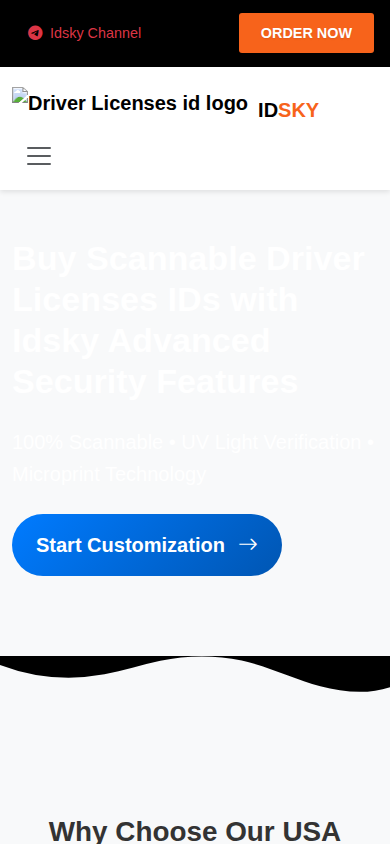
The page as captured
Key findings
- Automated classification: Sensitive Interaction Risk.
- First seen: 1 to 3 years before capture (web archive; no registration record was returned).
- Public web-archive history exists since 2025.
- No security engine marked this domain as malicious; some marked it suspicious, which TrustSniffer does not count as a listing.
Full analysis
Overview
IDSKY.ph is an online storefront that presents itself as a seller of "scannable" fake US driver licences and state ID cards, with additional catalogue sections for Canada and the United Kingdom. The homepage is titled around buying a scannable fake ID online. It promotes customisation, a demo video, ordering and payment guides, and a reseller guide. The apparent business model is per-unit sale of counterfeit identity documents at roughly $80 to $100 each, paid by PayPal, card or cryptocurrency.
Scam/Impersonation Risk
The site's own homepage offers forged identification for sale, and that is the decisive finding. This is a hard contradiction. The site presents itself as an illicit-goods storefront, which is incompatible with lawful trading. Its title and navigation use phrases such as "buy scannable fake ID online" and "novelty IDs vs fake IDs". The page markets "100% scannable" cards with UV marks, microprint, holographic overlays and "discreet global shipping". The "novelty" framing does not change the product as described: the page describes cards built to pass verification. Buying forged identity documents is a crime in most countries. Shops of this kind commonly take payment and deliver nothing, or harvest the personal data and photographs that buyers must submit. The critical-risk assessment rests on what the page itself says it sells. No outside source is claimed to have confirmed it, and no third-party reputation list or security-engine match is behind it. No brand impersonation, phishing behaviour or conflicting legal identities were observed. The risk comes from what the shop sells and from the sensitive data and payment flow it asks buyers to complete.
The site also asserts "15+ years" of operation and publishes testimonials. These claims could not be corroborated and are treated as unverified marketing statements. The domain was first seen in the web archive only about a year and a half before capture.
Some behavioural signals are visible, and each carries limited weight:
- The page produced 71 console errors and a DOM change of 2,671 after interaction. This is automated test output from our own run. It indicates a noisy or unstable page, not malicious intent, so it is a minor note.A console error is a technical error message that the page's own code reported inside the browser while it ran. It describes how the page is built, and on its own it is not proof that the site is harmful.
- VirusTotal returned one suspicious rating and no malicious detections. This is a single-engine, low-severity rating that does not meet the multi-engine threshold, so it is discounted. It is recorded as a soft note, not as confirmation of harm.
- Homepage: the title and navigation offer "buy scannable fake ID" and "fake ID online", and the page claims UV light verification, microprint and holographic overlays.
- Homepage: payment is accepted in PayPal, cards, BTC, LTC, ETH and USDT, and the order flow collects personal details and photographs.
- Archive record: first seen in the web archive 2025-06-13, with 131 snapshots through 2026-08-26 (a 439-day span), which is inconsistent with the "15+ years" claim.
- Behavioural testing: 71 console errors and a DOM change of 2,671 after interaction (minor, automated observation). VirusTotal returned one suspicious rating and no malicious detections (single-engine, low weight).
Regulatory Verification Notes
On the homepage, the only page read, the site names no legal entity, gives no physical address, and publishes no refund or returns terms and no terms or privacy policy. No licence or registration is claimed, and none could apply to a lawful business selling these goods. Identity is unverified. The available evidence could not be tied to any real-world operator or brand, and the one contact route shown ([email protected]) was not checked. Governance and ownership are both opaque. Those gaps matter more here than usual because the site asks for personal details, photographs and payment. No third-party broker or regulator record matched this site. That absence is neutral and is not a sign of legitimacy, because it only means no listing was found in that dataset. Registration details (registrant, registrar, creation date, expiry date, country) were absent from the registration record, so the domain's age rests only on its first appearance in the web archive.
- Homepage: no legal entity, address, refund terms or terms/privacy page appeared on the page read.
- Technical record: served from AS13335 (Cloudflare, Inc., US).
- Technical record: TLS certificate issued by WE1, domain-validated (DV), valid to 2027-01-17, which shows only that the connection is encrypted and says nothing about the operator.A TLS certificate is what puts the padlock and https:// in your browser and encrypts the connection. "WE1, domain-validated" is the name of the authority that issued it. DV (domain validated) means the issuer only confirmed who controls the domain name, not which person or company runs the site. "Valid to" is the date it expires.
- Third-party check: no match in the broker-reputation dataset (neutral, not an endorsement).
What to Verify Next
There is no legitimate registry to check for this business, so the useful steps concern the user's own exposure. Anyone who has already submitted personal details, photographs or payment details to the site should treat that data as potentially compromised and notify their card issuer, PayPal, or crypto exchange as appropriate. Official support channels should be confirmed through an offline route only if a previous interaction needs to be disputed. Anyone needing a replacement or genuine ID should use only the issuing government authority.
- Homepage: the order flow collects personal details and photographs, which is the data exposed to misuse.
- Homepage: crypto payment options are offered, and such payments are generally hard to reverse.
- Homepage: the page names no entity that could be held accountable for orders.
Summary Verdict
The site is assessed at critical risk, with moderate classification confidence. Its apparent commercial purpose, based on its own homepage, is to sell forged identity documents, and nothing found in the available evidence offsets that. The operator's identity remains unverified, and technical hygiene such as an encrypted connection does not change the conclusion.
Infrastructure Integrity
The site is served through Cloudflare's network, and all six observed addresses are edge addresses, so the hosting origin was not visible. A CDN is neutral here: it neither adds to nor reduces the risk, and a valid, correctly issued certificate shows only that traffic is encrypted. A host abuse check found no reports against the address, but that concerns the shared network, not the shop, so it is not evidence in the site's favour.
Closing Assessment
The site should not be used for any purchase, and no personal details, photographs or payment information should be submitted to it. Browsing it adds no value, and anyone who has already interacted should secure their payment accounts and monitor for identity misuse.
Written analysis generated 2026-11-14 by the TrustSniffer Analysis Engine from the evidence in this report.
What the analysis found
14 findings contributed to this verdict, raised by governance, page content, several checks together, behaviour in a sandbox, and registration and ownership.
01 Governance
- The review of the page content rated it very high risk, and that caps the score.Governance
rule:GOV_PAGE_RISK_VERY_HIGH - The site's own pages offer illegal goods for sale (stolen card or bank data, counterfeit money, forged documents, illegal drugs, prescription drugs sold without a prescription, or darknet-market access), and that caps the score.Governance
rule:gov_illicit_goods_storefront
02 Page content
- The review of the page content rated it high risk.Page content
rule:PAGE_RISK_HIGH - The page shows few of the signs expected from a trustworthy operator.Page content
rule:PAGE_TRUST_QUALITY_LOW - The page content shows three or more warning signs that deceptive sites commonly use.Page content
rule:PAGE_RED_FLAGS_STRONG - The page is about crypto and names several tokens, and it is not a news, education or documentation page.Page content
rule:PAGE_CRYPTO_TOKEN_HEAVY - The browser raised a warning while loading the page.Page content
rule:PAGE_BROWSER_FLAGS_SUSPICIOUS - The page has no description for search engines, which established sites usually provide.Page content
rule:PAGE_SEO_MISSING_META - The page carries none of the structured previews for search and social sharing that established sites usually provide.Page content
rule:PAGE_SEO_NO_STRUCTURED
03 Several checks together
- No external threat source confirms a listing for this site, but its own page content reads as risky.Several checks together
rule:HYB_POSITIVE_EXTERNAL_NEGATIVE_PAGE
04 Behaviour in a sandbox
- The structure of the page changed sharply during the sandbox session.Behaviour in a sandbox
rule:BEHAV_DOM_DENSITY_SPIKE - The page rewrote itself after it was interacted with, so what a visitor first sees is not what they end up on.Behaviour in a sandbox
rule:BEHAV_DOM_DIFF_AFTER_INTERACTION - The page produced an unusually high number of errors while it ran.Behaviour in a sandbox
rule:BEHAV_CONSOLE_ERRORS_HIGH
05 Registration and ownership
- The security certificate only proves control of the domain, not who operates it.Registration and ownership
rule:KF_SSL_DV_ONLY
How related findings were counted
Some findings above describe the same underlying fact, and some are weak on their own. TrustSniffer counts each such group under one shared limit, so one fact is not counted several times and weak signals stay bounded.
- Page structure: 2 findings share one limit, because they describe one page structure. The limit applied, so together they counted for less than their sum.
- Page quality: 2 findings share one limit, because each is weak evidence on its own. Together they stayed under the limit.
- Certificate and search-engine setup: 3 findings share one limit, because none of them is a sign of fraud on its own. Together they stayed under the limit.
Identity verification
| Status | UNVERIFIED |
|---|
The operator behind the site could not be connected to a real-world brand or person. What the page shows, if anything, is listed below; none of it was independently checked.
- Email address shown on the page: [email protected] (not checked)
What TrustSniffer observed
First-party facts recorded during the assessment of idsky.ph.
- The request stayed on idsky.ph. It was not redirected to another domain. Clear
- The earliest public archive of this site is from 2025-06-13. Clear
- It is hosted on CLOUDFLARENET, a network registered in US. Noted
Domain intelligence
| Registrar | Not available |
|---|---|
| Hosting | CLOUDFLARENET - Cloudflare, Inc. |
| Network registered in | US |
| Server IP | 2606:4700:20::681a:91a (a CDN edge address; the server behind it was not observed) |
| Name servers | Not available |
| CDN / edge network | Detected (cloudflare) |
| Resolved IP addresses | 6 |
| Edge IP addresses | 6 |
| Likely origin IP addresses | 0 |
| SSL issuer | WE1 |
| SSL expiry | 2027-01-17 |
| First seen (web archive) | 1.39 years before capture; no registration record was returned |
| Domain expiry | Not available |
| Archive first seen | 2025-06-13 (1.4 years before capture) |
| Archive snapshots | 131 |
| Reputation | VirusTotal: 0 malicious, 1 suspicious | AbuseIPDB (CDN edge address, not the host): 0% confidence, 0 reports | Google Safe Browsing: 0 matches |
About this assessment
A trust score summarises the evidence TrustSniffer could collect about idsky.ph at a point in time: domain registration and age, hosting and certificate, the content the site served, and third-party reputation feeds. A high score means the signals were consistent with a legitimately operated site; a low or critical score means several risk patterns were present. It is a starting point for your own judgement, not a guarantee and not a legal finding. There is no human rating and no user review in it. A site can change after it is assessed.