Verdict
The site's own pages showed several warning signs that deceptive sites commonly use, and together with the other checks they put it in the critical-risk band. Do not pay or share personal details with this site.
maxlaunch.app shows critical-risk indicators.
- Sensitive Interaction Risk: This label is given when the overall risk is high. The captured page did not ask for a password, card number or other sensitive details; if it ever does, entering them here could be unsafe.
- Governance Risk: A registration check came back incomplete: the registration lookup did not return the domain's registrant and country. That is a gap in what could be looked up, not a sign that ownership is hidden, and it does not say who runs the site.
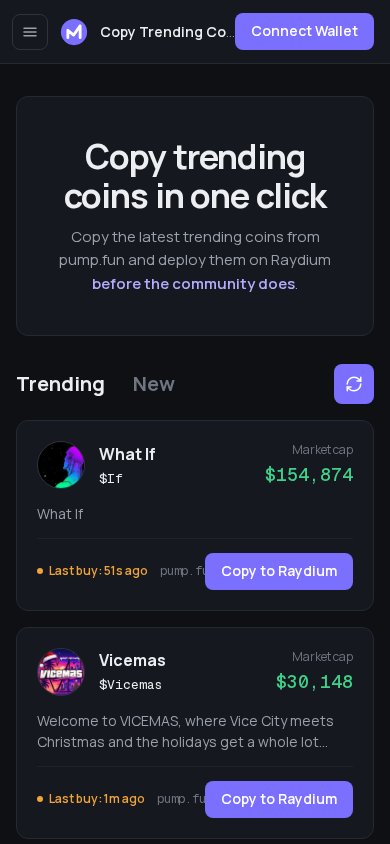
| How the site describes itself | MaxLaunch is a Solana web interface for creating SPL meme tokens, copying trending pump.fun coins to Raydium and managing liquidity. It is non-custodial and carries risk disclaimers, but it discloses no legal entity, address, regulator, contact channel or team, and it has an unresolved Phantom wallet warning. |
|---|
Evidence status and limitations
Evidence completeness: CompleteThis says whether every check on the site was recorded as finished. All of them were.
- The evidence was captured on 2026-11-11 and re-scored on 2026-11-16. The certificate, the registration age and the page content describe the site as it was on 2026-11-11.
- The real-world operator identity was not independently verified.
How to read these numbers
The trust score runs from 0 to 100, higher is safer. 3/100 rates the evidence found, not the probability that the site is a scam.
Evidence confidence (75%) measures how much of TrustSniffer's evidence set this site produced: the page reading, the browser sandbox, the web archive, the registration record and the reputation services. It falls when a check returns nothing, as listed above, and it does not change the score.
At a glance
The checks that decide most of this verdict.
| Malware engines | None flagged itVirusTotal | Clear |
|---|---|---|
| Google Safe Browsing | Not listedGoogle | Clear |
| Abuse reports on the host | 0% confidenceAbuseIPDB, 273 reports; shared hosting inflates reports | Clear |
| Domain age | 5 days oldRegistered 2026-11-06 | Risk |
| Web archive | Archived since 20262 snapshots; the archive has almost no record of this site, which counted against it | Watch |
| Certificate | Encrypted connectionIssued by YR2 | Noted |
The page as captured
Key findings
- Automated classification: Sensitive Interaction Risk, Governance Risk.
- Domain age: less than 1 year at capture (registered 2026-11-06).
- Public web-archive history exists since 2026.
- VirusTotal and Google Safe Browsing had no flags for this domain; its hosting IP carries AbuseIPDB reports below the confidence level TrustSniffer treats as a flag.
Full analysis
Overview
MaxLaunch presents itself as a Solana web interface for creating SPL meme tokens, copying trending pump.fun coins onto Raydium "before the community does", and managing liquidity. It describes itself as a free, non-custodial software interface that connects to a user's wallet and has the user sign on-chain transactions. The homepage runs a live feed of trending meme coins with market caps, a "Copy to Raydium" button on each, and navigation to a token studio, a liquidity manager, an "X Tracker", a Learn page, a FAQ, Terms of Use and a Privacy Policy.
Scam/Impersonation Risk: No contradictions were observed. There was no confirmed threat-list or phishing listing, no brand impersonation and no conflicting legal identities. This is a critical-risk site, but not for those reasons. The risk comes from the combination of a brand-new operation, a product that moves a visitor's funds, and an unusual set of behavioural findings. The pages show clear risk markers. The central mechanic is copying existing trending tokens, and the site itself states "A copy is a new, independent token, not the original project." The site's Terms disclaim responsibility for tokens that replicate existing tokens, brands or communities. This is a built-in route to look-alike tokens, and the site accepts no accountability for it. The Learn page says users must hold SOL to cover "network and platform fees", but no fee amount or recipient is stated on the pages read. The value flow is therefore opaque. A homepage banner says a wallet provider "may show a warning while we complete verification with their team — it's being resolved", while Connect Wallet and token creation are presented as live. The site's own pages thus ask visitors to proceed while a wallet-provider warning is still pending. The site also describes a copied token as carrying "No Hidden Allocations", a claim the pages do not support with any contract address. In automated browsing, the page layout and content changed substantially after interaction, and this was scored as a finding. The page also logged repeated console errors and sent data in 22 requests to other hosts, 9 of them to destinations TrustSniffer does not recognise. None of this is routine behaviour for the page. The page showed no login form and no sensitive-data form.A console error is a technical error message that the page's own code reported inside the browser while it ran. It describes how the page is built, and on its own it is not proof that the site is harmful.
Regulatory Verification Notes: The site presents itself as non-custodial. It states "We do not custody funds, execute transactions, provide financial advice, or guarantee outcomes" and "Use at your own risk." Terms of Use and Privacy Policy pages are present, with the Terms dated October 26, 2026, and these are the only expected disclosures found on the pages read. The Terms disclaim all liability for user-created tokens, liquidity outcomes and any financial, legal or regulatory consequences. The Privacy Policy says the site does not collect or store personal data or wallet credentials. On the pages read, no legal entity, regulator, registration, contact channel or team is named, and no token contract address is given. The only name shown is the product name, which is a claim by the site and not independent evidence of who operates it. Identity could not be verified, and the only signals available are the MaxLaunch name and the site's own identity statements. These are consistent with the site's own presentation but do not independently connect it to a real-world brand or person. Operator identity therefore remains unverified. No third-party regulatory or broker record was matched, and no licence is claimed. Because the service has users sign transactions that spend SOL, these gaps carry more weight than they would for a purely informational site.
What to Verify Next: Before any interaction, the token contract addresses involved should be located and checked directly on a public Solana block explorer, because the site does not publish one. The actual fee destination and amount should be established by inspecting the wallet's transaction preview before signing, since the site gives neither. The status of the pending wallet-provider verification should be confirmed with the wallet provider itself, not on the basis of the banner. Any claimed official channels should be reached by an independent route, and the existence of a responsible entity behind the product should be established before it is relied upon.
Summary Verdict: The site reads as a critical-risk property. Its operator is unverified, it launched only days before capture, and its pages contain claims the evidence does not support, together with scored behavioural findings that count against it. The technical hygiene of an encrypted, normally hosted site does not offset these weaknesses, and no external threat listing is involved in the assessment.
Infrastructure Integrity: The site resolves to a single IP address on an Amazon-operated network in the United States. No content-delivery layer was detected, which is neutral in itself. TrustSniffer also checked an abuse record for IP address 216.150.1.1, which is operated by Vercel, Inc (domain vercel.com). That address carries 273 abuse reports, a visible negative signal. These reports apply to the provider's shared address, not to this site. The address is whitelisted, has an abuse confidence score of 0, and the signal was discounted as shared infrastructure (reason: reports apply to shared provider IP). The reports are therefore not attributed to this site. The infrastructure is conventional and offers no evidence either for or against the operator's legitimacy.
Closing Assessment: The site should not be used to connect a wallet, sign transactions or commit any funds. Any look at it should stay read-only, with no assets exposed.
- Registration record: the domain was registered on 2026-11-06, 5 days before capture, with Porkbun LLC as registrar. The registrant and country fields were absent from the record.
- Web archive: 2 snapshots, first and last both on 2026-11-07 (span 0 days), so no meaningful history exists.
- Homepage: the pending wallet-provider verification banner sits alongside live Connect Wallet and token-creation controls.
- Learn page: fees are stated to apply, with no amount or recipient given.
- Terms of Use page: liability for user-created tokens, liquidity outcomes and regulatory consequences is disclaimed, and the page states that the wallet displays all fees before approval.
- Privacy Policy page: a wallet's public address may be visible during a session, and no personal data is said to be collected.
- Pages read (homepage, Terms, Privacy, Learn): no operator, regulator, team or contract-address disclosure.
- Hosting: served from AS16509 (Amazon-02, US). The site's TLS certificate is a domain-validated certificate issued by YR2, valid to 2027-02-04. This confirms an encrypted connection and says nothing about who operates the site.
- Learn page: platform fees are mentioned without an amount or recipient.
- Terms of Use page: the user's wallet is the only place where fees are said to be displayed.
- Homepage: the verification banner is the site's only reference to the wallet-provider review.
Written analysis generated 2026-11-16 by the TrustSniffer Analysis Engine from the evidence in this report.
What the analysis found
15 findings contributed to this verdict, raised by behaviour in a sandbox, page content, hosting and network, history in the web archive, and registration and ownership.
01 Behaviour in a sandbox
- During the sandbox session the page showed markedly different content to different visitor profiles. This can have ordinary causes such as bot defence, and it can also hide content from checks.Behaviour in a sandbox
rule:BEHAV_CLOAKING_STRONG - The page sent data to a destination TrustSniffer does not recognise.Behaviour in a sandbox
rule:BEHAV_NONWHITELISTED_POSTS - The page produced an unusually high number of errors while it ran.Behaviour in a sandbox
rule:BEHAV_CONSOLE_ERRORS_HIGH - The page made many background requests to other domains while it was open.Behaviour in a sandbox
rule:BEHAV_EXTERNAL_XHR_HEAVY - The page sent data to other domains many times while it was open.Behaviour in a sandbox
rule:BEHAV_EXTERNAL_POSTS_HEAVY - An automated reading of the page's network activity judged some requests unusual for this kind of page.Behaviour in a sandbox
02 Page content
- The page shows few of the signs expected from a trustworthy operator.Page content
rule:PAGE_TRUST_QUALITY_LOW - The page content shows three or more warning signs that deceptive sites commonly use.Page content
rule:PAGE_RED_FLAGS_STRONG - The page is about crypto and names several tokens, and it is not a news, education or documentation page.Page content
rule:PAGE_CRYPTO_TOKEN_HEAVY - The browser raised a warning while loading the page.Page content
rule:PAGE_BROWSER_FLAGS_SUSPICIOUS - The page has no description for search engines, which established sites usually provide.Page content
rule:PAGE_SEO_MISSING_META - The page carries none of the structured previews for search and social sharing that established sites usually provide.Page content
rule:PAGE_SEO_NO_STRUCTURED
03 Hosting and network
- The domain was registered, or a site on a hosting platform was first seen, less than three months before capture.Hosting and network
rule:DNS_NEW_DOMAIN_90D
04 History in the web archive
- The web archive has almost no record of this domain, which fits a site that is new.History in the web archive
rule:ARCH_PEN_YOUNG_AND_SPARSE
05 Registration and ownership
- The registration lookup did not return the domain's registrant and country.Registration and ownership
rule:KF_WHOIS_INCOMPLETE
How related findings were counted
Some findings above describe the same underlying fact, and some are weak on their own. TrustSniffer counts each such group under one shared limit, so one fact is not counted several times and weak signals stay bounded.
- Third-party connections: 3 findings share one limit, because they all measure one fact: the page loads files from other hosts. Together they stayed under the limit.
- Page quality: 2 findings share one limit, because each is weak evidence on its own. Together they stayed under the limit.
- Certificate and search-engine setup: 2 findings share one limit, because none of them is a sign of fraud on its own. Together they stayed under the limit.
Noted, not counted
Recorded during the assessment, but not counted against the site.
- AbuseIPDB: 273 reports on hosting IP 216.150.1.1 (AMAZON-02), 0% confidence. The reports are attributed to shared infrastructure, not specifically to this website.
Identity verification
| Status | UNVERIFIED |
|---|
The operator behind the site could not be connected to a real-world brand or person. What the page shows, if anything, is listed below; none of it was independently checked.
- org:MaxLaunch
- on_site_identity
What TrustSniffer observed
First-party facts recorded during the assessment of maxlaunch.app.
- The request stayed on maxlaunch.app. It was not redirected to another domain. Clear
- Registered through Porkbun LLC. Noted
- DNS for this domain is served by porkbun.com, across 4 name servers. Noted
- The domain is registered until 2027-11-06. Noted
- The earliest public archive of this site is from 2026-11-07. Watch
- It is hosted on AMAZON-02, a network registered in US. Noted
Domain intelligence
| Registrar | Porkbun LLC |
|---|---|
| Hosting | AMAZON-02 - Amazon.com, Inc. |
| Network registered in | US |
| Server IP | 216.150.1.1 |
| Name servers | curitiba.ns.porkbun.com, fortaleza.ns.porkbun.com, maceio.ns.porkbun.com, salvador.ns.porkbun.com |
| CDN / edge network | Not detected |
| Resolved IP addresses | 1 |
| Edge IP addresses | 0 |
| Likely origin IP addresses | 1 |
| SSL issuer | YR2 |
| SSL expiry | 2027-02-04 |
| Domain age | 5 days (registered 2026-11-06) |
| Domain expiry | 2027-11-06 |
| Archive first seen | 2026-11-07 (4 days before capture) |
| Archive snapshots | 2 |
| Reputation | VirusTotal: 0 malicious | AbuseIPDB: 0% confidence, 273 reports | Google Safe Browsing: 0 matches |
About this assessment
A trust score summarises the evidence TrustSniffer could collect about maxlaunch.app at a point in time: domain registration and age, hosting and certificate, the content the site served, and third-party reputation feeds. A high score means the signals were consistent with a legitimately operated site; a low or critical score means several risk patterns were present. It is a starting point for your own judgement, not a guarantee and not a legal finding. There is no human rating and no user review in it. A site can change after it is assessed.