Verdict
External threat listings named this site as malicious when the evidence was captured. Do not pay or share personal details with this site.
nodepro.pages.dev shows critical-risk indicators.
- Sensitive Interaction Risk: This label is given when the overall risk is high. The captured page did not ask for a password, card number or other sensitive details; if it ever does, entering them here could be unsafe.
- Governance Risk: A registration check came back incomplete: as a site on pages.dev, this address has no registration record of its own (the platform's domain is registered, not the site). That is a gap in what could be looked up, not a sign that ownership is hidden, and it does not say who runs the site.
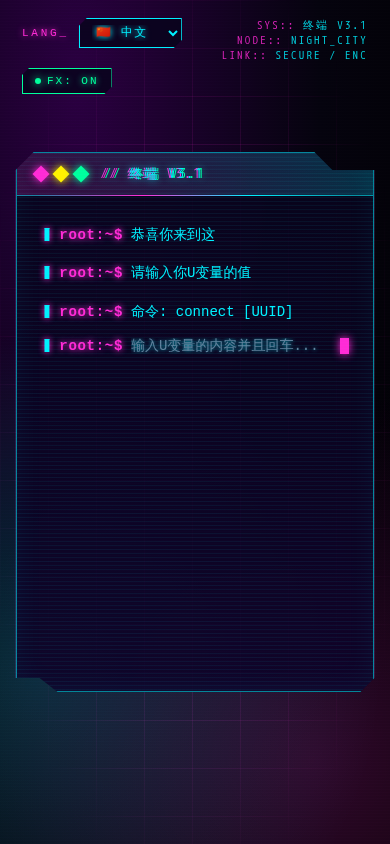
| How the site describes itself | A cyberpunk-styled terminal page with mostly unreadable character sequences, a language selector (Chinese, Persian), and a 'connect [UUID]' prompt. No product, service, business, or identity is described. |
|---|
Evidence status and limitations
Evidence completeness: CompleteThis says whether every check on the site was recorded as finished. All of them were.
- The evidence was captured on 2026-11-13 and re-scored on 2026-11-15. The certificate, the registration age and the page content describe the site as it was on 2026-11-13.
- External threat sources confirmed a listing for this site when the evidence was captured (VirusTotal, a threat-intelligence listing from a feed TrustSniffer monitors (phishing, the site itself as the source, last seen 2026-10-26)). It was not re-queried for this version. On its own it would limit the score to at most 24; the score is lower because of the other findings below.
- The real-world operator identity was not independently verified.
How to read these numbers
A trust score of 0 means the risk evidence outweighed every trust signal by more than the 0 to 100 scale can show. It rates the evidence found, not the probability that the site is a scam.
Evidence confidence (47%) measures how much of TrustSniffer's evidence set this site produced: the page reading, the browser sandbox, the web archive, the registration record and the reputation services. It falls when a check returns nothing, as listed above, and it does not change the score.
At a glance
The checks that decide most of this verdict.
| What limits the score | The findings belowThe confirmed external listing ceiling (at most 24) and the threat-listing ceiling (at most 5) also apply, but the findings brought the score lower. | Watch |
|---|---|---|
| Malware engines | 9 marked it malicious, 1 suspiciousVirusTotal; Fortinet, Sophos among the engines that flagged it | Risk |
| Google Safe Browsing | Not listedGoogle | Clear |
| Abuse reports on the CDN edge address | 0% confidenceAbuseIPDB, 0 reports; this is the record of the CDN edge address, not of the server behind it, which was not observed | Noted |
| Domain age | Not availableNo registration record was returned | Noted |
| Web archive | Never archivedNo public history of this site | Watch |
| Certificate | Encrypted connectionIssued by YE2 | Noted |
The page as captured
Key findings
- Automated classification: Sensitive Interaction Risk, Governance Risk.
- At least one reputation service TrustSniffer consulted had flagged this domain when the evidence was captured.
- The operator behind the site could not be independently connected to a real-world brand or person.
Full analysis
Security Alert
9 VirusTotal engines, including Fortinet, Sophos, marked this site as malicious; independent sources confirm a listing for this site.
Overview
The website is a single-page, cyberpunk-styled "terminal" interface served from a subdomain of Cloudflare's free Pages hosting platform. The page was titled "Terminal v3.1" (translated from Chinese). It showed long runs of unreadable katakana and symbol characters, a language selector offering Chinese and Persian, a greeting that translates as "Congratulations on arriving here", a prompt to "enter the value of your U variable", and a command line reading "connect [UUID]". The page described no product, price, company or service, so no business model could be established from what it presented.
Scam/Impersonation Risk
This is the decisive area, and it carries critical risk. The address was confirmed as listed for phishing, in the role of the actor distributing it rather than a bystander. The listing rests on two independent sources, a multi-engine reputation scan and a separate threat-intelligence listing, and the leading vendors Fortinet and Sophos were among the engines that flagged it. The listing was last seen on 26 October 2026, and the page itself was captured on 13 November 2026. The homepage showed no login form and no payment or data-entry form. It did show a terminal prompt asking visitors to supply a "U variable" value and a UUID to "connect". That is an unexplained request for an identifier, with no stated purpose, on a page that identifies no operator. The homepage's behaviour was not benign. Three suspicious inline scripts ran, and the page rewrote a very large part of its own structure after interaction. No requests went to other hosts and no data was sent elsewhere. No brand impersonation or conflicting legal identities were observed, so the risk rests on the confirmed listing and the page's behaviour, not on identity contradictions.
- VirusTotal: 9 engines rated the address malicious and 1 suspicious, including Fortinet and Sophos.
- Threat listing: a separate OSINT feed classes the address as phishing, role actor, last seen 2026-10-26.
- Homepage behaviour capture on 2026-11-13: 3 suspicious inline scripts and 2,361 structural changes after interaction, with zero external requests.
- Homepage content: the terminal prompt asks for a "U variable" value and a UUID ("connect [UUID]", translated) and explains neither.
Regulatory Verification Notes
On the single page read, the homepage, no contact channel and no terms or privacy information were found. The page names no operator, company or registration. It presents itself only through its title, "Terminal v3.1", which is a product-style label and not an identity, so the operator remains unverified. No licence or regulatory claim is made, so none can be assessed, and no third-party broker or regulator record matched this address. The address is a tenant subdomain of a free hosting platform, so it has no registration of its own to examine. A page that asks visitors to supply a value, yet offers no way to contact its operator and no stated terms, gives a visitor no recourse.
- Homepage: no contact channel and no terms or privacy information on the page read.
- Homepage: the only identity text is the title "Terminal v3.1" (translated), with no named operator.
- Transport layer: TLS certificate issued by YE2 (DV, domain validation only), valid at capture to 2027-01-18.
- Hosting: served from AS13335 (Cloudflare, Inc.), under the platform's shared Pages domain.
What to Verify Next
Anyone who received this address should confirm with the sender, through a separate channel they already trust, whether it was intended and what the "connect" step is for. They should also check whether any named organisation actually publishes a service at this address through its own official channels, because the page itself names none. Reporting the address to the hosting platform's abuse process is a reasonable step if it arrived unsolicited.
- Homepage: the prompt references a "U variable" and a UUID, but the page does not say who issues them.
- Homepage: no operator, contact route or terms were published for cross-checking.
- Threat listing: the phishing classification was last seen 2026-10-26.
Summary Verdict
The assessment is critical risk. Two sources, VirusTotal and the OSINT listing, confirm a listing for phishing distribution. The page is anonymous, asks for an unexplained identifier and showed suspicious script behaviour. Its transport encryption was technically sound and no outbound data transfers to other hosts were seen. The alert does not set the score, which is the sum of the scored findings. The operator's identity remains unverified, and nothing on the page supports a legitimate purpose.
Infrastructure Integrity
All four addresses observed for the site were Cloudflare edge addresses, and no origin server address was observable. Cloudflare's CDN is treated as neutral. It neither lowers nor raises the risk, and it says nothing about the content hosted behind it. Checking the host address's abuse record returned no reports, but that does not offset the listings against this specific page.
Closing Assessment
This address should not be used for anything beyond viewing. Do not supply any identifier, UUID or other value to its prompt, and do not follow links or instructions that point to it. Anyone who has already entered such a value should treat it as exposed and replace it where possible.
Written analysis generated 2026-11-15 by the TrustSniffer Analysis Engine from the evidence in this report.
What the analysis found
9 findings contributed to this verdict, raised by external reputation, page content, behaviour in a sandbox, and registration and ownership.
01 External reputation
- 9 VirusTotal engines, including a leading vendor (Fortinet, Sophos), marked this domain as malicious when the evidence was captured, which TrustSniffer counts as a confirmed external listing.External reputation
rule:EXT_BLACKLIST_CRITICAL
02 Page content
- The page shows few of the signs expected from a trustworthy operator.Page content
rule:PAGE_TRUST_QUALITY_LOW - The page runs on a free hosting-platform address instead of a domain of its own, a setup common to short-lived phishing and claim pages.Page content
rule:PAGE_FREE_PLATFORM_ADDRESS - The page has no description for search engines, which established sites usually provide.Page content
rule:PAGE_SEO_MISSING_META - The page carries none of the structured previews for search and social sharing that established sites usually provide.Page content
rule:PAGE_SEO_NO_STRUCTURED
03 Behaviour in a sandbox
- The page carried inline scripts written in a style TrustSniffer treats as suspicious.Behaviour in a sandbox
rule:BEHAV_SUSPICIOUS_INLINE_SCRIPTS - The structure of the page changed sharply during the sandbox session.Behaviour in a sandbox
rule:BEHAV_DOM_DENSITY_SPIKE - The page rewrote itself after it was interacted with, so what a visitor first sees is not what they end up on.Behaviour in a sandbox
rule:BEHAV_DOM_DIFF_AFTER_INTERACTION
04 Registration and ownership
- As a site on pages.dev, this address has no registration record of its own (the platform's domain is registered, not the site).Registration and ownership
rule:KF_WHOIS_INCOMPLETE
How related findings were counted
Some findings above describe the same underlying fact, and some are weak on their own. TrustSniffer counts each such group under one shared limit, so one fact is not counted several times and weak signals stay bounded.
- Page structure: 2 findings share one limit, because they describe one page structure. The limit applied, so together they counted for less than their sum.
- Certificate and search-engine setup: 2 findings share one limit, because none of them is a sign of fraud on its own. Together they stayed under the limit.
Identity verification
| Status | UNVERIFIED |
|---|
The operator behind the site could not be connected to a real-world brand or person. What the page shows, if anything, is listed below; none of it was independently checked.
- org:终端 V3 1
- on_site_identity
What TrustSniffer observed
First-party facts recorded during the assessment of nodepro.pages.dev.
- The request stayed on nodepro.pages.dev. It was not redirected to another domain. Clear
- It is hosted on CLOUDFLARENET, a network registered in US. Noted
Domain intelligence
| Registrar | Not available |
|---|---|
| Hosting | CLOUDFLARENET - Cloudflare, Inc. |
| Network registered in | US |
| Server IP | 2606:4700:310c::ac42:2cba (a CDN edge address; the server behind it was not observed) |
| Name servers | Not available |
| CDN / edge network | Detected (cloudflare) |
| Resolved IP addresses | 4 |
| Edge IP addresses | 4 |
| Likely origin IP addresses | 0 |
| SSL issuer | YE2 |
| SSL expiry | 2027-01-18 |
| First seen (web archive) | Not available (the web archive has no record of this address; a site on pages.dev has no registration of its own) |
| Domain expiry | Not available |
| Archive first seen | Not available |
| Archive snapshots | 0 |
| Reputation | VirusTotal: 9 malicious, 1 suspicious | AbuseIPDB (CDN edge address, not the host): 0% confidence, 0 reports | Google Safe Browsing: 0 matches |
About this assessment
A trust score summarises the evidence TrustSniffer could collect about nodepro.pages.dev at a point in time: domain registration and age, hosting and certificate, the content the site served, and third-party reputation feeds. A high score means the signals were consistent with a legitimately operated site; a low or critical score means several risk patterns were present. It is a starting point for your own judgement, not a guarantee and not a legal finding. There is no human rating and no user review in it. A site can change after it is assessed.