Verdict
An external threat listing named this site as malicious when the evidence was captured. Do not pay or share personal details with this site.
recoveryprotocols.xyz shows critical-risk indicators.
- Sensitive Interaction Risk: This label is given when the overall risk is high. The captured page did not ask for a password, card number or other sensitive details; if it ever does, entering them here could be unsafe.
- Governance Risk: The governance checks raised a concern: the kind of site it appears to be limits how high the score can go, because its operator could not be verified; a threat-intelligence listing limits the score; the domain's registration record withholds the owner's details. The findings below give the detail.
| How the site describes itself | A Finnish-language Google consent and redirect interstitial offering accept-all and reject-all controls, a notice that redirection may not activate, and Google service and language links. The supplied text shows no login form, payment request, or sensitive data entry. |
|---|
Evidence status and limitations
Evidence completeness: CompleteThis says whether every check on the site was recorded as finished. All of them were.
- The evidence was captured on 2026-11-04 and re-scored on 2026-11-05. The certificate, the registration age and the page content describe the site as it was on 2026-11-04.
- The real-world operator identity was not independently verified.
How to read these numbers
The trust score runs from 0 to 100, higher is safer. 5/100 rates the evidence found, not the probability that the site is a scam.
Evidence confidence (75%) measures how much of TrustSniffer's evidence set this site produced: the page reading, the browser sandbox, the web archive, the registration record and the reputation services. It falls when a check returns nothing, as listed above, and it does not change the score.
At a glance
The checks that decide most of this verdict.
| What limits the score | Business-model ceiling; Threat-listing ceilingTrustSniffer limits the score of a site whose operator it could not verify, according to the kind of site it appears to be; here that limit is what sets the score. A threat-intelligence feed TrustSniffer monitors listed a file on this site as malicious when the evidence was captured, and that listing caps the score. | Risk |
|---|---|---|
| Malware engines | None flagged itVirusTotal | Clear |
| Google Safe Browsing | Not listedGoogle | Clear |
| Abuse reports on the CDN edge address | 0% confidenceAbuseIPDB, 0 reports; this is the record of the CDN edge address, not of the server behind it, which was not observed | Noted |
| Domain age | 6 months oldRegistered 2026-05-06 | Watch |
| Web archive | 1 snapshot1 snapshot; the archive has almost no record of this site, which counted against it | Watch |
| Certificate | Encrypted connectionIssued by YE1 | Noted |
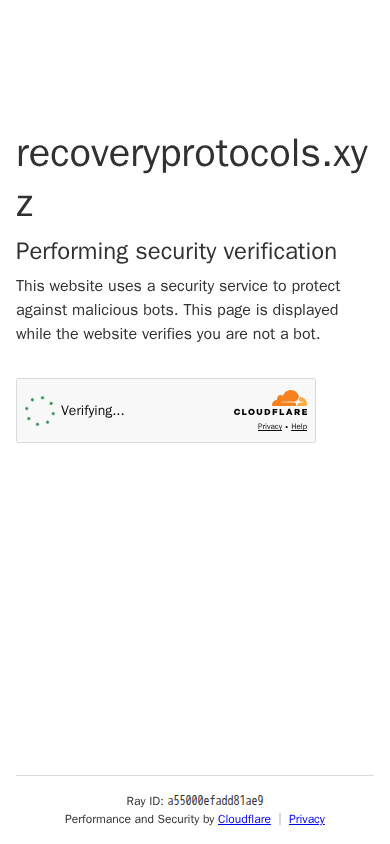
The page as captured
Key findings
- Automated classification: Sensitive Interaction Risk, Governance Risk.
- Domain age: less than 1 year at capture (registered 2026-05-06).
- No flags from the reputation services TrustSniffer consulted when the evidence was captured.
- The operator behind the site could not be independently connected to a real-world brand or person.
Full analysis
Overview
This website, served from a newly registered .xyz domain whose name suggests a recovery service, presents a Finnish-language Google-style consent and redirect page. The page offers accept-all and reject-all controls, a notice that automatic redirection may not activate, and links to Google services and language options. It shows no login form, payment request or product offer, so its apparent purpose is to act as a transit or landing page that hands visitors on to another destination.
Scam/Impersonation Risk
This is the decisive area. A threat-intelligence feed currently lists the site as the actor distributing phishing content. That is a direct finding about the site's own behaviour, not a sign that a third party compromised it, and it is the principal reason for the elevated risk assessment. The listing is active and recent, and it outweighs every benign element of the page. The page itself looks harmless: the supplied text has no credential form, payment prompt or deceptive call to action. This fits a phishing staging or redirect page, which can look clean until a visitor is forwarded onward. The consent text, branding and language menus reproduce a major search provider's interface, yet the domain has no connection to that provider. The analysis did not formally flag brand impersonation, but this mismatch between the page's presentation and the domain's identity adds weight to the listing. The page's own behaviour points the same way: the delayed-redirect notice, and a large share of network activity going to third-party hosts rather than to the site itself. Reputation checks from other major sources returned no malicious detections and one suspicious flag, which is thin corroboration and does not offset the active listing.
- Homepage: a consent and redirect interstitial with accept-all and reject-all controls and a "redirection may not activate" notice, with no login or payment form.
- Domain registration: registered 2026-05-06 (~0.5 years old) through NameSilo, LLC, a young domain with a recent registration.
- Web archive: 1 snapshot, dated 2026, covering 1 year tracked, so there is no meaningful operating history.
- Threat listing: active phishing-class listing with the site as actor, last seen 2026-10-25.
Regulatory Verification Notes
The page makes no claim of licensing, regulation or corporate registration, and no legal, terms or about pages were captured. The only content is the borrowed consent interface, so no operator is named and no regulatory standing can be assessed. Registration privacy is an administrative detail here and is not treated as a flaw. No third-party broker or regulatory-database entry exists for the site, so there is no reputational signal from that source in either direction. The site's technical hygiene is routine and does not offset the threat listing. Its transport encryption is valid but of the basic domain-validated kind, which confirms only that the connection is encrypted, not who runs the site.
- Transport encryption: TLS certificate issued by YE1 (DV), valid to 2027-01-28.A TLS certificate is what puts the padlock and https:// in your browser and encrypts the connection. "YE1" is the name of the authority that issued it. DV (domain validated) means the issuer only confirmed who controls the domain name, not which person or company runs the site. "Valid to" is the date it expires.
- Hosting: served from AS13335 (CLOUDFLARENET, Cloudflare, Inc., US).
- Domain record: expires 2027-05-06 and is registered under a privacy-protection service.
- Homepage: no licence, company name or registration number appears, and no legal pages were captured.
What to Verify Next
Before any engagement, the first step is to establish why the domain is serving a page styled after another company's service, and who operates it. Anyone who reached the site through an email, message or advertisement should confirm out of band with the supposed sender that the link was genuine. Anyone who arrived through a search result or a recovery-service offer should independently confirm that such a service exists, using contact details from a source that does not come from this site. Recovery-themed names are a common lure, so the claim of any recovery or restitution service should be treated as unproven. Users who have already interacted with the site should review any information they entered, and should change passwords and enable multi-factor authentication on accounts that could be affected.
- Homepage: the page presents another brand's consent interface under an unrelated domain name.
- Threat listing: the active phishing-class listing was still current at the time of analysis.
- Domain registration: the domain is about six months old, with no operator identity connected to it.
Summary Verdict
The site is assessed as high-risk. It is a young, unestablished domain carrying a current threat-intelligence listing for phishing activity, and its identity cannot be tied to any real-world brand or person. The unremarkable page content and clean technical configuration do not outweigh that listing, and the site presents a clear risk for any sensitive interaction.
Infrastructure Integrity
The site sits behind Cloudflare's CDN and WAF, and all observed addresses are edge servers, so the origin host could not be observed. Bot-protection filtering was also detected. This is a mitigating factor only. It shows the domain is competently fronted, but it neither establishes legitimacy nor offsets the active threat listing. It also means the content served can change quickly behind the edge without any visible change in hosting.
Closing Assessment
The site should be treated as unsafe for any sign-in, credential entry, payment or file download. At most it may be viewed briefly without interaction, and ideally not at all. Links to it should not be followed from unsolicited messages.
Written analysis generated 2026-11-05 by the TrustSniffer Analysis Engine from the evidence in this report.
What the analysis found
6 findings contributed to this verdict, raised by governance, history in the web archive, behaviour in a sandbox, page content, and registration and ownership.
01 Governance
- TrustSniffer limits the score of a site whose operator it could not verify, according to the kind of site it appears to be; here that limit is what sets the score.Governance
rule:gov_business_model_cap - A threat-intelligence feed TrustSniffer monitors listed a file on this site as malicious when the evidence was captured, and that listing caps the score.Governance
rule:gov_active_threat_listing
02 History in the web archive
- The web archive has almost no record of this domain, which fits a site that is new.History in the web archive
rule:ARCH_PEN_YOUNG_AND_SPARSE
03 Behaviour in a sandbox
- Most of the files the page loaded (scripts, images, fonts) came from other domains. This is about where its content is hosted, not about data being sent elsewhere.Behaviour in a sandbox
rule:BEHAV_EXTERNAL_RATIO_HIGH
04 Page content
- The browser raised a warning while loading the page.Page content
rule:PAGE_BROWSER_FLAGS_SUSPICIOUS
05 Registration and ownership
- The registration record withholds contact details for the operator.Registration and ownership
rule:KF_WHOIS_HIDDEN
Identity verification
| Status | UNVERIFIED |
|---|
The operator behind the site could not be connected to a real-world brand or person. What the page shows, if anything, is listed below; none of it was independently checked.
- No contact detail, company registration number or linked social profile was extracted from the page for checking. Any operator the page names in its own words (see how the site describes itself, above) is not verified here.
What TrustSniffer observed
First-party facts recorded during the assessment of recoveryprotocols.xyz.
- The request for recoveryprotocols.xyz ended on www.google.com, a different domain. Watch
- Registered through NameSilo, LLC. Noted
- DNS for this domain is served by ns.cloudflare.com, across 2 name servers. Noted
- The domain is registered until 2027-05-06. Noted
- It is hosted on CLOUDFLARENET, a network registered in US. Noted
Domain intelligence
| Registrar | NameSilo, LLC |
|---|---|
| Hosting | CLOUDFLARENET - Cloudflare, Inc. |
| Network registered in | US |
| Server IP | 2606:4700:3037::6815:2b1a (a CDN edge address; the server behind it was not observed) |
| Name servers | rosa.ns.cloudflare.com, michael.ns.cloudflare.com |
| CDN / edge network | Detected (cloudflare) |
| Resolved IP addresses | 4 |
| Edge IP addresses | 4 |
| Likely origin IP addresses | 0 |
| SSL issuer | YE1 |
| SSL expiry | 2027-01-28 |
| Domain age | 182 days (registered 2026-05-06) |
| Domain expiry | 2027-05-06 |
| Archive first seen | Not available |
| Archive snapshots | 1 |
| Reputation | VirusTotal: 0 malicious | AbuseIPDB (CDN edge address, not the host): 0% confidence, 0 reports | Google Safe Browsing: 0 matches |
About this assessment
A trust score summarises the evidence TrustSniffer could collect about recoveryprotocols.xyz at a point in time: domain registration and age, hosting and certificate, the content the site served, and third-party reputation feeds. A high score means the signals were consistent with a legitimately operated site; a low or critical score means several risk patterns were present. It is a starting point for your own judgement, not a guarantee and not a legal finding. There is no human rating and no user review in it. A site can change after it is assessed.