Verdict
This assessment found strong scam indicators. Do not pay, sign in, or share personal details with this site.
royaleuro-finance.com shows high-risk / scam indicators.
| What this site appears to be | Royal Euro (REURO) is a self-described EUR-pegged stablecoin and DeFi staking protocol on the TRON network. It offers staking tiers advertised at 7.5% to 18% APY, requires a crypto wallet connection, and cites audits, reserves, and a bug bounty without verifiable legal entity, custodian, or contract evidence. Its reserve, peg, and admin-control claims conflict with each other, and staking is a high-stakes financial action. |
|---|
Evidence status and limitations
Evidence completeness: Not recorded
- The real-world operator identity was not independently verified.
- Module-level completeness metadata is unavailable for this legacy report.
At a glance
The checks that decide most of this verdict.
| Malware engines | 16 flagged itVirusTotal | Risk |
|---|---|---|
| Google Safe Browsing | Not listedGoogle | Clear |
| Abuse reports on the host | 0% confidenceAbuseIPDB, 0 reports; shared hosting inflates reports | Clear |
| Domain age | 3 months oldMost scam domains are under a year old | Risk |
| Web archive | Archived since 20261 snapshot | Clear |
| Certificate | Encrypted connectionIssued by WE1 | Noted |
The page as captured
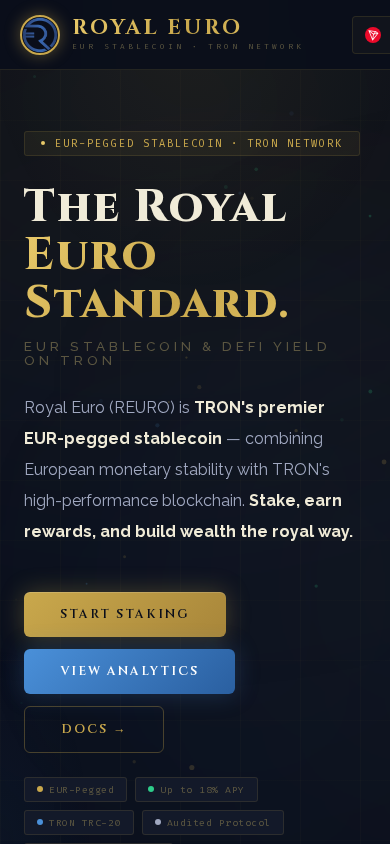
Key findings
- Automated classification: Sensitive Interaction Risk.
- Domain age: less than 1 year (registration continuity).
- Public web-archive history exists since 2026.
- At least one reputation service TrustSniffer consulted had flagged this domain at assessment time.
Full analysis
Security Alert
Fortinet, Sophos flagged this site in external intelligence checks, indicating elevated compromise/scam exposure that requires immediate caution.
Royal Euro is a single-page staking application that presents itself as a EUR-pegged stablecoin ("REURO") and DeFi yield protocol on the TRON network. Its homepage promotes "Premium Stablecoin & DeFi Protocol" branding, a "Start Staking" call to action, and a wallet-connection flow. Its apparent business model is to have visitors mint or buy REURO and lock it in staking tiers advertised at 7.5% to 18% APY. The site says it earns revenue from protocol fees and early-exit penalties of 1% to 5%.
Scam/Impersonation Risk
This site shows confirmed adverse contradictions. Multiple independent security vendors currently flag the domain as malicious, and the overall reputation picture amounts to a confirmed blacklist listing. This is the decisive factor in the assessment. No brand impersonation, phishing form, or conflicting legal identity was observed, so the risk comes from the blacklist and from the site's own content. That content shows claim-versus-evidence dissonance around a deposit-first product. The homepage advertises a 1:1 peg that is "fully backed", yet also describes 104% overcollateralization and algorithmic stabilization, which are different mechanisms. It states that there are "no admin keys", yet describes a 5-of-9 multisig emergency pause, which is a form of administrative control. It promotes EUR reserves, yet tells users to mint with USDT or USDC. The yield of up to 18% APY is attributed to protocol fees, "reserve asset management", and a launch community pool, none of which can be traced or independently confirmed. The wallet-connection FAQ tells visitors that "we never have access to your funds", but the site gives no verifiable contract address to support that claim. During behavioral testing the page also sent a notable share of its network traffic, including POST requests, to non-whitelisted third-party destinations. A staking and transaction-signing flow of this kind therefore carries a real risk of financial loss. Evidence:
- Homepage (staking dApp): the "Up to 18% APY" headline, the 7.5%–18% tiers, and the 1%–5% early-exit penalties are presented with no named custodian, legal entity, or contract reference.
- Homepage claims: the "fully backed" 1:1 peg conflicts with the stated 104% overcollateralization and algorithmic stabilization. "No admin keys" conflicts with the 5-of-9 multisig emergency pause.
- Behavioral test of the homepage: 3 of 12 external POST requests and 3 of 12 external XHR requests went to non-whitelisted destinations.
- Reputation checks: 16 security engines rated the domain malicious and 2 suspicious. Two tier-one security vendors were among them.
Regulatory Verification Notes
The homepage names no operating company, jurisdiction, license, or registration number. It cites "audits", "proof of reserves", and a bug bounty without linking any report, attestation, auditor name, or reserve custodian. Because the product is a EUR-referenced stablecoin offering yield, its absence of any regulatory standing or disclosed legal entity is material. No third-party broker or regulatory record corroborates the site. Its governance claims ("DAO governance", multisig control) cannot be reconciled with any identified responsible party. Identity remains unverified, and nothing on the site connects the protocol to a real-world operator. Taken alone, a missing license is a verification gap rather than proof of fraud. Here it adds to the adverse signals above rather than offsetting them. Evidence:
- Domain registered 2026-07-31 (~0.22 years old, roughly 82 days) through the registrar Atak Domain, with expiry set for 2027-07-31.
- Web archive: 1 snapshot, captured 2026-08-05, spanning 1 year tracked. No earlier history exists.
- Hosting network AS13335 (Cloudflare, Inc., US). TLS certificate issued by WE1 (DV, domain validation only), valid to 2026-12-27.
- Homepage: no legal entity, license number, custodian, audit report link, or contract address is published.
What to Verify Next
The protocol's claims should be tested against independent sources before any interaction. First, any contract address cited by the project should be located through an independent route and checked on a public TRON blockchain explorer. That check should cover who controls the contract, whether the multisig is real, and whether the supply and reserves match the claims. Second, the named audit and bug bounty should be confirmed directly with the audit firms or bounty platform, not through links on this site. Third, the reserve custodian and the legal issuer of the stablecoin should be checked against the public registers of the relevant European and national financial regulators. Fourth, official contact and support channels should be confirmed through an independent, offline route. Evidence:
- Homepage: "Audited Protocol", the bug bounty, and proof-of-reserves claims appear without any attached report or attestation.
- Homepage: the stated reward sources are protocol fees, reserve asset management, and a launch community pool, none of which are quantified or independently verifiable.
- Homepage: the site makes the 1:1 backing claim and the overcollateralization claim without naming a custodian or publishing reserve data.
Summary Verdict
The site is assessed as high risk, with a decisive adverse reputation record and a very young, thinly evidenced presence. Its deposit-first staking model rests on internally inconsistent claims. Technical hygiene such as valid encryption does not offset these findings. The overall posture is clearly cautionary, and the site is not considered suitable for any financial or credential-bearing interaction.
Infrastructure Integrity
The site is served entirely from Cloudflare's CDN/WAF network. All four observed addresses are CDN edge servers and no origin server was observable, so the real hosting location cannot be independently verified. This also means the underlying content could be swapped quickly without any visible change in hosting. The protection is a mitigating factor only, as it shows the site is behind mainstream infrastructure. It does not offset the external threat detections or the weak provenance. A heuristic flag for a young domain with sparse subdomains is consistent with the domain's age but is not a confirmed risk on its own.
Closing Assessment
The site should not be used for wallet connection, token minting, staking, or any transfer of funds, and no credentials or signing approvals should be given to it. Anyone who has already connected a wallet or signed a transaction should revoke the token approvals and move any exposed assets to a fresh wallet. Visiting the page for read-only observation is the only low-exposure use.
Written analysis generated 2026-10-21 by the TrustSniffer Analysis Engine from the evidence in this report.
What the analysis found
4 findings contributed to this verdict, raised by external reputation, page content, hosting and network, history in the web archive.
01 External reputation
- An external threat feed lists this domain: either Google Safe Browsing marked it malicious, or a significant number of malware engines flagged it.External reputation
rule:EXT_BLACKLIST_CRITICAL
02 Page content
- The page shows few of the signs expected from a trustworthy operator.Page content
rule:PAGE_TRUST_QUALITY_LOW - The page content shows three or more warning signs that deceptive sites commonly use.Page content
rule:PAGE_RED_FLAGS_STRONG - The review of the page content rated it moderate risk.Page content
rule:PAGE_RISK_MED
03 Hosting and network
- The domain was registered less than three months ago.Hosting and network
rule:DNS_NEW_DOMAIN_90D
04 History in the web archive
- The web archive has almost no record of this domain, which fits a site that is new.History in the web archive
rule:ARCH_PEN_YOUNG_AND_SPARSE
Identity verification
| Status | UNVERIFIED |
|---|---|
| Identity score | 30/100 |
| Identity verification confidence | 50% |
- No on-site identity signals detected
Identity verification measures whether the site can be independently connected to a real-world brand or person. It is separate from the classification confidence.
What TrustSniffer observed
First-party facts recorded during the assessment of royaleuro-finance.com.
- The request stayed on royaleuro-finance.com. It was not redirected to another domain. Clear
- Registration is published under Atak Domain. Clear
- DNS for this domain is served by cloudflare.com, across 2 name servers. Noted
- The registration is paid up to 2027-07-31. Noted
- The earliest public archive of this site is from 2026-08-05. Clear
- It is hosted on CLOUDFLARENET, from a server in US. Noted
Domain intelligence
| Registrar | Atak Domain |
|---|---|
| Hosting | CLOUDFLARENET - Cloudflare, Inc., US |
| Country | US |
| Server IP | 2606:4700:3036::ac43:c4a6 |
| Name servers | ELIJAH.NS.CLOUDFLARE.COM, TEAGAN.NS.CLOUDFLARE.COM |
| CDN / edge network | Detected (cloudflare) |
| Resolved IP addresses | 4 |
| Edge IP addresses | 4 |
| Likely origin IP addresses | 0 |
| SSL issuer | WE1 |
| SSL expiry | 2026-12-27 |
| Domain age | 0.22 years (continuous registration) |
| Domain expiry | 2027-07-31 |
| Archive first seen | 2026-08-05 |
| Archive snapshots | 1 |
| Reputation | VirusTotal: 16 flagged | AbuseIPDB: 0% confidence, 0 reports | Google Safe Browsing: 0 matches |
About this assessment
A trust score summarises the evidence TrustSniffer could collect about royaleuro-finance.com at assessment time. It is a starting point for your own judgement, not a guarantee: a high score means the signals were consistent with a legitimately operated site, a low or critical score means several risk patterns were present.
TrustSniffer assesses a website from the evidence it can collect at a point in time: domain registration and age, hosting and certificate, the content the site served, and third-party reputation feeds. A score is a summary of that evidence, not a guarantee and not a legal finding. There is no human rating and no user review in it. A site can change after it is assessed.