Verdict
unisa.ac.za is moderately trusted.
Most signals looked ordinary, and some evidence was missing. Read the checks below before you pay or hand over personal details.
| What this site appears to be | Official Unisa university website pages including information on admissions, colleges, research, news, events and contact details. Primarily informational and institutional. |
|---|
Evidence status and limitations
Evidence completeness: UNKNOWN
- The real-world operator identity was not independently verified.
- Module-level completeness metadata is unavailable for this legacy report.
At a glance
The checks that decide most of this verdict.
| Malware engines | None flagged itVirusTotal | Clear |
|---|---|---|
| Google Safe Browsing | Not listedGoogle | Clear |
| Abuse reports on the host | 0 reportsAbuseIPDB; shared hosting inflates this count | Noted |
| Domain age | Not availableNo registration record was returned | Noted |
| Web archive | Never archivedNo public history of this site | Watch |
| Certificate | Encrypted connectionIssued by HARICA DV TLS ECC | Noted |
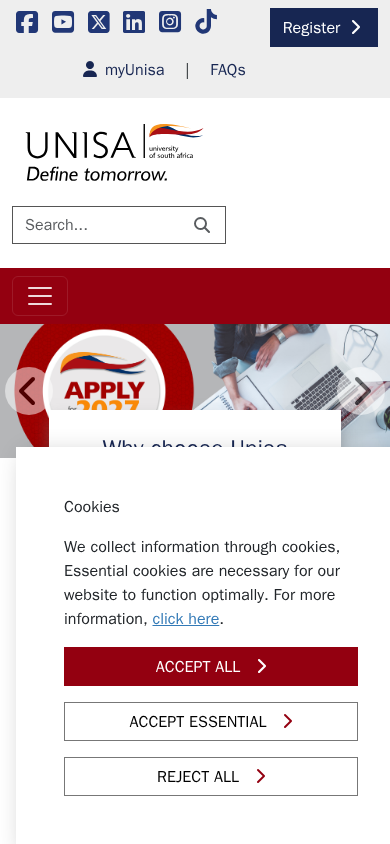
The page as captured
Key findings
- Automated classification: Governance Risk.
- No flags from the reputation services TrustSniffer consulted at assessment time.
- The operator behind the site could not be independently connected to a real-world brand or person.
Full analysis
Overview
This is the Unisa website, an academic and institutional portal presenting admissions guidance, registration, qualifications, research, governance, news, student services, and contact information. Its apparent purpose is to support public university administration, education delivery, and institutional communication rather than direct consumer investment or commercial trading.
Scam/Impersonation Risk
No confirmed phishing, blacklist, malware, or impersonation contradiction was observed. The site consistently presents itself as Unisa and provides coherent university-related content, including admissions, colleges, research, governance, legislation, and student services. A page-similarity signal associated some content with another prominent institutional brand, but this did not produce a confirmed identity conflict; the broader page content, domain context, and observed behavior support the interpretation of an academic website. External reputation checks were clean, the site has a top-tier global traffic footprint, and its page authority is established at a mid-level. The resulting posture is therefore cautious but not accusatory: the apparent institutional purpose is credible, while independent operator identity remains unverified.
- The homepage and institutional pages identify Unisa and provide university-specific sections for admissions, research, governance, employment, legislation, and student services.
- The site behavior showed no login form, hidden form, external password submission, wallet connection, clipboard manipulation, or suspicious script activity.
- External checks recorded zero malicious and zero suspicious detections, with no confirmed blacklist or phishing result; the site’s traffic rank was 7633.
Regulatory Verification Notes
The site’s stated model is education and institutional services, not a regulated financial offering. Its legal and identity navigation includes the Institutional Statute, legislation, terms and conditions, access-to-information material, privacy information, an email legal notice, and an ombudsman function, which are substantive governance disclosures. No financial or other specialist operating licence is claimed in the supplied content; for the stated university model, this is a transparency and institutional-verification matter rather than evidence of a scam. The real-world operator identity is not independently verified by the available evidence, so the site’s institutional presentation should be treated as apparent rather than conclusive. No adverse broker-related reputational signal was identified. Transport security is valid but uses domain validation rather than an organisation-validated certificate.
- The About, Governance, Legislation, Terms and Conditions, and privacy-related pages provide institutional and legal content, including the Institutional Statute and ombudsman information.
- The site’s TLS certificate is issued by HARICA DV TLS ECC, uses DV validation, and is valid to 2027-02-11.
- The site presents an academic business model comprising course listings, admissions guidance, research, institutional news, tuition-related information, and student services.
What to Verify Next
Before sensitive account or payment activity, independently confirm that the relevant admissions, registration, and payment instructions are current through an official institutional channel obtained separately from the web session. For higher-value engagements, confirm the institution’s legal status and authorised contact points through an appropriate academic or public-sector registry, and ensure that any payment beneficiary corresponds to the institution rather than an unrelated intermediary.
- The admissions pages include application, registration, student-fee, funding, and payment-method information that can be cross-checked independently.
- The Contact and Regional Centres material provides the basis for validating official communication routes.
- The About, Governance, and Legislation pages identify the institutional framework that should be matched against an independent public or academic record.
Summary Verdict
The website presents a coherent, established-looking academic service and no active threat or impersonation contradiction was observed. Its overall posture is moderate trust: suitable for ordinary informational use, but not sufficient on the available evidence to establish the real-world operator identity conclusively.
Infrastructure Integrity
The site resolves directly to one identified host rather than through a CDN or WAF edge. Hosting is provided by TENET (The UNINET Project) in South Africa, and the direct infrastructure attribution is consistent with an academic web presence; the absence of a CDN is a technical characteristic, not evidence of maliciousness.
- Hosted on AS2018, TENET (The UNINET Project), ZA; resolved IP: 163.200.81.55.
- Infrastructure data records one unique IP, zero edge IPs, one likely origin IP, and no detected CDN or WAF vendor.
- TLS is provided by HARICA DV TLS ECC with DV validation and expiry at 2027-02-11T13:27:44+00:00.
Closing Assessment
Routine browsing and academic information gathering may proceed, while sensitive account, registration, or payment actions should follow the independent institutional and contact-channel checks described above.
Written analysis generated 2026-08-17 by the TrustSniffer Analysis Engine from the evidence in this report.
What the analysis found
1 finding contributed to this verdict, raised by registration and ownership.
01 Governance Risk
- A widely visited domain with no public registration record, which is unusual at that level of traffic.Registration and ownership
rule:KF_WHOIS_MISSING_HIGH_RANK
Identity verification
| Status | UNVERIFIED |
|---|---|
| Identity score | 55/100 |
| Identity verification confidence | 60% |
- Identity verified on page
Identity verification measures whether the site can be independently connected to a real-world brand or person. It is separate from the classification confidence.
What TrustSniffer observed
First-party facts recorded during the assessment of unisa.ac.za.
- The request stayed on unisa.ac.za. It was not redirected to another domain. Clear
- It is hosted on TENET (The UNINET Project), from a server in ZA. Noted
Domain intelligence
| Registrar | Not available |
|---|---|
| Hosting | TENET (The UNINET Project) - TENET (The UNINET Project), ZA |
| Country | ZA |
| Server IP | 163.200.81.55 |
| Name servers | Not available |
| SSL issuer | HARICA DV TLS ECC |
| SSL expiry | 2027-02-11 |
| Domain age | Not available (no registration date was returned) |
| Domain expiry | Not available |
| Archive first seen | Not available |
| Archive snapshots | 0 |
| Reputation | VirusTotal: 0 flagged | AbuseIPDB: 0 reports | Google Safe Browsing: 0 matches |
About this assessment
A trust score summarises the evidence TrustSniffer could collect about unisa.ac.za at assessment time. It is a starting point for your own judgement, not a guarantee: a high score means the signals were consistent with a legitimately operated site, a low or critical score means several risk patterns were present.
TrustSniffer assesses a website from the evidence it can collect at a point in time: domain registration and age, hosting and certificate, the content the site served, and third-party reputation feeds. A score is a summary of that evidence, not a guarantee and not a legal finding. There is no human rating and no user review in it. A site can change after it is assessed.