Verdict
An external threat listing named this site as malicious when the evidence was captured. Do not pay or share personal details with this site.
v3vaultloop.pages.dev shows critical-risk indicators.
- Sensitive Interaction Risk: This label is given when the overall risk is high. The captured page did not ask for a password, card number or other sensitive details; if it ever does, entering them here could be unsafe.
- Governance Risk: A registration check came back incomplete: as a site on pages.dev, this address has no registration record of its own (the platform's domain is registered, not the site). That is a gap in what could be looked up, not a sign that ownership is hidden, and it does not say who runs the site.
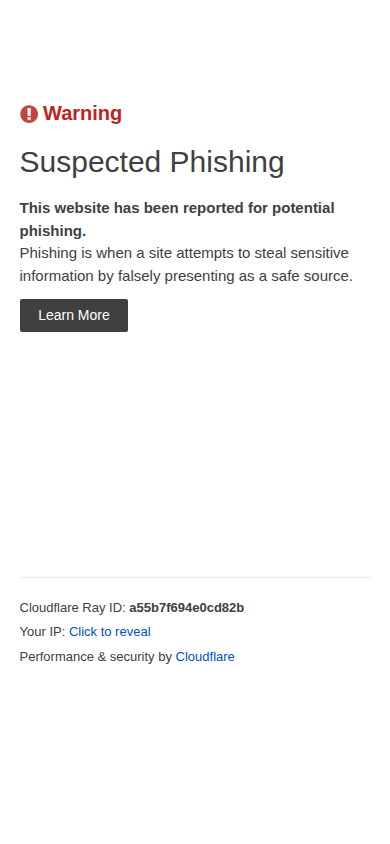
| How the site describes itself | This is a Cloudflare 'Suspected Phishing' warning page stating that the requested site has been reported for potential phishing. The capture contains no login form, offers, or descriptive content about the underlying service, so the target site cannot be assessed. |
|---|
Evidence status and limitations
Evidence completeness: CompleteThis says whether every check on the site was recorded as finished. All of them were.
- The real-world operator identity was not independently verified.
How to read these numbers
A trust score of 0 means the risk evidence outweighed every trust signal by more than the 0 to 100 scale can show. It rates the evidence found, not the probability that the site is a scam.
Evidence confidence (75%) measures how much of TrustSniffer's evidence set this site produced: the page reading, the browser sandbox, the web archive, the registration record and the reputation services. It falls when a check returns nothing, as listed above, and it does not change the score.
At a glance
The checks that decide most of this verdict.
| Malware engines | 12 marked it maliciousVirusTotal | Risk |
|---|---|---|
| Google Safe Browsing | Not listedGoogle | Clear |
| Abuse reports on the CDN edge address | 0% confidenceAbuseIPDB, 0 reports; this is the record of the CDN edge address, not of the server behind it, which was not observed | Noted |
| First seen | 2.5 years before captureWeb archive; a site on pages.dev has no registration of its own | Clear |
| Web archive | Archived since 202414 snapshots | Clear |
| Certificate | Encrypted connectionIssued by WE1 | Noted |
The page as captured
Key findings
- Automated classification: Sensitive Interaction Risk, Governance Risk.
- First seen: 1 to 3 years before capture (web archive; a site on pages.dev has no registration of its own).
- Public web-archive history exists since 2024.
- At least one reputation service TrustSniffer consulted had flagged this domain when the evidence was captured.
Full analysis
Security Alert
Fortinet, Kaspersky, Sophos flagged this site in external intelligence checks, indicating elevated compromise/scam exposure that requires immediate caution.
Overview
This website is a subdomain on a free, shared application-hosting platform whose address suggests a vault or "loop" style online service. On the capture, visitors do not reach the site's own content. They see a security interstitial headed "Suspected Phishing", which states that the site has been reported for potential phishing. The capture shows no product description, pricing, login form, or business model, so the site's purpose cannot be determined. What the capture does show is a destination that a protective network layer has flagged and blocked.
Scam/Impersonation Risk
Confirmed contradictions are present, and the posture is clearly cautionary. The site is blacklisted: a substantial number of independent security engines classify it as malicious. These include several top-tier vendors, and the volume of detections alone meets the threshold for the strongest reputational penalty. The interstitial reinforces this. The site's own edge-network layer has intercepted visitors and warned that the destination attempts to steal sensitive information while posing as a safe source. No conflicting legal entities appear and no specific brand impersonation was confirmed, so there is no identity contradiction. The weight of the risk comes from the blacklisting and the phishing report. The site's address sits on a shared hosting platform and closely resembles that platform's own domain, which means a throwaway tenant can borrow the platform's familiarity. Behavioral testing recorded no wallet-connection prompts, clipboard tampering, hidden forms, or cross-site password forms. That absence does not offset the external findings, because the real service sits behind the warning and was not exercised. Heavy third-party request traffic was observed (nearly all requests went to external destinations), together with large DOM changes after interaction and repeated console errors. This is consistent with a script-driven page that is not behaving like a simple static site.A console error is a technical error message that the page's own code reported inside the browser while it ran. It describes how the page is built, and on its own it is not proof that the site is harmful.
- Homepage: the capture is a "Suspected Phishing" warning stating the site "has been reported for potential phishing", with no legal, contact, or service content.
- External reputation: 12 engines rated the site malicious and 2 suspicious, including three leading security vendors, which triggered the strictest blacklist ceiling.
- Homepage behavior: 81 external data requests, up to 96.8% of requests going to external hosts, 1,508 DOM mutations after interaction, and 12 console errors across 3 runs.
- Domain provenance: registered about 2.5 years ago (first observed April 2024), with 14 archive snapshots over 2024–2026 (3 years tracked), so there is a modest, continuous history but no established reputation.
Regulatory Verification Notes
No licensing claim, registration number, or regulatory affiliation is present in the capture, because the visible page is only a warning notice. Ownership and governance are opaque, and the operator cannot be tied to any real-world person or organization. Hosting on a shared platform subdomain provides no corporate identity of its own. No broker-database match exists, so there is no third-party broker reputation to weigh. The only reputational signals are the adverse security detections and the phishing report. The site's technical hygiene is ordinary and offers no reassurance about legitimacy. A valid but basic domain-validated certificate says only that the connection is encrypted, and it confirms nothing about who operates the site.
- Homepage: no company name, license, address, or jurisdiction appears anywhere in the captured content.
- Site hosting: served from AS13335 (Cloudflare, Inc., US), a shared platform with no operator-specific identity.
- Transport encryption: TLS certificate issued by WE1 at DV level, valid to 2026-12-08 (32 days remaining).
- Domain registration: the registrant is not identifiable, and the domain is a subdomain of a shared hosting service.
What to Verify Next
Any contact that directed a person to this address should be treated as unverified until the sender is authenticated through an independent channel, such as a known phone number or an official website reached by typing its address directly. If the site claims to be a branded vault, wallet, or financial service, the claimed brand's official domain should be confirmed from the brand's own verified materials, not from links in messages. Official support channels should be confirmed the same way. Anyone who has already interacted with the site should review their accounts and rotate credentials. Phishing reports should be filed with the relevant platform and national cyber-incident authority.
- Homepage: the interstitial indicates the site has been reported, so the original message or advertisement that led to it is a relevant artifact to preserve.
- Domain: the address is a tenant subdomain, so it cannot be treated as the official domain of any known brand.
- External reputation: the adverse detections are current, so any past visit should be treated as potentially exposing submitted data.
Summary Verdict
The overall posture is high-risk. Confirmed adverse reputation from multiple independent security sources, together with an active phishing warning and an unverifiable operator, outweighs the absence of observed on-page exploitation. The site offers no basis for engagement or trust at this time.
Infrastructure Integrity
The site sits behind Cloudflare's CDN and WAF, and every observed address is a CDN edge server, so the origin server was not observable. This protection means the hosting layer is professionally run, and it is the layer that raised the phishing warning. It is only a mitigating factor. Because only edge addresses are visible, the real hosting origin cannot be independently checked, and content could be swapped behind the edge without a visible change. The infrastructure cannot offset the external threat detections.
Closing Assessment
Do not enter credentials, connect a wallet, make a payment, or download anything from this site. Any message, advertisement, or QR code that led here should be treated as hostile and reported.
Written analysis generated 2026-11-05 by the TrustSniffer Analysis Engine from the evidence in this report.
What the analysis found
6 findings contributed to this verdict, raised by external reputation, page content, several checks together and behaviour in a sandbox.
01 External reputation
- A confirmed external listing marks this domain as malicious: at least five security engines including a leading vendor, ten engines, or Google Safe Browsing.External reputation
rule:EXT_BLACKLIST_CRITICAL
02 Page content
- The review of the page content rated it high risk.Page content
rule:PAGE_RISK_HIGH - The page shows few of the signs expected from a trustworthy operator.Page content
rule:PAGE_TRUST_QUALITY_LOW - The page runs on a free pages.dev address instead of a domain of its own, a setup common to short-lived phishing and claim pages.Page content
rule:PAGE_BRAND_SUSPECTED
03 Several checks together
- Several independent checks pointed to risk at the same time.Several checks together
rule:HYB_MULTIPLE_MODULES_HIGH_RISK
04 Behaviour in a sandbox
- Most of the files the page loaded (scripts, images, fonts) came from other domains. This is about where its content is hosted, not about data being sent elsewhere.Behaviour in a sandbox
rule:BEHAV_EXTERNAL_RATIO_HIGH
Identity verification
| Status | UNVERIFIED |
|---|
The operator behind the site could not be connected to a real-world brand or person. What the page shows, if anything, is listed below; none of it was independently checked.
- No contact detail, company registration number or linked social profile was extracted from the page for checking. Any operator the page names in its own words (see how the site describes itself, above) is not verified here.
What TrustSniffer observed
First-party facts recorded during the assessment of v3vaultloop.pages.dev.
- The request stayed on v3vaultloop.pages.dev. It was not redirected to another domain. Clear
- The earliest public archive of this site is from 2024-04-23. Clear
- It is hosted on CLOUDFLARENET, a network registered in US. Noted
Domain intelligence
| Registrar | Not available |
|---|---|
| Hosting | CLOUDFLARENET - Cloudflare, Inc. |
| Network registered in | US |
| Server IP | 2606:4700:310c::ac42:2c51 (a CDN edge address; the server behind it was not observed) |
| Name servers | Not available |
| CDN / edge network | Detected (cloudflare) |
| Resolved IP addresses | 4 |
| Edge IP addresses | 4 |
| Likely origin IP addresses | 0 |
| SSL issuer | WE1 |
| SSL expiry | 2026-12-08 |
| First seen (web archive) | 2.53 years before capture; a site on pages.dev has no registration of its own |
| Domain expiry | Not available |
| Archive first seen | 2024-04-23 (2.5 years before capture) |
| Archive snapshots | 14 |
| Reputation | VirusTotal: 12 malicious | AbuseIPDB (CDN edge address, not the host): 0% confidence, 0 reports | Google Safe Browsing: 0 matches |
About this assessment
A trust score summarises the evidence TrustSniffer could collect about v3vaultloop.pages.dev at a point in time: domain registration and age, hosting and certificate, the content the site served, and third-party reputation feeds. A high score means the signals were consistent with a legitimately operated site; a low or critical score means several risk patterns were present. It is a starting point for your own judgement, not a guarantee and not a legal finding. There is no human rating and no user review in it. A site can change after it is assessed.