Verdict
The site's own pages showed several warning signs that deceptive sites commonly use, and together with the other checks they put it in the critical-risk band. Do not pay, sign in, or share personal details with this site.
veriftool.fun shows critical-risk indicators.
- Sensitive Interaction Risk: The overall risk is high enough that entering private details here (a password, card number or wallet recovery phrase) could be unsafe.
- Governance Risk: An ownership check raised a concern: the registration lookup did not return the domain's registrant and country and the site asks visitors to sign in while its operator could not be verified. On its own this does not say who runs the site or that anything is wrong with it.
| How the site describes itself | A paid service that generates images of forged passports, ID cards, driver's licences, bank statements and utility bills. Users top up a crypto balance and pay per document. The operator's legal identity, address, licence and refund terms are not shown, and login and payment forms are present. |
|---|
Evidence status and limitations
Evidence completeness: PartialThis says whether every check on the site was recorded as finished. At least one check failed or returned no result.
- The real-world operator identity was not independently verified.
- These checks returned no result: web archive lookup.
How to read these numbers
A trust score of 0 means the risk evidence outweighed every trust signal by more than the 0 to 100 scale can show. It rates the evidence found, not the probability that the site is a scam.
Evidence confidence (55%) measures how much of TrustSniffer's evidence set this site produced: the page reading, the browser sandbox, the web archive, the registration record and the reputation services. It falls when a check returns nothing, as listed above, and it does not change the score.
At a glance
The checks that decide most of this verdict.
| Malware engines | None malicious; 2 marked it suspiciousVirusTotal, including Fortinet | Watch |
|---|---|---|
| Google Safe Browsing | Not listedGoogle | Clear |
| Abuse reports on the host | 0% confidenceAbuseIPDB, 0 reports | Clear |
| Domain age | 4 months oldRegistered 2026-07-20 | Risk |
| Certificate | Encrypted connectionIssued by YE2 | Noted |
| Hosted by | AS-HOSTINGERNetwork registered in UA | Noted |
The page as captured
Key findings
- Automated classification: Sensitive Interaction Risk, Governance Risk.
- Domain age: less than 1 year at capture (registered 2026-07-20).
- No security engine marked this domain as malicious; some marked it suspicious, which TrustSniffer does not count as a listing.
- The operator behind the site could not be independently connected to a real-world brand or person.
Full analysis
Overview
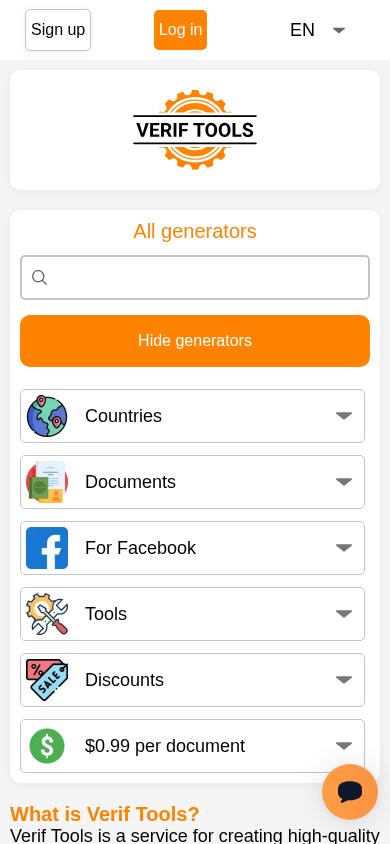
Verif Tools is a paid web service, presented under the page title "Fake Documents Generator", that produces images of identity and financial documents. The homepage and its country-specific generator pages list US state driver's licence templates and offer passports, ID cards, bank statements and utility bills for many countries. It runs on prepaid crypto balances. A referral program rewards visitors who promote it. The only brand label found, "Veriftool Fun", has not been independently tied to a real-world person or organisation, so the operator's identity remains unverified.
Scam/Impersonation Risk: No hard contradictions were observed: no confirmed third-party listing, no phishing finding, no brand impersonation and no conflicting legal identities. One soft note applies: external detections exist but are unspecified, and they are treated as a reputation note, not a finding. The risk is instead the product itself, and TrustSniffer assesses it as a critical risk. The service describes itself as "a service for creating high-quality photos of ID documents" and claims users can create passports, ID cards, driver's licences, bills and bank statements "in just 2 minutes". Its own pages therefore advertise counterfeit identity and financial paperwork. The site's news items also reference bypassing KYC verification. The homepage says "Legal usage of the service is your responsibility". That sentence does not contradict the product, but it shifts all legal exposure onto the buyer while the operator stays unnamed. The money flow is opaque and custodial. Users must top up at least $20 in Bitcoin, Litecoin, Dogecoin, Solana or USDT before they can pay $0.99 per document. Funds sit in a balance that, on the evidence read, appears to be operator-controlled, with no refund terms, no named company and no postal address on the pages read. For a business of this type, a stated price and a disclaimer do not offset those gaps. The domain is also very new. The sandbox run showed heavy outbound traffic, including data sent to destinations TrustSniffer does not recognise, and a high count of console errors. These are visible negative observations. They are not attributed to a specific party or confirmed as harmful, so they are noted as unresolved and are not treated as proof of wrongdoing.A console error is a technical error message that the page's own code reported inside the browser while it ran. It describes how the page is built, and on its own it is not proof that the site is harmful.
Regulatory Verification Notes: The pages read name no legal entity, regulator, licence or registration. The copyright line reads "© [contact withheld]" on both the homepage and the signature page, and the only organisation label is the site's own brand name. No terms of service or privacy policy appeared on the pages read. The only contact route found is a support contact form on the homepage. For a service that takes prepaid funds and personal sign-ups, these are material gaps on the pages read. The service also does not appear to fit any licensed activity a regulator could oversee, so a missing licence here looks like a structural matter. The registration record lacks registrant and country fields, which is consistent with the operator not being named on the site. No third-party broker or regulatory listing matched this site. Two engines at one multi-engine scanner returned suspicious verdicts, and none returned a malicious one. This is a soft third-party warning only. It is discounted because no engine returned a malicious verdict and no top-tier vendor flagged the site, so it does not amount to a confirmed listing.
What to Verify Next: Any contact with the operator should not assume that a verifiable real-world identity stands behind the site, because none has been established. A prospective user would need to find an operating company name, an address and a refund policy from a source other than the site, and the pages read give none. The site's own links give no independent corroboration of who runs it. Anyone considering the crypto top-up should first establish whether the receiving wallets and the balance mechanism are controlled by an accountable party. Nothing on the pages read answers that. Separately, the legality of buying or using such documents in the user's own jurisdiction should be checked before any engagement.
Summary Verdict: The site presents a critical risk. Its pages advertise the sale of forged identity and financial documents, and it appears to be run by an operator who is not named and who takes prepaid crypto from users. The absence of a confirmed third-party listing does not lower that assessment. The technical hygiene it shows, such as working encryption, a major hosting provider and a content-rich page, is consistent with a functioning site but gives no support to the legitimacy that a site of this type would need.
Infrastructure Integrity: The site is hosted on Hostinger's network. The analysis resolved four IP addresses, all treated as likely origin servers, and detected no CDN. The host address had no abuse reports on record. The absence of a CDN is neither a mitigating factor nor a sign of exposure, and it does not change the risks the site's own content raises.
Closing Assessment: No funds should be sent to this service, and no sensitive details should be entered into its sign-up or top-up forms. Anyone who encounters the site through a referral or a KYC-bypass pitch should treat it as a critical risk.
- Registration record: the domain was registered on 2026-07-20 and was 117 days old at capture.
- Homepage and generator pages: the site describes itself as a service for creating photos of ID documents and lists passports, ID cards, licences, bills and bank statements, priced at $0.99 per document.
- Homepage top-up flow: a minimum $20 balance paid in five named cryptocurrencies, with a referral program attached.
- Sandbox run of the homepage: 52 requests sent data to other hosts, 23 of them to destinations TrustSniffer does not recognise, and 127 console errors were logged.
- Homepage and signature page: the copyright line carries no named operator, and no legal entity, regulator or terms and privacy pages were found on the four pages read.
- Registration record: registered through HOSTINGER operations, UAB, with registrant and country fields absent.
- Hosting record: the site is served from AS47583 (Hostinger International Limited).
- Transport encryption: the TLS certificate was issued by YE2 at domain-validation level only, valid to 2026-12-17 at capture.
- VirusTotal result: 0 malicious and 2 suspicious engine verdicts, with no top-tier vendor malicious verdict recorded.
- Homepage: the only support route is a contact form, and the footer shows no operator or address.
- Homepage top-up section: payment goes to a prepaid balance in several cryptocurrencies with no stated refund terms.
- Generator pages: the same disclaimer assigns legal responsibility to the user.
Written analysis generated 2026-11-14 by the TrustSniffer Analysis Engine from the evidence in this report.
What the analysis found
18 findings contributed to this verdict, raised by page content, several checks together, hosting and network, registration and ownership and behaviour in a sandbox.
01 Page content
- The review of the page content rated it high risk.Page content
rule:PAGE_RISK_HIGH - The page shows few of the signs expected from a trustworthy operator.Page content
rule:PAGE_TRUST_QUALITY_LOW - The page content shows three or more warning signs that deceptive sites commonly use.Page content
rule:PAGE_RED_FLAGS_STRONG - The page is about crypto and names several tokens, and it is not a news, education or documentation page.Page content
rule:PAGE_CRYPTO_TOKEN_HEAVY - The browser raised a warning while loading the page.Page content
rule:PAGE_BROWSER_FLAGS_SUSPICIOUS - The page has no description for search engines, which established sites usually provide.Page content
rule:PAGE_SEO_MISSING_META - The page carries none of the structured previews for search and social sharing that established sites usually provide.Page content
rule:PAGE_SEO_NO_STRUCTURED
02 Several checks together
- Several independent checks pointed to risk at the same time.Several checks together
rule:HYB_MULTIPLE_MODULES_HIGH_RISK
03 Hosting and network
- The domain was registered, or a site on a hosting platform was first seen, three to six months before capture.Hosting and network
rule:DNS_YOUNG_6M
04 Registration and ownership
- The registration lookup did not return the domain's registrant and country.Registration and ownership
rule:KF_WHOIS_INCOMPLETE - The security certificate only proves control of the domain, not who operates it.Registration and ownership
rule:KF_SSL_DV_ONLY
05 Behaviour in a sandbox
- The page exchanged network traffic with destinations TrustSniffer does not recognise.Behaviour in a sandbox
rule:BEHAV_NONWHITELISTED_TRAFFIC - The page sent data to a destination TrustSniffer does not recognise.Behaviour in a sandbox
rule:BEHAV_NONWHITELISTED_POSTS - The page made background requests to destinations TrustSniffer does not recognise.Behaviour in a sandbox
rule:BEHAV_NONWHITELISTED_XHR - The page produced an unusually high number of errors while it ran.Behaviour in a sandbox
rule:BEHAV_CONSOLE_ERRORS_HIGH - An automated reading of the page's network activity judged some requests unusual for this kind of page.Behaviour in a sandbox
- The page made many background requests to other domains while it was open.Behaviour in a sandbox
rule:BEHAV_EXTERNAL_XHR_HEAVY - The page sent data to other domains many times while it was open.Behaviour in a sandbox
rule:BEHAV_EXTERNAL_POSTS_HEAVY
How related findings were counted
Some findings above describe the same underlying fact, and some are weak on their own. TrustSniffer counts each such group under one shared limit, so one fact is not counted several times and weak signals stay bounded.
- Third-party connections: 5 findings share one limit, because they all measure one fact: the page loads files from other hosts. The limit applied, so together they counted for less than their sum.
- Page quality: 2 findings share one limit, because each is weak evidence on its own. Together they stayed under the limit.
- Certificate and search-engine setup: 3 findings share one limit, because none of them is a sign of fraud on its own. Together they stayed under the limit.
Identity verification
| Status | UNVERIFIED |
|---|
The operator behind the site could not be connected to a real-world brand or person. What the page shows, if anything, is listed below; none of it was independently checked.
- org:Veriftool Fun
- contact:form
- on_site_identity
What TrustSniffer observed
First-party facts recorded during the assessment of veriftool.fun.
- The request stayed on veriftool.fun. It was not redirected to another domain. Clear
- Registered through HOSTINGER operations, UAB. Noted
- DNS for this domain is served by dns-parking.com, across 2 name servers. Noted
- The domain is registered until 2027-07-20. Noted
- It is hosted on AS-HOSTINGER, a network registered in UA; the provider, Hostinger International Limited, lists its country as CY. Noted
Domain intelligence
| Registrar | HOSTINGER operations, UAB |
|---|---|
| Hosting | AS-HOSTINGER - Hostinger International Limited (the provider lists its country as CY) |
| Network registered in | UA |
| Server IP | 2a02:4780:44:7d26:b3ff:a85a:8219:79ea |
| Name servers | orbit.dns-parking.com, horizon.dns-parking.com |
| CDN / edge network | Not detected |
| Resolved IP addresses | 4 |
| Edge IP addresses | 0 |
| Likely origin IP addresses | 4 |
| SSL issuer | YE2 |
| SSL expiry | 2026-12-17 |
| Domain age | 117 days (registered 2026-07-20) |
| Domain expiry | 2027-07-20 |
| Archive first seen | Not available |
| Archive snapshots | Not counted (archive lookup incomplete) |
| Reputation | VirusTotal: 0 malicious, 2 suspicious | AbuseIPDB: 0% confidence, 0 reports | Google Safe Browsing: 0 matches |
About this assessment
A trust score summarises the evidence TrustSniffer could collect about veriftool.fun at a point in time: domain registration and age, hosting and certificate, the content the site served, and third-party reputation feeds. A high score means the signals were consistent with a legitimately operated site; a low or critical score means several risk patterns were present. It is a starting point for your own judgement, not a guarantee and not a legal finding. There is no human rating and no user review in it. A site can change after it is assessed.