Verdict
An external threat listing named this site as malicious when the evidence was captured. Do not pay or share personal details with this site.
virtual-voti1ng.pages.dev shows critical-risk indicators.
- Sensitive Interaction Risk: This label is given when the overall risk is high. The captured page did not ask for a password, card number or other sensitive details; if it ever does, entering them here could be unsafe.
- Governance Risk: The governance checks raised a concern: the business-model ceiling (at most 40) applies, but the score is below it; a threat-intelligence listing limits the score; as a site on pages.dev, this address has no registration record of its own (the platform's domain is registered, not the site). The findings below give the detail.
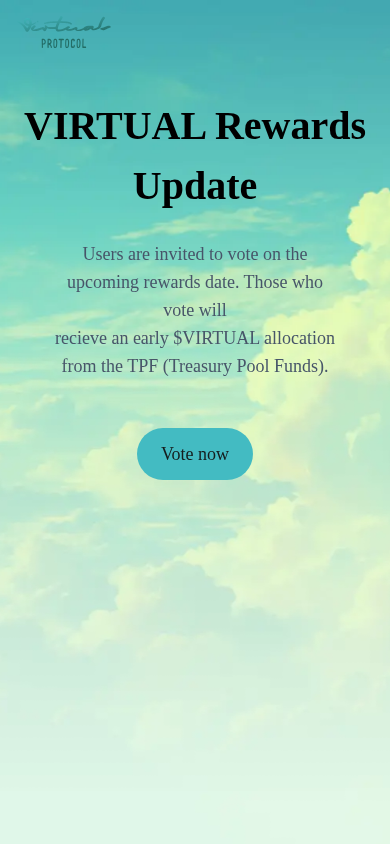
| How the site describes itself | Virtuals Protocol home page promoting the creation and co-ownership of AI agents, an agent commerce framework, an ecosystem fund and a $VIRTUAL token rewards vote. It shows Terms and Privacy links and a truncated token contract address, but no legal entity, registration, contact channel or risk warning on the home page. |
|---|
Evidence status and limitations
Evidence completeness: CompleteThis says whether every check on the site was recorded as finished. All of them were.
- Two sources reported this site when the evidence was captured: a threat-intelligence listing from a feed TrustSniffer monitors (phishing, the site itself as the source, last seen 2026-10-24), and 1 VirusTotal engine that marked it as malicious. A single VirusTotal engine is below TrustSniffer's bar for a confirming source, so no second source confirms the listing. The alert is from the evidence captured on 2026-11-10 and is treated as unconfirmed. On its own the alert would limit the score to at most 49; the threat-listing ceiling holds it at 5, because the listing names the site itself as the source.
- The real-world operator identity was not independently verified.
How to read these numbers
The trust score runs from 0 to 100, higher is safer. 5/100 rates the evidence found, not the probability that the site is a scam.
Evidence confidence (75%) measures how much of TrustSniffer's evidence set this site produced: the page reading, the browser sandbox, the web archive, the registration record and the reputation services. It falls when a check returns nothing, as listed above, and it does not change the score.
At a glance
The checks that decide most of this verdict.
| What limits the score | Threat-listing ceilingA threat-intelligence feed TrustSniffer monitors listed this site itself as the source of a threat when the evidence was captured (last seen 2026-10-24), and that listing caps the score. The business-model ceiling (at most 40) and the unconfirmed alert ceiling (at most 49) also apply, but the score is below them. | Risk |
|---|---|---|
| Malware engines | 1 marked it malicious, 2 suspiciousVirusTotal; a single engine, not a confirmed listing | Watch |
| Google Safe Browsing | Not listedGoogle | Clear |
| Abuse reports on the CDN edge address | 0% confidenceAbuseIPDB, 0 reports; this is the record of the CDN edge address, not of the server behind it, which was not observed | Noted |
| First seen | 5 months before captureWeb archive; a site on pages.dev has no registration of its own | Risk |
| Web archive | Archived since 20263 snapshots; the archive has almost no record of this site, which counted against it | Watch |
| Certificate | Encrypted connectionIssued by WE1 | Noted |
The page as captured
Key findings
- Automated classification: Sensitive Interaction Risk, Governance Risk.
- First seen: less than 1 year before capture (web archive; a site on pages.dev has no registration of its own).
- Public web-archive history exists since 2026.
- At least one reputation service TrustSniffer consulted had flagged this domain when the evidence was captured.
Full analysis
Overview
The site is a single-page crypto landing page that presents itself as Virtuals Protocol, an ecosystem for creating, co-owning and interacting with AI agents. It advertises an agentic framework for agent commerce, an ecosystem fund called Virtuals Venture, a partner network connecting builders with venture partners, and developer resources. Its centrepiece is a "VIRTUAL Rewards Update" that invites visitors to vote on an upcoming rewards date in exchange for an early $VIRTUAL token allocation from the "Treasury Pool Funds". The apparent business model is a token ecosystem around $VIRTUAL, and the page does not explain how value or fees flow to the project. The page is served from a free pages.dev hosting subdomain, not from a standalone domain of its own.
Scam/Impersonation Risk
The assessment is at critical risk. A threat-intelligence feed classified this address as phishing, with the site itself in the role of actor, and last saw the listing on 24 October 2026. The score is held down by the threat-listing ceiling. Separately, one engine at a multi-engine scanner flagged the address as malicious and two flagged it as suspicious. No leading security vendor flagged it malicious, and Google Safe Browsing did not list it. This scanner result is a single alert and is not treated as a confirmed listing. No brand impersonation or conflicting legal identities were confirmed on the page that was read. The address nonetheless carries a Virtuals-style name in which the word "voting" is spelled with the digit 1 in place of the letter n. The page also carries a copyright line in the name of VIRTUALS.io while being hosted on a free platform subdomain. The page's own claims about who runs it are unverified, and the analysis did not connect this address to the operator of Virtuals Protocol. The page's pitch is an undated "vote now" prompt that promises an "early $VIRTUAL allocation" to those who vote. The page states no date for the rewards and does not say how the allocation is calculated or paid. The page's behaviour is consistent with the critical risk assessment. It sent 18 requests to other hosts, 6 of them to destinations TrustSniffer does not recognise. Most of its files came from other domains, and the page threw repeated console errors. Each of these is a scored finding, so the page's behaviour cannot be called clean. No login, password or payment form was observed.A console error is a technical error message that the page's own code reported inside the browser while it ran. It describes how the page is built, and on its own it is not proof that the site is harmful.
- Threat-intelligence feed: the address was classified as phishing, with the site in the actor role, and last seen on 2026-10-24. The evidence was captured on 2026-11-10.
- VirusTotal: 1 engine reported malicious and 2 reported suspicious, with no leading vendor reporting malicious. Google Safe Browsing did not list the address.
- Homepage behaviour: 18 requests sent data to other hosts, 6 of them to unrecognised destinations. 57.1% of files loaded from other domains, and 9 console errors were recorded.
- Homepage: the rewards prompt offers an early $VIRTUAL allocation to voters, and the page never states the rewards date.
Regulatory Verification Notes
On the pages that were read (the homepage only), the site discloses a truncated token contract address and links to Terms of Use, a Privacy Policy and a Launch Agreement. These show an organised page, but they do not establish who operates it. On the pages that were read, no legal entity, registration number, licence, contact channel, postal address or team information appeared. The copyright range on the homepage ends in 2025 while the rewards announcement reads as current, and the Launch Agreement is linked but its content is not shown. The site presents no licence or regulatory status, and none was claimed. Third-party broker databases returned no entry for it. The on-site brand claims make the identity of the operator likely at most, and they are not independently verified.
- Homepage: the contract address appears only in truncated form, and links to the Terms of Use, Privacy Policy and Launch Agreement are present. No team, legal entity, registration number or contact detail appeared on the pages read.
- Web archive: the address was first seen on 2026-06-04, 159 days before capture. It has 3 snapshots through 2026-07-03, spanning 29 days, with a longest gap of 29 days. This is a short history.
- Hosting: served from AS13335 (Cloudflare, Inc., US).
- Transport encryption: the DV certificate seen at capture was issued by WE1 and valid until 2026-12-14. A valid certificate establishes encryption only and says nothing about who operates the site.
What to Verify Next
Any connection between this address and Virtuals Protocol should be checked through the project's official channels, obtained independently of this page, because links the page publishes are not independent evidence. The rewards vote and the early allocation should be confirmed against those official channels, including whether a vote exists at all and the date it applies to. The full token contract address should be compared against an independent source, since the page shows only a truncated form. The Launch Agreement and Terms should be read in full from the project's official documentation, and the team and legal operator confirmed there.
- Homepage: the token contract address is shown only as a truncated string, so it cannot be matched against an independent source from this page alone.
- Homepage: the rewards date is referenced but never stated, and the Launch Agreement is linked but not displayed.
Summary Verdict
The site sits at critical risk. Its professional presentation and a plausible project narrative sit beside a phishing classification attached to this address, a scanner alert, and unexplained third-party traffic. The score is held down by the threat-listing ceiling. The apparent identity of Virtuals Protocol is not independently verified for this address.
Infrastructure Integrity
The site is served through Cloudflare, with all four observed addresses being edge addresses and no origin address observable. This arrangement is neutral. It neither vouches for the site nor counts against it. The abuse record for the host address was checked and showed no reports, but that record concerns the shared edge network and says nothing about the content of this page.
Closing Assessment
This address should not be used for anything beyond reading. The rewards vote and any token-allocation claim made on it should be left alone. Anyone interested in Virtuals Protocol should reach it only through channels they obtained independently, never through this address.
Written analysis generated 2026-11-10 by the TrustSniffer Analysis Engine from the evidence in this report.
What the analysis found
12 findings contributed to this verdict, raised by governance, history in the web archive, page content, hosting and network, behaviour in a sandbox, and registration and ownership.
01 Governance
- TrustSniffer limits the score of a site whose operator it could not verify, according to the kind of site it appears to be (this one reads as a crypto token project on its own pages); here that limit is at most 40, and the score is below it, so it does not set the score.Governance
rule:gov_business_model_cap - A threat-intelligence feed TrustSniffer monitors listed this site itself as the source of a threat when the evidence was captured (last seen 2026-10-24), and that listing caps the score.Governance
rule:gov_active_threat_listing
02 History in the web archive
- The web archive has almost no record of this domain, which fits a site that is new.History in the web archive
rule:ARCH_PEN_YOUNG_AND_SPARSE
03 Page content
- The page runs on a free hosting-platform address instead of a domain of its own, a setup common to short-lived phishing and claim pages.Page content
rule:PAGE_FREE_PLATFORM_ADDRESS - The page content shows at least one warning sign that deceptive sites commonly use.Page content
rule:PAGE_RED_FLAGS_SOME - The page has no description for search engines, which established sites usually provide.Page content
rule:PAGE_SEO_MISSING_META - The page carries none of the structured previews for search and social sharing that established sites usually provide.Page content
rule:PAGE_SEO_NO_STRUCTURED
04 Hosting and network
- The domain was registered, or a site on a hosting platform was first seen, three to six months before capture.Hosting and network
rule:DNS_YOUNG_6M
05 Behaviour in a sandbox
- A large share of the files the page loaded (scripts, images, fonts) came from other domains. This is about where its content is hosted, not about data being sent elsewhere.Behaviour in a sandbox
rule:BEHAV_EXTERNAL_RATIO_MODERATE - The page produced an unusually high number of errors while it ran.Behaviour in a sandbox
rule:BEHAV_CONSOLE_ERRORS_HIGH - The page made many background requests to other domains while it was open.Behaviour in a sandbox
rule:BEHAV_EXTERNAL_XHR_HEAVY - An automated reading of the page's network activity judged some requests unusual for this kind of page.Behaviour in a sandbox
06 Registration and ownership
- As a site on pages.dev, this address has no registration record of its own (the platform's domain is registered, not the site).Registration and ownership
rule:KF_WHOIS_INCOMPLETE
Identity verification
| Status | LIKELY (NOT INDEPENDENTLY VERIFIED) |
|---|
What the page shows points to a real-world brand or person, but nothing was independently checked.
- org:VIRTUALS
- on_site_identity
What TrustSniffer observed
First-party facts recorded during the assessment of virtual-voti1ng.pages.dev.
- The request stayed on virtual-voti1ng.pages.dev. It was not redirected to another domain. Clear
- The earliest public archive of this site is from 2026-06-04. Watch
- It is hosted on CLOUDFLARENET, a network registered in US. Noted
Domain intelligence
| Registrar | Not available |
|---|---|
| Hosting | CLOUDFLARENET - Cloudflare, Inc. |
| Network registered in | US |
| Server IP | 2606:4700:310c::ac42:2f6b (a CDN edge address; the server behind it was not observed) |
| Name servers | Not available |
| CDN / edge network | Detected (cloudflare) |
| Resolved IP addresses | 4 |
| Edge IP addresses | 4 |
| Likely origin IP addresses | 0 |
| SSL issuer | WE1 |
| SSL expiry | 2026-12-14 |
| First seen (web archive) | 159 days before capture; a site on pages.dev has no registration of its own |
| Domain expiry | Not available |
| Archive first seen | 2026-06-04 (159 days before capture) |
| Archive snapshots | 3 |
| Reputation | VirusTotal: 1 malicious, 2 suspicious | AbuseIPDB (CDN edge address, not the host): 0% confidence, 0 reports | Google Safe Browsing: 0 matches |
About this assessment
A trust score summarises the evidence TrustSniffer could collect about virtual-voti1ng.pages.dev at a point in time: domain registration and age, hosting and certificate, the content the site served, and third-party reputation feeds. A high score means the signals were consistent with a legitimately operated site; a low or critical score means several risk patterns were present. It is a starting point for your own judgement, not a guarantee and not a legal finding. There is no human rating and no user review in it. A site can change after it is assessed.