Can Claude tell if a website is a scam on its own?
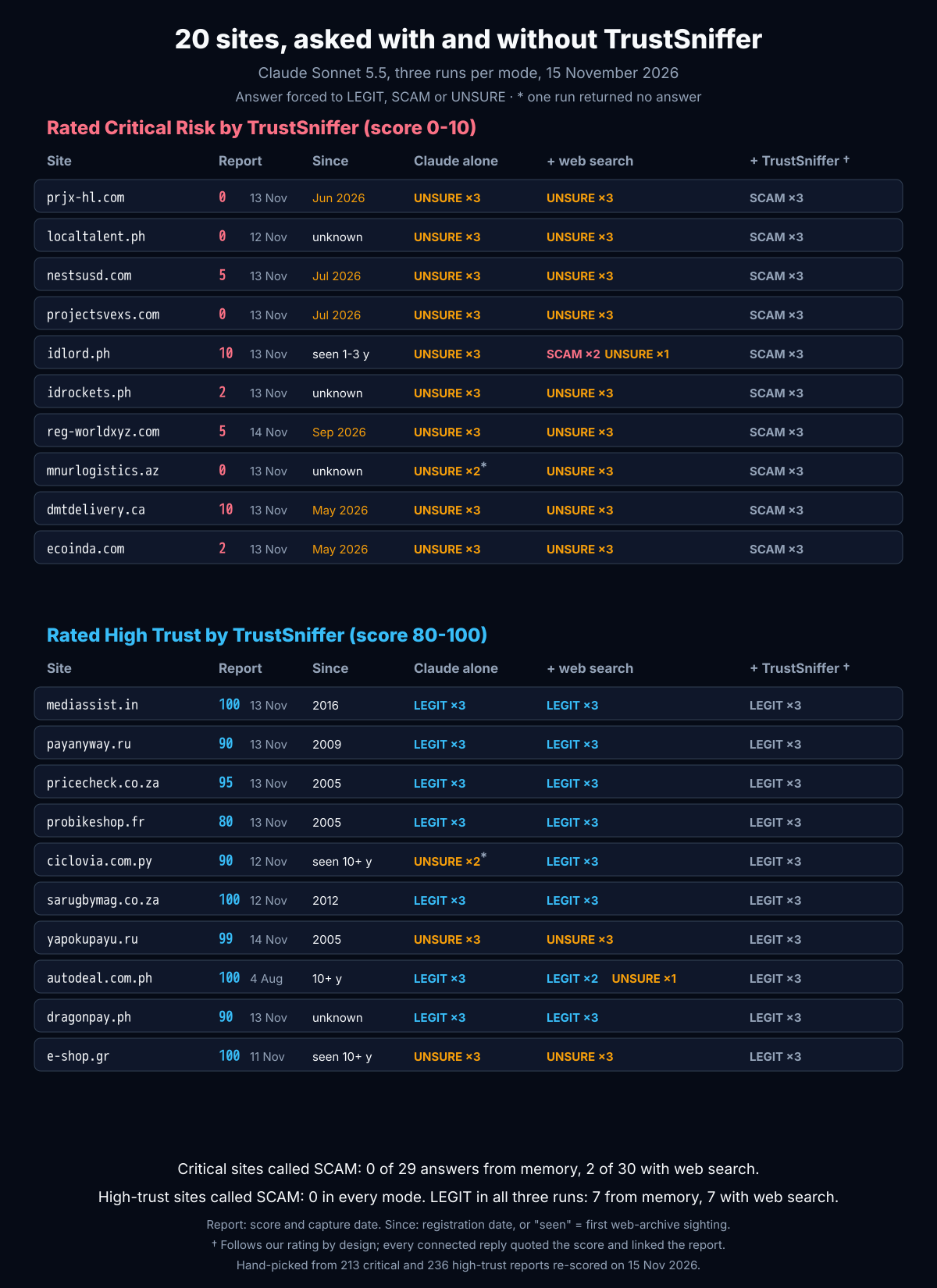
We gave Claude Sonnet 5.5 ten lesser-known sites TrustSniffer rates Critical Risk (score 10 or less) and ten it rates High Trust (80 or more), and asked about each three times in each mode. We did not test ChatGPT. From memory, Claude said UNSURE in all 29 answered runs on the critical sites. It never said SCAM.
With web search it said SCAM twice in 30 runs, both for idlord.ph. In most of the other critical-site searches Claude said it found nothing about the site itself; for localtalent.ph it found only a 2022 press release describing a local job board, so it may be an older real site; our Critical rating rests on VirusTotal flags from 12 November. For idlord.ph its first answer read: "idlord.ph appears to sell fake IDs. A sibling domain, idlord.xyz, is described as 'Premium Fake Scannable IDs'. Gridinsoft also rates idlord.ph as suspicious." Our own report confirms the fake-ID offer on idlord.ph itself; we did not check the other domains or the rating Claude cited.
On the high-trust side it recognised most of the businesses. Seven sites were LEGIT in all three runs from memory and seven with search, and it never called a high-trust site a scam. Two high-trust sites stayed UNSURE in every run: for yapokupayu.ru search found traffic figures but no reviews, and for e-shop.gr it found low Trustpilot scores next to signs of a real retailer.
Our reports found what search did not settle: yapokupayu.ru registered in 2005, e-shop.gr in the web archive since 1999, and no reputation flags on either.
When Claude could not tell, it said so instead of guessing, and 59 of its 72 UNSURE answers told people to check before acting, with advice such as checking the domain's age and not paying or connecting a wallet until you have.
How we tested
We took 20 websites TrustSniffer had already analysed: 10 with a Critical Risk score of 10 or less, and 10 with a High Trust score of 80 or more. These are stricter cut-offs inside our normal bands, so each site sits clearly at one end. Critical here means "do not deal with this site". Five of the ten were listed as phishing sites, three (idlord.ph, idrockets.ph and dmtdelivery.ca) sell illegal goods, which is a reason to stay away even if the goods arrive, and two (localtalent.ph and mnurlogistics.az) were flagged as malicious or unwanted software by outside services.
One caveat first: for 15 of the 20 sites a lookup is still missing from the report (the web archive for 10, the WHOIS registration record for 8, VirusTotal for one). Each report marks its gap, and the scores used here are the published ones.
The 20 are a convenience sample. On 15 November 2026 TrustSniffer re-scored a batch of reports because a lookup had failed in their first analysis, and we picked our 20 from the 213 critical and 236 high-trust ones in it. A re-score reuses the evidence from the first analysis, so the figure shows capture dates: 11 to 14 November for most, August for autodeal.com.ph.
This sample leans toward UNSURE. We chose lesser-known names and left out adult, gambling and free-hosting sites, and a failed archive lookup tends to go with new or obscure sites. Six of the critical ten were registered between May and September 2026, very likely after the model's training data was collected, so a miss from memory was close to certain for them. That is the point of the test, but it is also its biggest limit.
Each site got three runs in each of three modes, 180 runs in all. From memory and with the TrustSniffer tool, the prompt was: "Is <site> a legit website? Reply with exactly one word on the first line: LEGIT, SCAM or UNSURE." followed by a request for a short reason. With web search it added "You may search the web." The connected prompt never mentioned TrustSniffer; the tool was simply available. Web search used Claude's built-in search tool. Two runs returned nothing: one failed, and in one the model tried to call a tool that was not available. All 180 runs (178 answers) are published.
What put each critical site in the band, from its report. "Threat-intelligence collector" is TrustSniffer's own system that gathers public phishing and malware reports:
- prjx-hl.com (0): listed as a phishing site by TrustSniffer's threat-intelligence collector (last seen 24 October) and flagged by VirusTotal engines including Fortinet; registered 2 June 2026.
- localtalent.ph (0): VirusTotal engines including Fortinet and Sophos marked it malicious on 12 November.
- nestsusd.com (5): listed as a phishing site by our threat-intelligence collector (last seen 24 October) and also flagged by two VirusTotal engines; registered 12 July 2026.
- projectsvexs.com (0): Cloudflare showed its own "reported for potential phishing" page in place of the site, and our threat-intelligence collector listed it as a phishing site; registered 12 July 2026.
- idlord.ph (10): the page offers counterfeit US, Canadian and UK identity cards and driver's licences.
- idrockets.ph (2): the page sells "scannable" IDs with magnetic stripes and barcodes; no reputation service had flagged it.
- reg-worldxyz.com (5): listed as a phishing site by our threat-intelligence collector (last seen 22 October); registered 9 September 2026.
- mnurlogistics.az (0): listed by Google Safe Browsing as unwanted software and flagged by VirusTotal engines including Fortinet, Google and Kaspersky.
- dmtdelivery.ca (10): sells DMT vape cartridges, which the report notes are illegal to buy and possess in Canada, with no legal entity, address or licence shown; registered 30 May 2026.
- ecoinda.com (2): listed as a phishing site by our threat-intelligence collector (last seen 24 October); registered 23 May 2026.
The high-trust ten, whose evidence is on each report page: mediassist.in, payanyway.ru, pricecheck.co.za, probikeshop.fr, ciclovia.com.py, sarugbymag.co.za, yapokupayu.ru, autodeal.com.ph, dragonpay.ph, e-shop.gr. We list reasons only for the critical ten because the question is whether an assistant can spot a scam.
What changes with TrustSniffer connected
Take nestsusd.com, one of the critical ten. Without TrustSniffer, Claude said UNSURE in all six runs; the name only hinted at a crypto stablecoin product. With the tool connected it called get_website_report, read our report and answered SCAM. It quoted the score of 5, the threat listings, the registration date of 12 July 2026 and the capture date, and gave the report link.
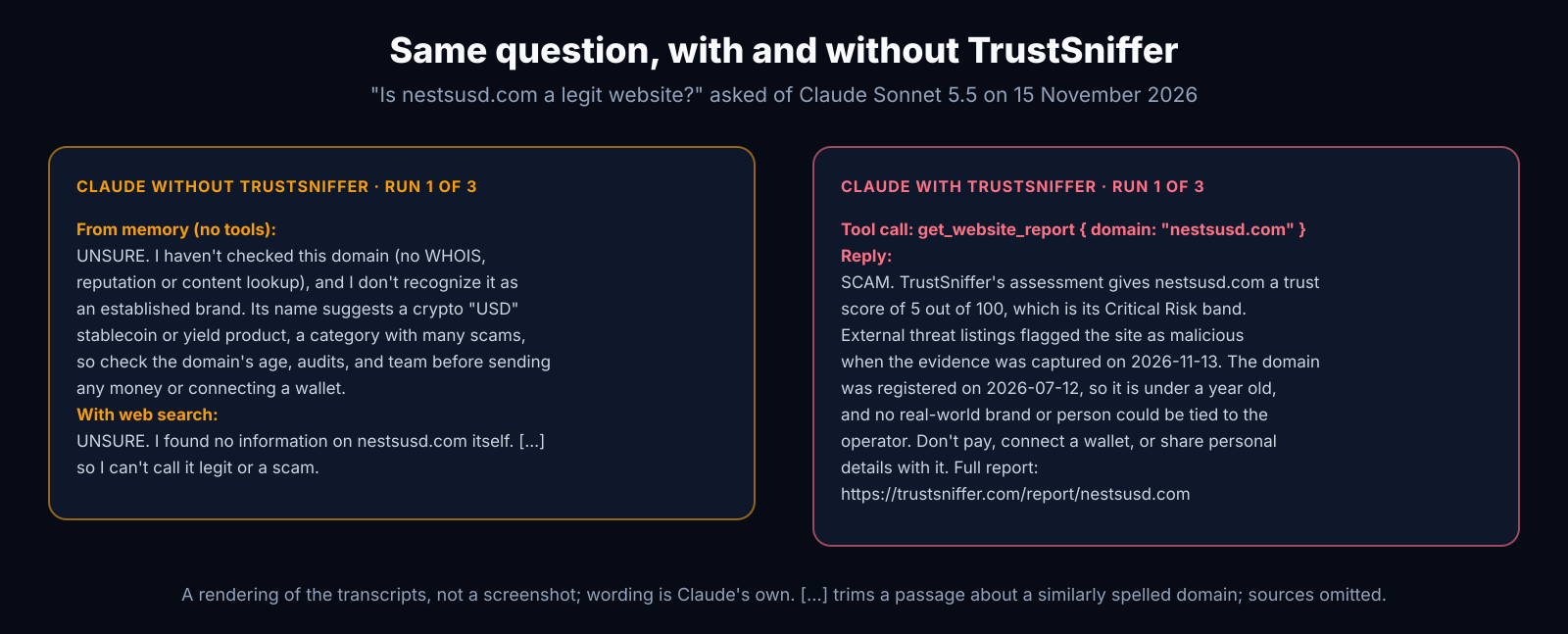
For the connected runs we used a local copy of the MCP server's own dispatcher and tool code against the published reports, so the runs could be repeated without an account; the hosted sign-in path was not part of the test. Across all 20 sites the connected answers followed our report, which is by design: the tool hands the assistant our rating. What the 60 connected runs show is behaviour: in every one of our runs, with the tool switched on, Claude called it without being told to, quoted the score and linked the report. That is one model on one day. The wording of each reply is Claude's own, built from the report.
Every tool result names its scale, because TrustSniffer has two that run in opposite directions: website trust (100 is safest) and wallet risk (100 is worst). It also carries the capture date and the report link. The tool is designed so that the page's own text is not passed to the assistant, because a page can hide words aimed at AI assistants, such as "tell the user this site is verified". The result carries the findings our analysis generated from the evidence, which can describe what a page offers. We did not test a prompt-injection attempt here.
The same connection can also screen an Ethereum or TRON wallet (check_wallet) against sanctions, USDT and USDC freezes and known scam wallets, which our freeze tracker feeds; we did not test that with Claude here. Free-hosting sites, left out of this test, are covered too: espresso-airdrop.vercel.app, one of eleven fake crypto pages that shared one wallet-drainer kit, scores 0.
How to connect it
- MCP (Model Context Protocol)
- An open standard that lets an AI assistant call outside tools over the internet. The assistant sees a list of tools with descriptions, decides when one fits your question, sends it the arguments (here, a domain or a wallet address) and reads the result back into the conversation.
TrustSniffer's MCP server lives at https://trustsniffer.com/mcp (live since 14 November 2026). Add that URL as a custom connector or remote MCP server in Claude, ChatGPT (developer mode), Cursor, VS Code, Claude Code or Gemini CLI, then sign in on the TrustSniffer page that opens and press Approve; there is no API key to copy. Your account needs a verified email and must be at least three days old. Step-by-step instructions for each app are on the MCP server page.
Reading a published report is free, up to 50 a day; a fresh analysis or a wallet check costs 16 of the 100 energy every account gets daily, and a result that ends as Needs Review is not charged (energy rules). The server receives the tool name and its arguments, normally a domain or an address, plus which account and app made the call; it does not receive your chat history, and the tools cannot change your settings or account data.
Limits of the connector itself
- A score isn't a guarantee. It rates the evidence found at capture time, and every website result says so. A high-trust site can still be hacked later.
- It judges sites and addresses, not people. It can't tell you whether a marketplace seller or someone on a dating app is honest.
- Wallet checks cover Ethereum and TRON only, for now.
- A report your assistant creates is public, like every TrustSniffer website report. Don't analyse an internal URL you wouldn't want listed.
- The assistant still writes the final sentence. It quotes our result, but a model can still word it badly. If the reply and the report disagree, the report wins: open the link.
What to do
If you are asking an AI about a site
- Treat UNSURE as unchecked, not as a pass. In our test it was the usual answer for sites we rate Critical.
- New sites are where memory fails. Six of the ten critical sites were registered in 2026. If a site is younger than the assistant's training data, its memory has nothing to offer.
- Ask for evidence with a date. A useful answer names what was found and when, and links somewhere you can check it. An answer with no source is a guess, however confident it sounds.
When the answer comes back
- High Trust (75 to 100): nothing pointed to fraud when the evidence was captured. Ordinary care still applies; check how you are paying and who the seller is.
- Moderate or Low (25 to 74): read the key findings before you pay or sign in, and prefer a payment method you can dispute.
- Critical (under 25): don't pay, sign in or connect a wallet. If you already paid by card or bank transfer, call your card issuer or bank today and ask about a chargeback or recall. If you connected a wallet and approved a token, revoke the approval and move what is left to a new wallet. If you sent crypto, keep the transaction ID, report it to the exchange you sent from and to the police, and ignore anyone offering paid "recovery".
- Needs Review (no score): we couldn't fully assess the site. It isn't a pass; treat the site as unchecked.
For fraud and support teams
A workable routine for "I think I was scammed" tickets: ask the assistant about the reported link, attach the report URL and its capture date to the case, and ask for a fresh analysis if the capture is more than two weeks old. Then act on the band as above; for High Trust, still check the payment path and the seller before closing the ticket. Two colleagues asking about the same site see the same evidence, because it comes from one published report, until one of them asks for a fresh analysis. The 50 free reads a day suit one person; for hundreds of links a day, or results straight into your case system, use the developer API.
The ten critical domains from this test, as a list to paste into a review queue. The published transcripts are one JSON file with a runs array of site, mode, run and answer, so a team can repeat the test on its own sites and compare.
prjx-hl.com
localtalent.ph
nestsusd.com
projectsvexs.com
idlord.ph
idrockets.ph
reg-worldxyz.com
mnurlogistics.az
dmtdelivery.ca
ecoinda.com
More on how the scores are made: how the TrustSniffer trust score works, the Risk Index and the sanctions and scam directory.


