Eleven pages, eleven disguises
Between 4 and 9 November 2026, TrustSniffer's analysis captured eleven pages that a visitor would never put in the same group. Five are airdrop or rewards pages. espresso-airdrop.vercel.app claims to hand out Espresso's "ESP" token and asks for an EVM wallet and a signed claim under a countdown, with no token contract or eligibility list to check. katana-airdrop.vercel.app offers a $KATANA eligibility check, airdrop-7su.pages.dev a Konnex points programme, and nedode.pages.dev a "$1xTokens" claim that uses the 1xBet name. asdasd-4ei.pages.dev copies Zeta Markets and opens with a banner saying trading has been halted and users should withdraw their funds, then asks for a wallet to "check eligibility".
The other six do not mention an airdrop at all. ai-wallet-scout.pages.dev sells "early pump alerts" for Solana memecoins and asks for a wallet to "activate" them. testetsttt.pages.dev sells a meme coin called WEPE by card or crypto. cimiha.pages.dev is a Ukrainian-language trading-broker page promising payouts of up to 218%. blockaml1.pages.dev copies Binance Academy's article pages, and ghbchbj.pages.dev copies the landing page of AMLBot Tracer, a blockchain-analytics product. hunego.pages.dev showed only a bot-verification screen when we captured it on 9 November, but it still served the same files as the rest.
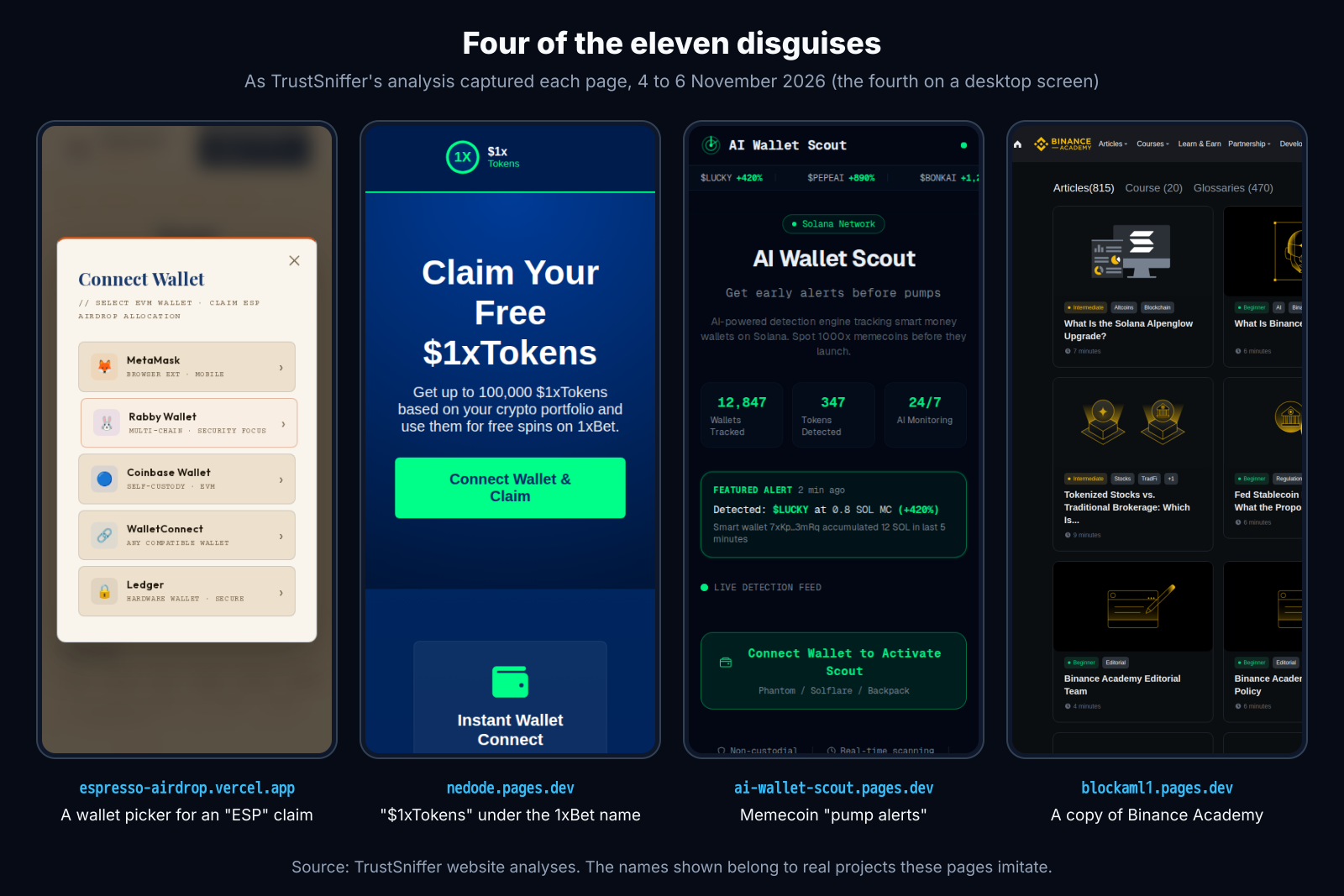
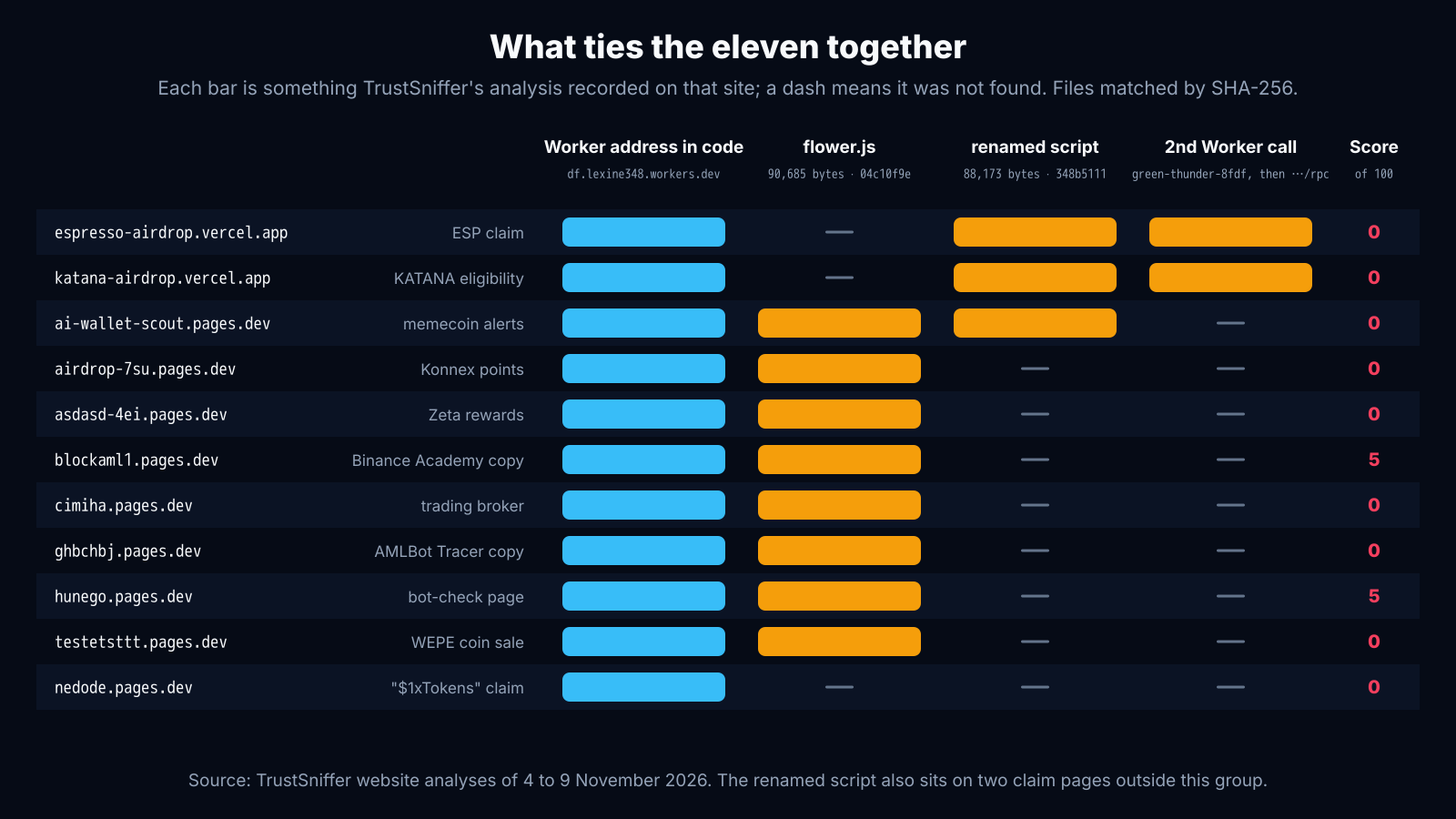
All eleven live on free hosting: nine on Cloudflare Pages (pages.dev) and two on Vercel (vercel.app). That costs nothing and leaves no domain registration record, which is why none of the eleven reports carries a registration date. Every one is rated Critical on the evidence found on its own page: nine score 0 out of 100 and two, the Binance Academy copy and the bot-check page, score 5.
The same files under new names
Our analysis fingerprints every script a site serves from its own address with SHA-256, a hash that changes completely if one byte changes. Two scripts back up the link.
- flower.js, 90,685 bytes (SHA-256 04c10f9e3fa16c775133790941b2db949883acf5ad7d4c47fd81fc569f432455), identical on eight of the eleven: ai-wallet-scout.pages.dev, airdrop-7su.pages.dev, asdasd-4ei.pages.dev, blockaml1.pages.dev, cimiha.pages.dev, ghbchbj.pages.dev, hunego.pages.dev and testetsttt.pages.dev.
- An 88,173-byte script (SHA-256 348b5111017a62ad16be1e54454e824979fbe96981c6b618caf5394fcf056094) that never keeps its name: it is /8phixoeci82.js on the Espresso page, /z0bgexhglo.js on the Katana page and /dduaw6e9y3.js on the AI Wallet Scout page.
A likely reason for the random names is to slip past blocklists that match a file by its name. They do nothing against a hash, which is why the same 88,173 bytes show up as one file in our records however it is named. Two other claim pages we analysed serve it too, but they share that one file with the group and nothing else, which our linking rule does not count as a link. Neither has a published report yet, so we do not name them.
The rule is the same for every network we publish: two sites are linked only when they serve two or more distinctive files byte for byte, or carry the same identifier written into their pages, such as a collection address, a wallet or a tracking account. All eleven pass the second test: the lexine348 Worker address is written into the code of every one. The scripts back that up on ten of them; nedode.pages.dev serves neither and is linked by the address alone. A copy of a real site has no reason to load either file, yet the AMLBot Tracer copy, the Binance Academy copy and the broker page each reproduce someone else's page and then add flower.js on top.
What the scripts say about themselves
On 9 November we downloaded both scripts from ai-wallet-scout.pages.dev as plain text, confirmed that their SHA-256 hashes match the ones above, and read them without running them. Both are obfuscated: the variable names are scrambled into strings such as _0x48aa3c. The text they carry is not, and it is specific.
- A routine named twoStepDrain, and a value named UnlimitedAllowanceAmount.
- Requests for every kind of token permission a wallet can grant: approve, increaseAllowance, setApprovalForAll and permit signatures, including Uniswap's Permit2.
- Routines that list the visiting wallet's tokens, its NFTs and its existing Permit2 approvals, a minWalletPrice threshold, and a low-balance step for wallets worth less.
- Code that attaches itself to any element matching "button, a, .claim-button", so whatever the visitor clicks starts the flow.
- Both lexine348 Worker addresses, df and green-thunder-8fdf, written into the code.
flower.js  SHA-256 04c10f9e3fa16c775133790941b2db949883acf5ad7d4c47fd81fc569f432455
byte offset  literal string as found
41106        'button,\x20a,\x20.claim-button'
41139        'setApprovalForAll'
41392        'twoStepDrain'
41979        'df.lexine348.workers.dev'
43142        'UnlimitedAllowanceAmount'
76717        'minWalletPrice'
85715        'isPermit2Enabled'
Those are the parts of a wallet drainer: find out what a wallet holds, then ask its owner for permission to move it. What we have not done is watch one work. Our sandbox never connects a wallet, so it has never seen these scripts receive a signature, and we have no record of a wallet drained through these eleven pages.
What the pages do before you click
A Cloudflare Worker is a small program that runs on Cloudflare's network at an address ending in workers.dev. The address has two parts: the program's name, then the account it belongs to. In df.lexine348.workers.dev, "df" is the program and "lexine348" is the account.
None of the eleven called df.lexine348.workers.dev while we watched, which fits code that waits for a wallet. Two pages did act on their own. Within one second of opening, espresso-airdrop.vercel.app loaded its renamed script, loaded the ethers Ethereum library, called green-thunder-8fdf.lexine348.workers.dev and then sent three POST requests to joyfulpatriot.click/rpc, the first 86 milliseconds after the Worker call. katana-airdrop.vercel.app followed the same order: the same green-thunder-8fdf Worker, then a POST to joyfulpatriot.com/rpc.
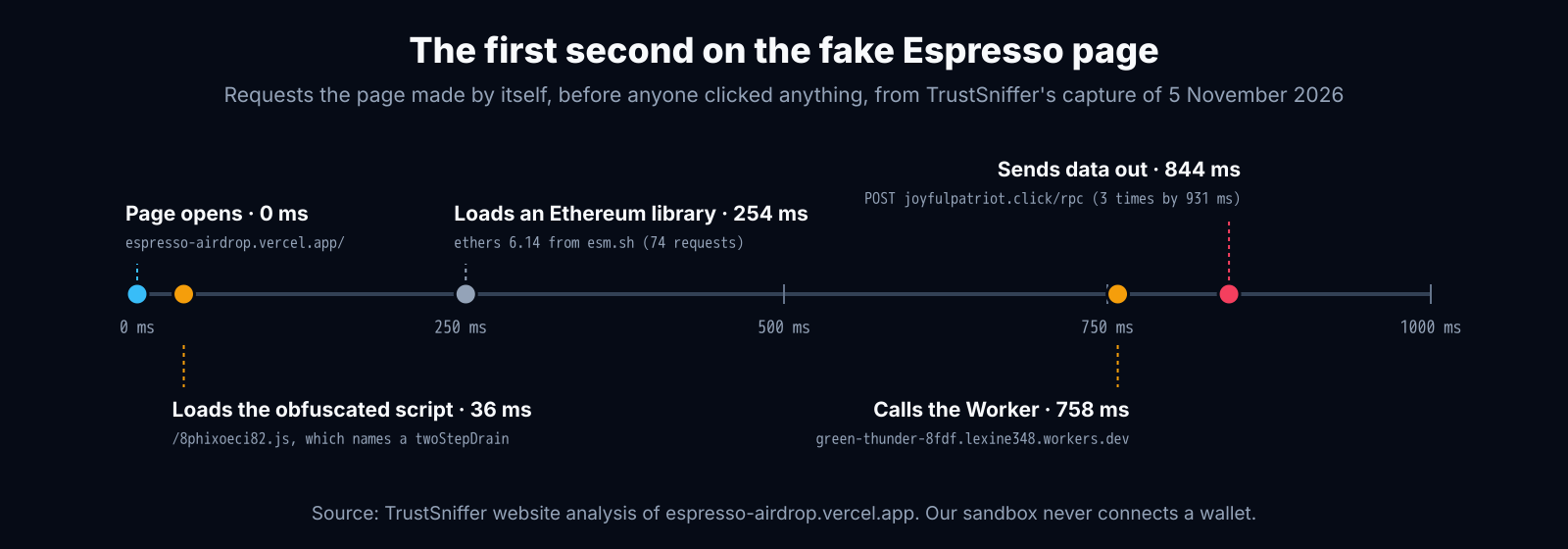
"RPC" is the name of the gateway a wallet uses to talk to a blockchain, so a request to /rpc looks routine to anyone glancing at the traffic. Neither joyfulpatriot address belongs to a blockchain provider we recognise, and our sandbox records where a page sends data, not what the server does with it. By 9 November neither name resolved, and joyfulpatriot.com was no longer registered.
Two links we removed
When we first grouped these pages, the group had 13 members, not 11. Two more pages that copy AMLBot's website, amlbot74838.pages.dev and sdi2jfnjmdpasd.pages.dev, shared a Hotjar analytics ID (3556817) and a second Worker (small-star-b48f.linkamlbot.workers.dev) with two of the eleven.
On 9 November we checked amlbot.com itself. The real site carries the same Hotjar ID and calls the same Worker. A clone copies whatever the original page contains, analytics included, so those two values show only that the pages carrying them copied AMLBot's site. We removed both values as evidence, and the two pages that were linked only through them dropped out of the group. Both are still rated Critical on their own evidence, but they are not part of this network.
How to check a claim page before you connect
None of these pages needs to break into anything. They ask, and the visitor signs. Our explainer on how wallet drainers work covers what a signature can hand over. These five habits protect against what the pages above ask for:
- Start from the project, not the link. Open the project's own website or verified account and follow its claim link from there. A claim on a free-hosting address (pages.dev, vercel.app, web.app) or a fresh .live domain that the project itself does not link to is a warning sign.
- Never grant a permission to check a claim. Connecting a wallet shows a site your address. Some real claims also ask you to sign a readable sign-in message, which moves nothing. An approve, permit or setApprovalForAll request is different: it lets someone else move your tokens, and a claim page has no reason to ask for one.
- Read the request in your wallet. Words such as approve, setApprovalForAll, permit or increase allowance give someone the right to move your tokens. They are the exact requests the scripts above are built to make. A claim should send tokens to you, not ask for permission to spend yours.
- Revoke approvals only through a tool you reached yourself, such as your block explorer's approval checker typed into the address bar. A revoke page that arrived in a message may be a lure of its own: see the related networks below.
- Check the address first. Paste any claim link into the TrustSniffer website checker before you connect. If a token shows up in your wallet unasked, our guides on checking the contract first and on airdrop pages that show a number, not a transfer go further.
If you already signed something on one of these pages, move whatever is left to a new wallet you have never connected anywhere, then revoke the approvals on the old one from your block explorer. You can check where funds went with the wallet risk checker. The directory lists every report we publish, and the Risk Index shows how they split by verdict.
For security teams: indicators and takedown
The account name held across every page we captured, while the program names on it varied. Block the whole account (*.lexine348.workers.dev) and expect it to change: a Workers subdomain can be renamed and a new account costs nothing. Match files by hash, never by name.
# Worker addresses written into the pages (Cloudflare)
df.lexine348.workers.dev
green-thunder-8fdf.lexine348.workers.dev

# POST targets seen 5 November 2026 (not resolving on 9 November)
https://joyfulpatriot.click/rpc
https://joyfulpatriot.com/rpc

# Scripts (SHA-256)
04c10f9e3fa16c775133790941b2db949883acf5ad7d4c47fd81fc569f432455  flower.js, 90,685 bytes
348b5111017a62ad16be1e54454e824979fbe96981c6b618caf5394fcf056094  random names, 88,173 bytes
Pages and Workers on Cloudflare can be reported through Cloudflare's abuse reporting, and Vercel deployments through Vercel's abuse page. A site on its own domain goes to the registrar named in its TrustSniffer report. Link the report of the page you report: each one carries the capture, the files and the addresses as evidence. The projects being imitated can warn their own users faster than anyone, so tell them too.
Related networks
Our analysis found a separate group of nine Critical pages, captured on 4 and 5 November 2026, whose code carries a different Worker address, quiet-pine-8993.hellohyper110.workers.dev. They share no file and no address with the eleven above. Their lures include token claims in the names of ether.fi at efilaunch.live and MegaETH at megaethchain.live, fake approval-revoke tools in the names of Morpho at morphochain.live and Ondo Finance at revokeonondo.live, and a page at noxachain.live claiming that the $NOXA contract was exploited and holders must "migrate". noxachain.live was registered on 23 July 2026 with NiceNIC. Each member's report lists the sites linked to it, and new threats we track appear on the Radar.


