What the warning is
Cloudflare's Suspected Phishing page is a warning Cloudflare places in front of a site it serves, because the site has been reported. Cloudflare sits in front of a large share of the web, so a site's traffic passes through its network first. The page, shown in the figure below, reads "This website has been reported for potential phishing" (or "for potentially distributing malware") and offers two buttons, Learn More and Ignore & Proceed. The footer gives a Cloudflare Ray ID.
The warning is Cloudflare's, not the site's, and nothing on it asks for anything: no login, no code, no wallet. A page with a Cloudflare logo that asks you to sign in, verify a wallet or paste a command into your computer is something else, whatever it calls itself.
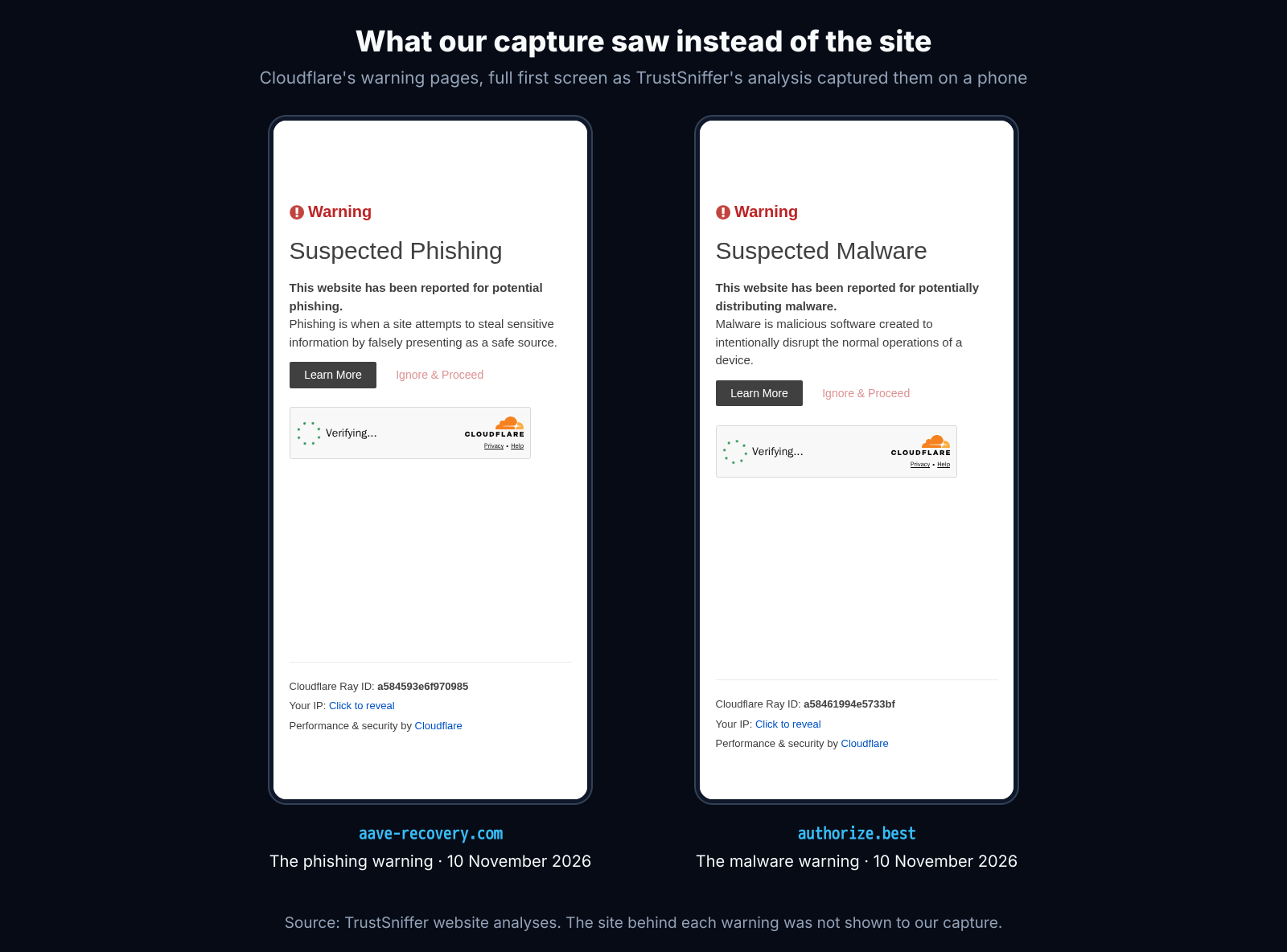
Both captures come from published reports: aave-recovery.com and authorize.best. Our analysis opens a site the way a person would, and on these two the warning was all it was shown. That limit applies to everything below: when Cloudflare's page is in the way, we do not see the site behind it, and the report says so.
What 256 warned sites had in common
TrustSniffer published 1,365 website reports dated 9 to 11 November 2026, the days a large batch of reports was re-analysed and our detection learned to recognise Cloudflare's current warning titles. 707 of those sites were served through Cloudflare's network, and on 256 of them our capture landed on the warning: 254 the phishing version and 2 the malware version. These are sites people submitted to TrustSniffer or that our own intelligence feeds picked up, many of them already suspected, so they are not a random sample of everything Cloudflare warns about. Of the 256, 252 are rated Critical and 4 are Needs Review, the rating we give when we could not see enough of a site to score it. Those ratings count Cloudflare's warning itself, so they are not a second opinion on it; the lookups below are what tells you more.
Cloudflare's warning was rarely the only alarm, although the other alarms are agreement rather than proof: security vendors and Cloudflare may draw on some of the same reports. Each report also records a VirusTotal lookup (how many of its security vendors flag the address), a Google Safe Browsing lookup and the domain's registration, all taken at the time of the analysis:
- 251 of 256 were flagged by at least one VirusTotal vendor, 166 by five or more and 108 by ten or more.
- 21 of 256 were matched by Google Safe Browsing, the list behind the red full-screen warning in Chrome and Firefox. On the other 235, Safe Browsing had no match when we checked.
- 113 were hosted on Cloudflare Pages, at a free pages.dev address with no domain of their own. The other 143 used their own domain.
- Every one of those 143 has a registration date in its report. 134 were under a year old when analysed, 9 were between one and three years old, none was older, and the median was about five months.
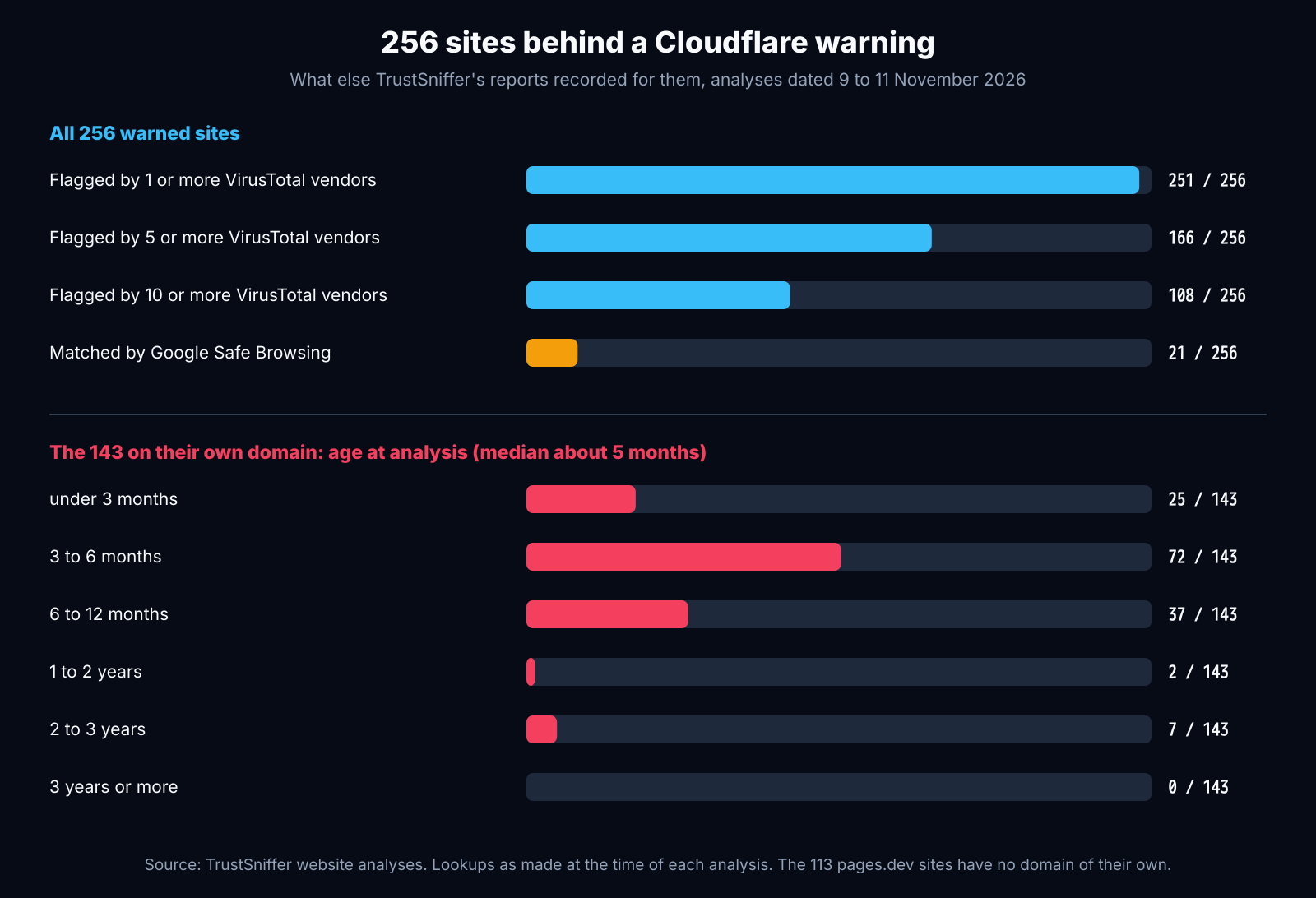
The gap between the two lookups is the practical lesson. On 235 of these sites, the list that drives the browser's red screen had no match at the time we checked, while Cloudflare's page was already in place. That is not special to these sites: Safe Browsing matched only 38 of the 680 other reports rated Critical in the same three days, not counting the 256. Our lookup is a snapshot, and Chrome's real-time protection can differ from it. We did not test other browser protections, such as Microsoft's, or wallet blocklists. If you have learned to trust the red screen, learn this page too, and do not read a missing red screen as a clean result.
Here are eight of the reports, to show what sits behind the totals. Each is rated Critical with a score of 0 out of 100:
- voting-apyx.com: registered 8 June 2026 through NICENIC, flagged by 14 VirusTotal vendors.
- keeta-votes.com: registered 10 June 2026 through NICENIC, 10 vendors.
- vote-neutrl.finance: registered 13 August 2026 through NICENIC, 11 vendors.
- xrpl-claim.xyz: registered 30 July 2026 through NICENIC, 13 vendors.
- starknet-bridge.com: registered 9 April 2026 through Atak Domain, 16 vendors.
- details-aave.com: registered 21 April 2026 through PublicDomainRegistry, 11 vendors.
- billions.sale: registered 9 March 2026 through Global Domain Group, 9 vendors.
- uniswap.st: registered 22 September 2026 (the report names ST Registry as registrar), 2 vendors.
What the addresses promise
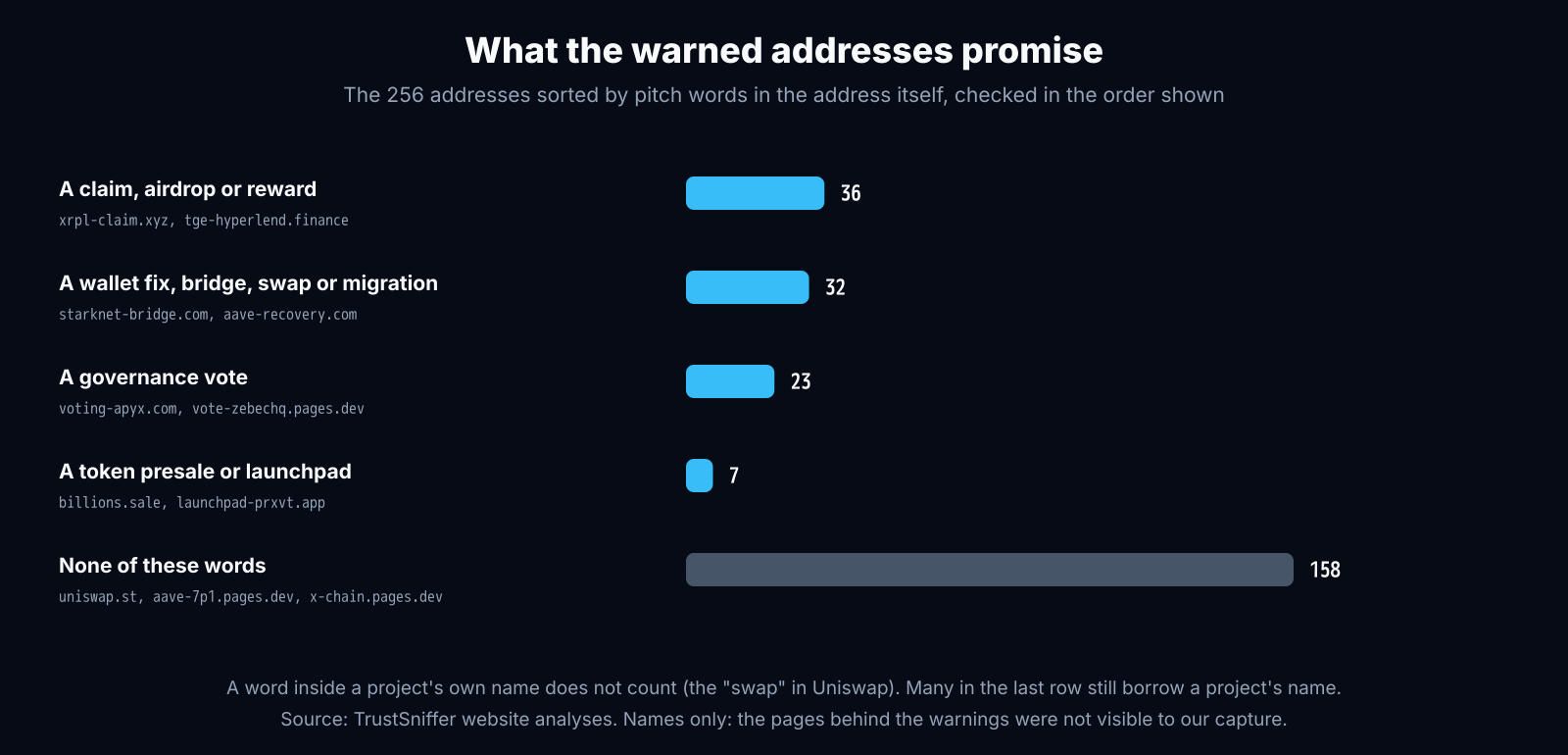
We cannot see the pages, but we can read the addresses. We checked each address for these word stems, anywhere in the name, in this order and counted it under the first match: claim words (claim, airdrop, drop, allocation, eligibility, reward, tge, whitelist, refund), wallet-tool words (dapp, defi, swap, bridge, migrat, dashboard, restore, recovery, validator, stak, connect, sync, rectif, fix, reset, resolution, credential, portal), vote words (vote, voting, dao) and sale words (presale, sale, launch). A word inside a project's own name does not count, so the "swap" in Uniswap is ignored.
98 of the 256 addresses announce a crypto pitch: 36 a claim, airdrop or reward (tge-hyperlend.finance), 32 a wallet fix, bridge, swap or migration (aave-recovery.com), 23 a governance vote (vote-zebechq.pages.dev) and 7 a presale or launchpad (launchpad-prxvt.app). The other 158 use none of these words, but many still borrow a project's name, such as aave-7p1.pages.dev; 17 of the 256 contain "xrp".
The vote pages deserve a note, because they are less familiar than fake airdrops. Real crypto projects let token holders vote on proposals, often by signing a message in their wallet. A fake vote page borrows that habit: the visitor arrives expecting to sign something, which is the moment a page can ask for a signature that hands over tokens. Our explainer on what happens when you connect a wallet to a scam site covers what a signature can do, and how wallet drainers work covers the code behind it.
How TrustSniffer treats the warning
When our capture lands on Cloudflare's page, the measurements we normally take on a site (its text, its forms, the requests it makes, how its page changes) describe Cloudflare's page, not the site. Since 9 November 2026 our analysis switches those page and behaviour rules off for such a capture. The rating then rests on Cloudflare's report and on what can still be checked from outside: the security-vendor lookups, the domain's age and the hosting. Where that outside evidence is thin, the report can say Needs Review instead of giving a score. How the Trust Score works explains the scale.
What to do when you see the warning
- Close the tab. There is nothing on the warning to fill in, and a reported site is not worth the risk of finding out what it does.
- Find the link you came from. If it arrived in a message, a comment or an ad promising a claim, a refund or a vote, treat the message as part of the scam. Go to the project's own website or verified account and look for the offer there.
- Check the address without opening it. Paste it into the website checker. If we have analysed it, the report shows what we found; if not, a new analysis runs in our sandbox, not in your browser.
- Read the address itself. A domain a few months old, or a pages.dev address, that borrows a well-known project's name and adds a word like claim, vote or bridge is the pattern in the reports above.
- If you already pressed Ignore & Proceed and typed a password, change it on the real site and turn on two-factor sign-in. If you signed anything with a wallet, follow our guide to revoking token approvals after a scam site, and check where your funds went with the wallet risk checker.
Our guide on how to report a scam website explains where each kind of report goes. The directory lists every website report we publish, the Radar shows what is being reported now, and the Risk Index gives the totals.
For security teams
The 256 reports share a few patterns worth matching on. Registration is concentrated: 91 of the 143 own domains were registered through NICENIC, the next being PublicDomainRegistry with 13 and Global Domain Group with 12. The top-level domains among the 143 are .com (64), .live (15), .info (10), .xyz (10) and .app (10). 113 sit on pages.dev, where blocking the parent is not an option, so match the full host name. The low-trust and high-risk directory lists them alongside our other low-trust reports, and each report carries the capture, the lookups and the registration date.
# A partial list: address patterns among the 256 warned hosts
# (count of hosts; match the full host name)
vote-<project>.<tld>      13   e.g. vote-neutrl.finance, vote-zebechq.pages.dev
voting-<project>.<tld>     3   e.g. voting-apyx.com, voting-octra.xyz
tge-<project>.<tld>        2   e.g. tge-hyperlend.finance, tge-variational.pro
<project>-bridge.<tld>     2   e.g. starknet-bridge.com, super-bridge.net
A site served through Cloudflare can be reported through Cloudflare's abuse form; a site on its own domain also goes to the registrar named in its report. Link the TrustSniffer report in what you send.
If it is your own site
If Cloudflare has put this warning in front of a site you run, the way out is Cloudflare's own review process, from your Cloudflare account, after you have checked the site for pages or files you did not put there. A site can be compromised without its owner knowing. Our data cannot measure how often Cloudflare's warning is wrong, and because our sample leans towards sites already suspected, it makes the warning look more reliable than a random sample of the web would. From outside we also cannot tell whether any of the 256 were legitimate sites caught up by mistake: the 5 without a single VirusTotal flag were all on their own domain and all under a year old, and their pages were hidden from us like the rest.


