Many websites print a company number at the bottom of the page: a UK company number, a Brazilian CNPJ, an Australian ABN, a Korean business registration number. To most visitors that line of digits looks like proof that a real, registered business stands behind the site. We wanted to know how much it is really worth, so we checked every number on every site in our own analyses against the official registers themselves.
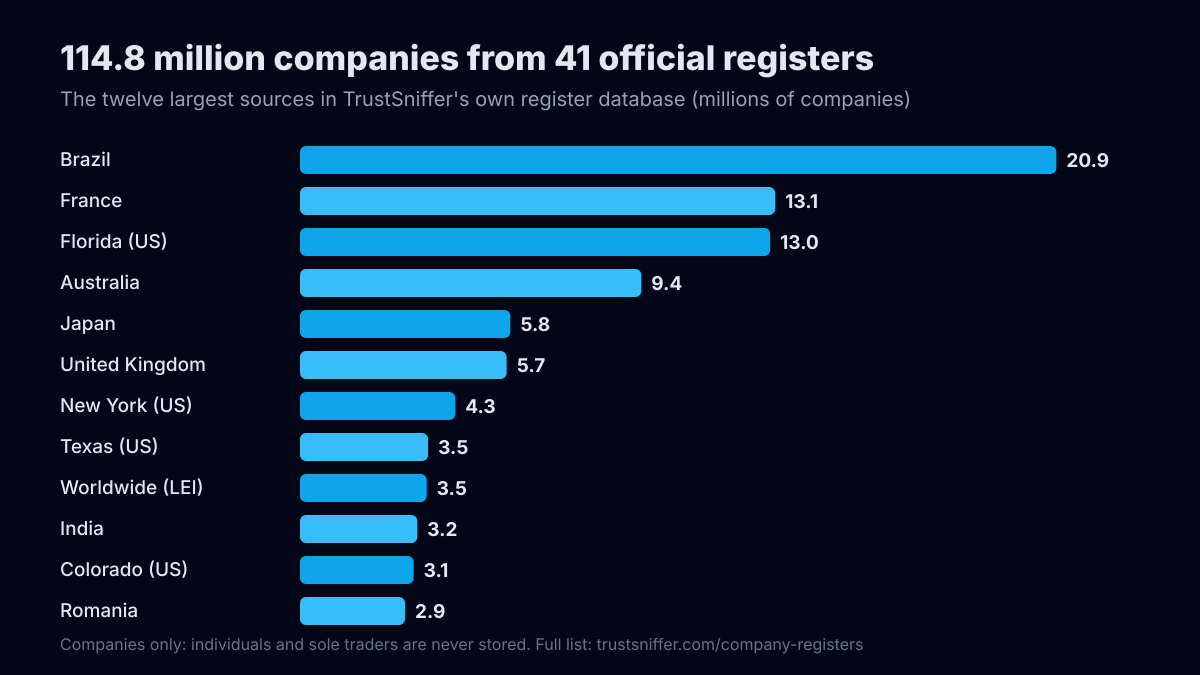
To do that, TrustSniffer built its own copy of 41 official company registers covering 32 countries: national registers such as those of France, the UK, Brazil, Japan, Australia and India, eight US states and the SEC list, and the worldwide LEI index. It holds companies only: individuals and sole traders are never stored. Every website report now includes this check.
Finding 1: legitimate sites print a company number far more often
A number only counts when it sits next to its own label and passes its official check digit, so a phone number or an order number is never mistaken for one. Of the 3,006 sites TrustSniffer rated High trust, 187 (6.2%) printed a valid company number. Of the 5,812 rated Critical, only 15 (0.3%) did. Moderate (4.6%) and Low trust (2.0%) sites sit in between, in the same order as the ratings.
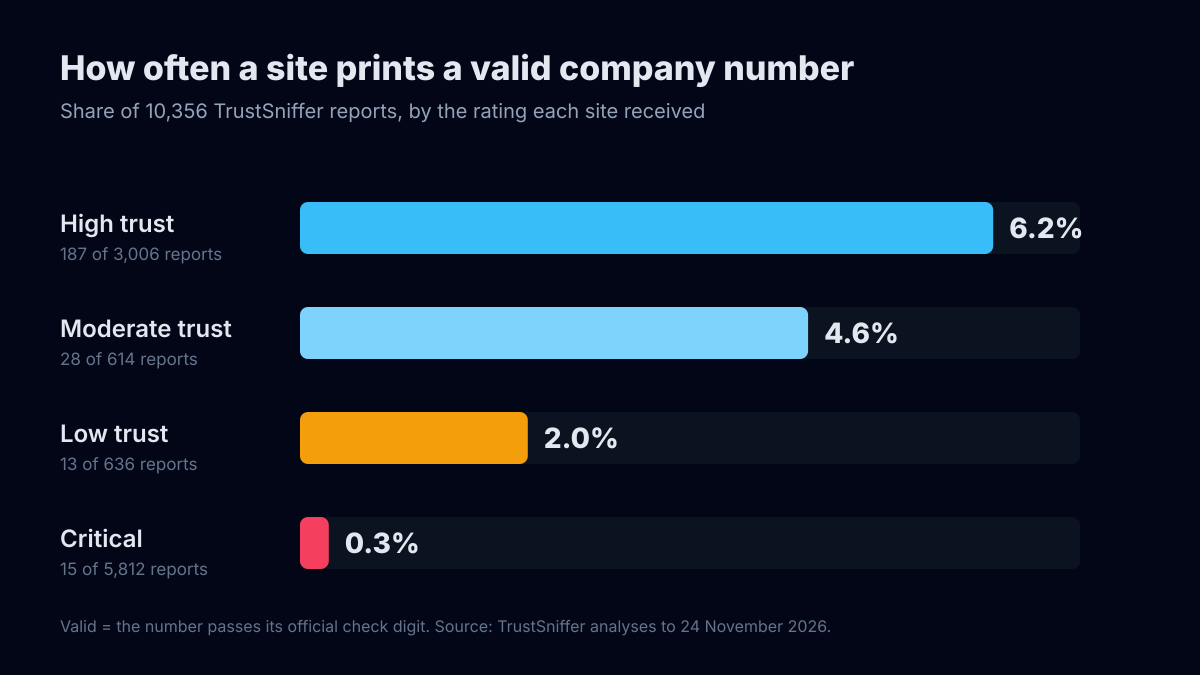
So the absence of a number is a weak warning sign, and its presence a weak good sign. Most legitimate sites print no number at all: 94% of High trust sites did not. That is why TrustSniffer never treats a missing number as evidence against a site.
Finding 2: a valid number can belong to someone else
The 15 Critical sites that printed a valid number are the interesting ones. We looked each number up. Ten belong to real, active companies. Five are not in our register copy, which proves nothing either way: our copy leaves out individuals and many countries.
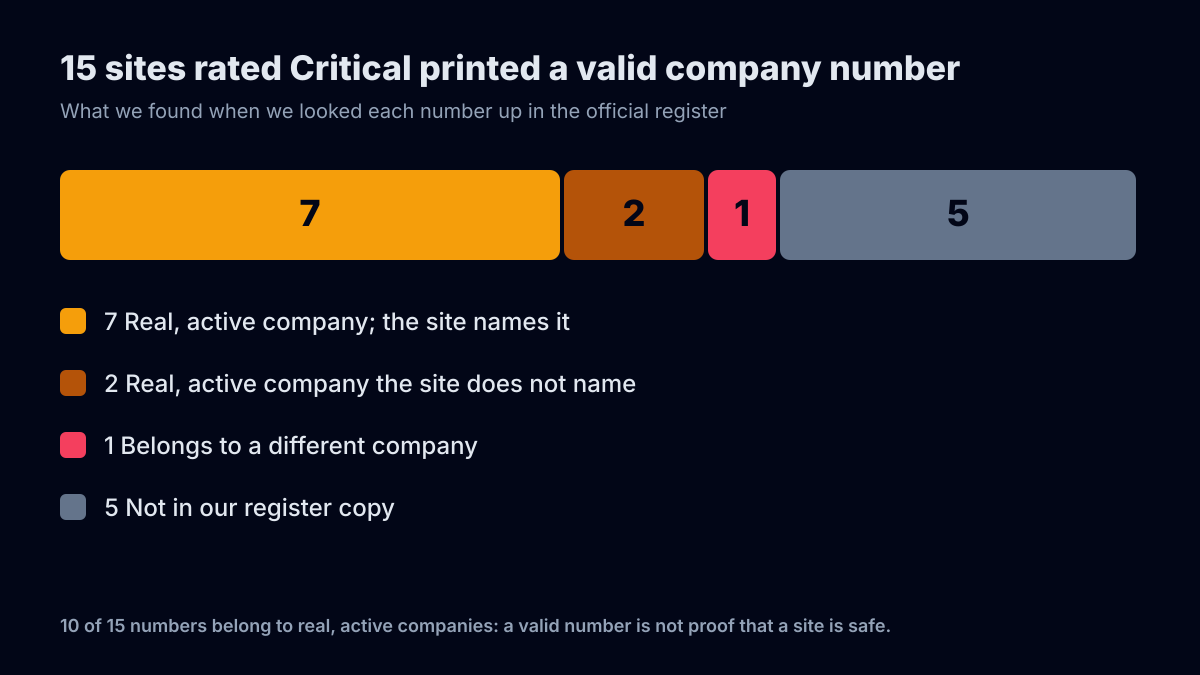
Three examples from those reports show how a real number ends up on a risky site. In each case the number is real; the company it belongs to has no visible link to the website.
- exoticinvest.ltd, rated Critical, promises "up to 98% daily wins" and says it is "SEC registered". The UK company number it prints belongs to an unrelated, active UK trade-finance company, not to anything called Exotic Invest.
- aspidagames.com, rated Critical, is a German-language site whose footer prints a Brazilian CNPJ. The official register lists that number for a small construction company in Brazil.
- shellplc.xyz, rated Critical, sits on an address that borrows the name of the oil company Shell, and presents itself as a Brazilian shop with that shop's real company number.
Finding 3: what actually confirms who runs a site
Some official registers record a company's own website: Norway's Brønnøysund register, Finland's trade register, Belgium's Crossroads Bank for Enterprises, Romania's trade register and South Korea's online-seller register among them. When the register itself lists the exact site, and the registered company name matches, the link between the website and a real company comes from the government, not from the site.
In our analyses that happened for 15 websites, all of them rated High trust, and for no site rated Critical. Examples include booking.com, listed by the Norwegian register for Booking.com B.V., and tv2.no. A matching name next to a matching number is weaker: clone sites often copy both the name and the number of a real firm, which is why TrustSniffer does not raise a score for a name match alone.
How to check a company number yourself
You do not need TrustSniffer to do the first check. Copy the number from the site and search for it in the official register of that country. Then ask three questions: does the register know this number, is the company active, and is it plausibly the company that runs this website?
- United Kingdom: company number (8 digits) at Companies House, find-and-update.company-information.service.gov.uk
- France: SIREN (9 digits) at annuaire-entreprises.data.gouv.fr
- Brazil: CNPJ (14 digits) at the Receita Federal CNPJ lookup
- Australia: ABN (11 digits) at abr.business.gov.au
- India: CIN (21 characters, starting with L or U) at the Ministry of Corporate Affairs, mca.gov.in
- South Korea: business registration number (10 digits) at the Fair Trade Commission online-seller search, ftc.go.kr
- Anywhere: a Legal Entity Identifier (20 characters) at search.gleif.org
If a site takes your money for investments, a company number is not enough on its own: the firm also needs a licence from a financial regulator. Our report on 17,226 sites on regulator warning lists explains how to check that, and our guide on how to check if a website is legit covers the other signs.
How we checked
The data covers 10,356 published TrustSniffer website reports up to 24 November 2026. For each, we read the page text our capture recorded, extracted registration numbers printed next to their own label (SIREN and SIRET, UK company number, CNPJ, ABN and ACN, Korean business number, Indian CIN, Russian INN, Belgian enterprise number and others), kept only numbers that pass their official check digit, and looked them up in TrustSniffer's copy of the official registers, refreshed automatically from each publisher. Ratings are the result of TrustSniffer's automated analysis on the day each site was captured. Sources and licences for every register are listed on the company registers page.
Frequently asked questions
Does a company registration number on a website mean it is safe?
What is the best sign that a real company runs a website?
What if I cannot find the company number in the register?
How does TrustSniffer use company registers?
Want to check a site now? Run it through the TrustSniffer website checker; the company-register check is part of every report. For the bigger picture, see the Risk Index and our analysis of a 178-site XRP and TRON wallet-drainer network.