People usually learn that a USDT wallet was frozen after the fact, from a block explorer or a news story. We wanted to know earlier, for a practical reason: a platform about to receive funds from a wallet is better off knowing that the issuer has already started to freeze it. This piece explains where that early signal comes from, what our own record shows after 75 days, and what it cannot tell you.
A freeze is two transactions, not one
Tether does not freeze an address with a single key. The freeze function on the USDT contract belongs to a multi-signature wallet. One signer proposes the freeze, naming the address, and it only takes effect when enough other signers approve. Between the proposal and the final approval, the address can still move its funds.
- Freeze proposal
- A pending transaction in a stablecoin issuer's multi-signature wallet that, once approved by enough signers, adds an address to the token's blacklist so it can no longer send the token.
Both steps are recorded on chain, and the proposal names its target. So the freeze is visible before it happens. Our engine reads every new proposal on TRON and on Ethereum, decodes which address it targets, and writes it to a ledger with the time we saw it. When the issuer's approvals complete, the freeze shows up in our freeze feed, the ledger entry is marked frozen, and the gap between the two times is the head start.
A second signal: the same key on another chain
A TRON address and an Ethereum address made from the same private key share the same 20-byte account hash; only the encoding differs. Issuers freeze one network at a time. When a freeze lands on one chain, we derive the twin on the other and flag it if it still holds USDT. This is rarer: 4 twins flagged this way were later frozen themselves, but between them they held $130.1 million.
What the record shows
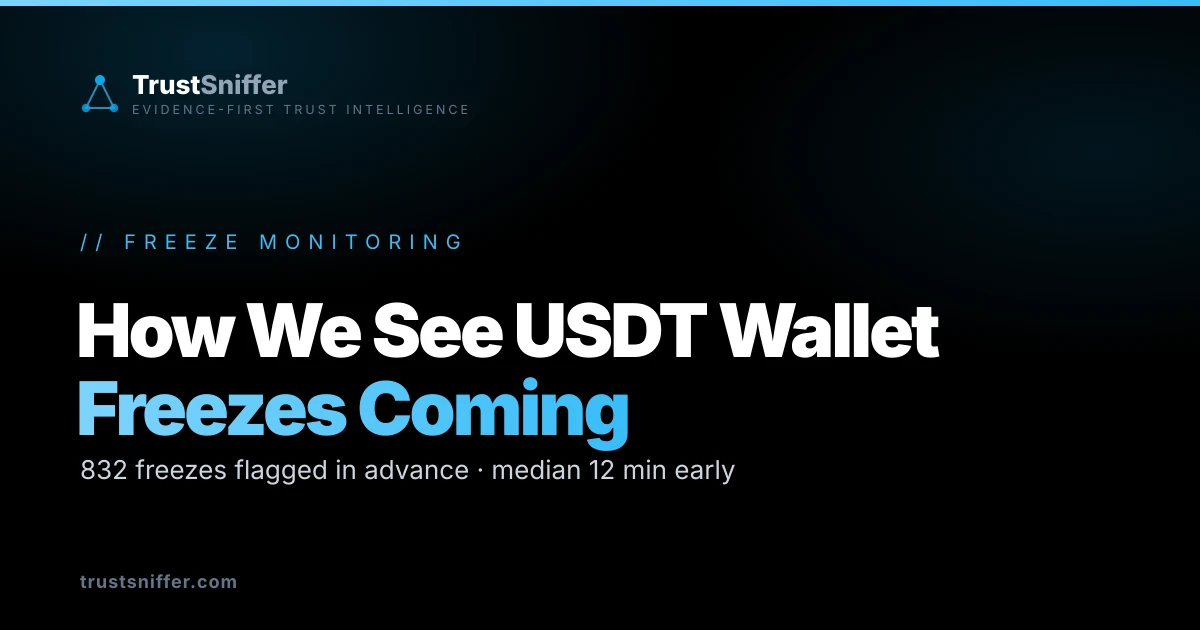
Over the whole ledger, 832 flagged wallets were frozen, holding $382.1 million between them when they were flagged. On TRON the median head start was 10 min across 752 freezes. Ethereum was slower at 33 min across 76.
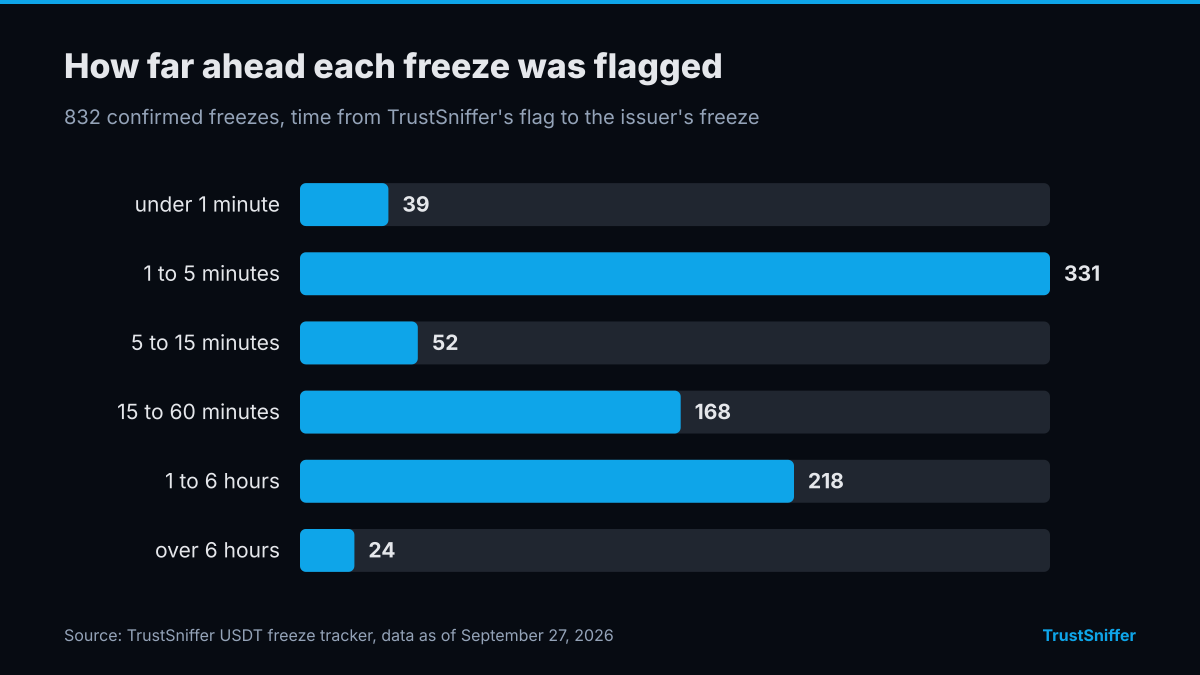
The spread matters more than the median. Most proposals are approved within minutes, so the warning is short. A minority wait hours (the 90th percentile is 3.2 h), and those are the cases where an early flag is most useful to anyone deciding whether to accept funds.
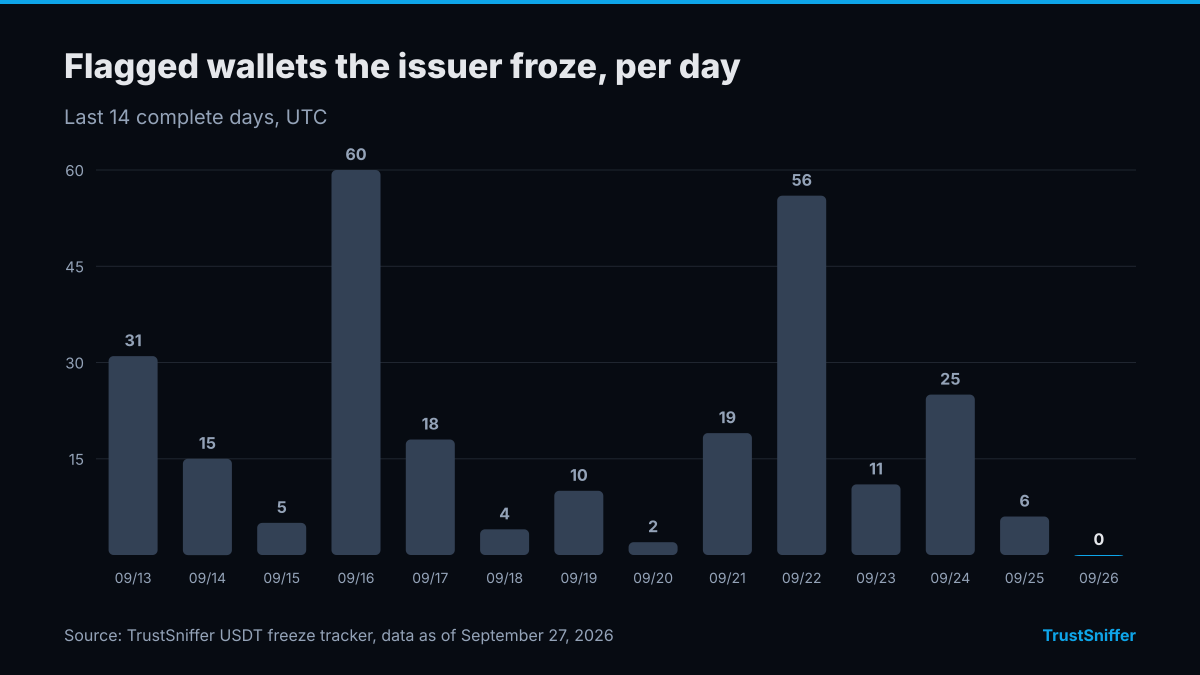
3 flagged proposals have not been executed within 14 days. We count those against ourselves: the rate above is frozen divided by every flag with a known outcome, and a proposal nobody approved is an outcome.
Why pending freezes are not published in full
A pending entry is a freeze that has not happened. Publishing its address would warn the holder with a median of 12 min to move the money, which would make the tracker a tool for exactly the people a freeze is aimed at. So until the freeze executes, the tracker shows only the network, an amount range, the time to the nearest ten minutes and a reference code. The full address, the amount and the head start appear the moment the freeze lands on chain. The search box and every filter follow the same rule, so a pending entry cannot be found by its address.
What this does not tell you
- Who controls a wallet, or why it was frozen. The ledger records the issuer's action and when we saw it coming, nothing more.
- Anything in advance about USDC. Our proposal readers watch Tether's approval step only; USDC freezes are recorded when they happen, with no head start.
- Freezes on networks other than TRON and Ethereum, which our proposal readers do not cover.
- The exact balance in every case. Where we could not read a balance at the moment of flagging, the ledger records zero, so some confirmed freezes show $0.
A flag is also not a verdict on the wallet's owner. It is a record that the issuer had started a freeze. Each wallet page on the site states what the chain shows and where it came from, and nothing beyond that.
Using it
The freeze tracker refreshes every 20 seconds and can be filtered by date, network, method, amount and address, the same controls our own team uses. The full list downloads as CSV. To check one address, use the wallet checker; to be told when an address you care about is frozen or unfrozen, add it to wallet monitoring. Every freeze the issuers execute, flagged or not, is listed on the frozen TRON wallets and frozen Ethereum wallets pages, and the daily totals are in our stablecoin freeze reports and the Risk Index.