Stablecoin freezes on August 10, 2026
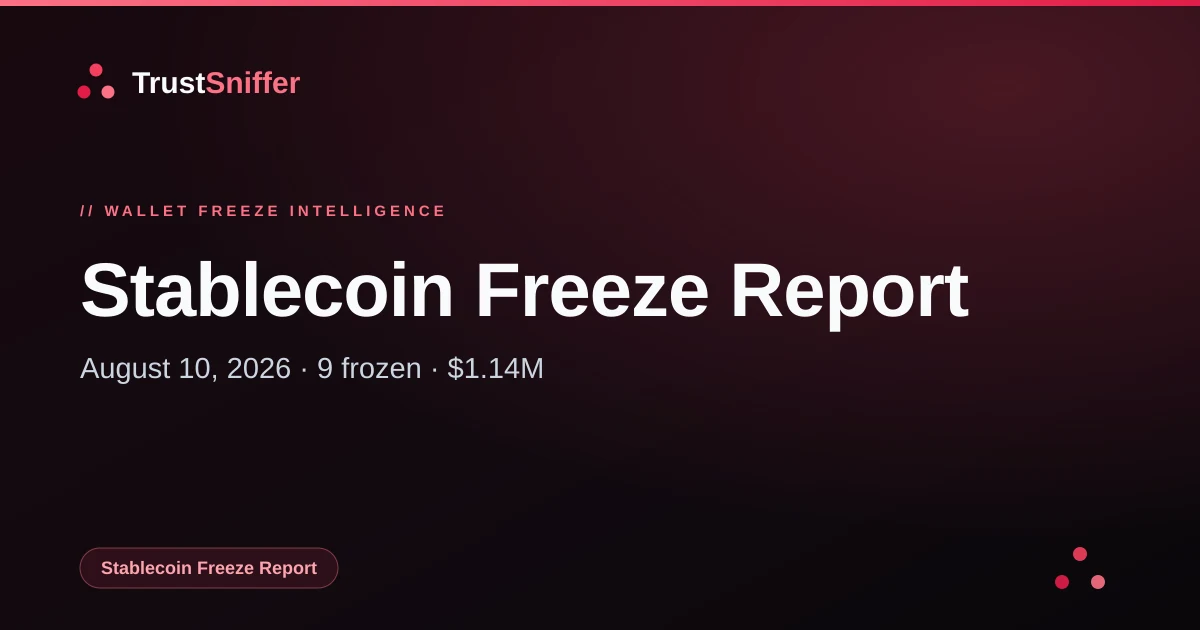
Across the networks TrustSniffer traces, issuers froze 9 addresses on August 10, 2026, removing about $1.14M in USDT and USDC from circulation. A freeze means the token issuer blacklisted the address on-chain, so the affected stablecoins can no longer be moved from it.
- Ethereum: 2 freezes, $116.9k frozen
- TRON: 7 freezes, $1.02M frozen
Most of that movement sat on TRON: 7 of the 9 addresses and about $1.02M of the day's total, against 2 addresses and $116.9k on Ethereum. Because a small number of TRON addresses carried the bulk of the value, one large blacklisting can move the daily figure on its own, which is what happened here.
Largest freeze of the day
The single largest freeze on August 10, 2026 was $313.2k on TRON, on the address TBYqvtTZzT2JLfAPaAUgaiR6PaMyLB4eBj. Open its analysis page for the full risk verdict, exposure trace, and connected addresses.
Wallets frozen on August 10, 2026
Each frozen address is listed below with the amount frozen, linking to its dedicated TrustSniffer analysis (verdict, exposure trace, and connected wallets).
- TBYqvtTZzT2JLfAPaAUgaiR6PaMyLB4eBj on TRON, $313.2k frozen
- TQ4RY7KiEPur2yFdHqvBtXKxGyKPcebfkN on TRON, $300.0k frozen
- TLz51nr6MZEXM2RfijaoRc9LxH4dKVrRcf on TRON, $227.7k frozen
- TEFXiJi4PXcMcxb6kafD7hPFHT4VxzRwaY on TRON, $149.9k frozen
- 0x6EB2c41547b524900B2310d0f23bafff923684a3 on Ethereum, $107.8k frozen
- TUrnYdmKLS8hZna5EjskLRdirLo4HG1jAx on TRON, $25.7k frozen
- 0xe4FcA73783C82d95724F69b08C30810cE8aa9005 on Ethereum, $9.1k frozen
- TEJbrZ4SwsKxyztPLkhfPkapHoPjyQ35eJ on TRON, $7.9k frozen
- TFLqQn2YJkgJL63nN8mNiEwBLnWbSAPix6 on TRON, $0.00 frozen
The running picture
As of August 10, 2026, TrustSniffer's freeze index counts 10,049 addresses currently frozen by stablecoin issuers across Ethereum and TRON, holding roughly $3.53B in immobilised funds, out of 11,373 addresses ever blacklisted. Browse the full picture in the live Risk Index and the sanctions directory.
A single day is a small slice of the index. The 9 addresses added on August 10, 2026 sit inside a running total of 10,049 addresses currently blocked by issuers, holding roughly $3.53B, out of 11,373 addresses ever blacklisted. The gap between those two counts comes from addresses issuers have since released, which is a useful reminder that a block is the state an address is in at a given moment rather than a permanent label. Reading any single day against the running totals in the live Risk Index gives you a better sense of whether a day looks unusual or routine.
How one day fits the bigger picture
How TrustSniffer tracks freezes
Every figure here comes from TrustSniffer's own on-chain monitoring: it listens directly to the USDT and USDC issuer contracts on Ethereum and TRON and records each blacklist and un-blacklist event as it happens. Bulk imports and non-issuer flags are excluded, so this report reflects real issuer freezes only. To check an address yourself, use the free wallet-risk checker; to screen a website, use the website checker.
- Paste the address into the free wallet risk checker to see its verdict, exposure trace, and connected wallets at assessment time.
- Follow the connected addresses. A counterparty one hop away from a blocked wallet can carry exposure the evidence suggests is worth a second look before you send anything else.
- If the payment reached you through a website or a platform, run that site through the website checker before dealing with it again.
- Keep in mind that an issuer can later reverse a block, so what you see now is a snapshot of the address rather than a final state.
- Screen the next counterparty before the transfer instead of after, since by the time an address shows up in a report like this the issuer has already acted.
If you have dealt with one of these addresses
- Stablecoin freeze
- An on-chain action in which a token issuer (such as Tether for USDT or Circle for USDC) blacklists a specific address, preventing the affected stablecoins from being moved from it. Issuers do this in response to sanctions, law-enforcement requests, or theft. A freeze can later be reversed by the issuer.
Frequently asked questions
What does it mean when a stablecoin wallet is frozen?
How can I check a specific frozen wallet?
Which networks does this report cover?
How current is this data?
Freezes are a lagging signal: by the time an issuer blacklists an address, the funds are often already flagged as high-risk. TrustSniffer's monitoring frequently identifies an address as a freeze candidate before the issuer acts, which is why screening a counterparty in advance, rather than after a freeze, is the safer habit.