Stablecoin freezes on August 15, 2026
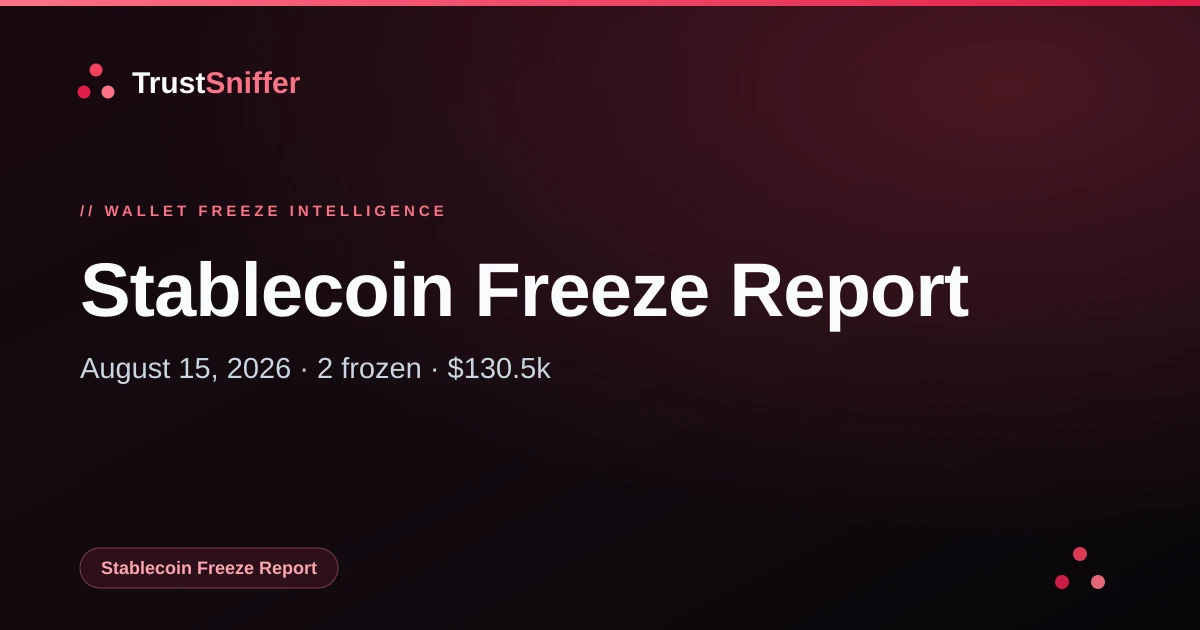
Across the networks TrustSniffer traces, issuers froze 2 addresses on August 15, 2026, removing about $130.5k in USDT and USDC from circulation. A freeze means the token issuer blacklisted the address on-chain, so the affected stablecoins can no longer be moved from it.
- TRON: 2 freezes, $130.5k frozen
Largest freeze of the day
The single largest freeze on August 15, 2026 was $130.0k on TRON, on the address TZEBfRJEstMj6sxrC3D5TcNLwdRHmKspMX. Open its analysis page for the full risk verdict, exposure trace, and connected addresses.
Wallets frozen on August 15, 2026
Each frozen address is listed below with the amount frozen, linking to its dedicated TrustSniffer analysis (verdict, exposure trace, and connected wallets).
- TZEBfRJEstMj6sxrC3D5TcNLwdRHmKspMX on TRON, $130.0k frozen
- TM9XjNEJp43ErSFhkunr3Y2KEiiyEii14L on TRON, $521.33 frozen
Both freezes that day happened on TRON, and one address accounted for almost the entire total: $130.0k of the roughly $130.5k frozen. The second address held $521.33 when the issuer acted. Issuers usually freeze funds in response to sanctions, law-enforcement requests, or theft, but this report does not say which reason applied to either wallet. The evidence TrustSniffer gathered for each one, including its risk verdict, exposure trace, and connected addresses, is on its linked analysis page.
The running picture
As of August 15, 2026, TrustSniffer's freeze index counts 10,118 addresses currently frozen by stablecoin issuers across TRON, holding roughly $3.53B in immobilised funds, out of 11,446 addresses ever blacklisted. Browse the full picture in the live Risk Index and the sanctions directory.
How TrustSniffer tracks freezes
Every figure here comes from TrustSniffer's own on-chain monitoring: it listens directly to the USDT and USDC issuer contracts on TRON and records each blacklist and un-blacklist event as it happens. Bulk imports and non-issuer flags are excluded, so this report reflects real issuer freezes only. To check an address yourself, use the free wallet-risk checker; to screen a website, use the website checker.
- Before you send stablecoins to a new counterparty, paste their address into the wallet checker to see its verdict and sanctioned-exposure trace.
- If you have already dealt with one of the addresses above, open its analysis page and review the connected wallets it lists.
- To see how this day fits the wider trend, browse the live Risk Index and the sanctions directory.
- If a site asked you to pay into a wallet, screen the site too with the website checker.
- Stablecoin freeze
- An on-chain action in which a token issuer (such as Tether for USDT or Circle for USDC) blacklists a specific address, preventing the affected stablecoins from being moved from it. Issuers do this in response to sanctions, law-enforcement requests, or theft. A freeze can later be reversed by the issuer.
Frequently asked questions
What does it mean when a stablecoin wallet is frozen?
How can I check a specific frozen wallet?
Which networks does this report cover?
How current is this data?
Freezes are a lagging signal: by the time an issuer blacklists an address, the funds are often already flagged as high-risk. TrustSniffer's monitoring frequently identifies an address as a freeze candidate before the issuer acts, which is why screening a counterparty in advance, rather than after a freeze, is the safer habit.