Stablecoin freezes on August 28, 2026
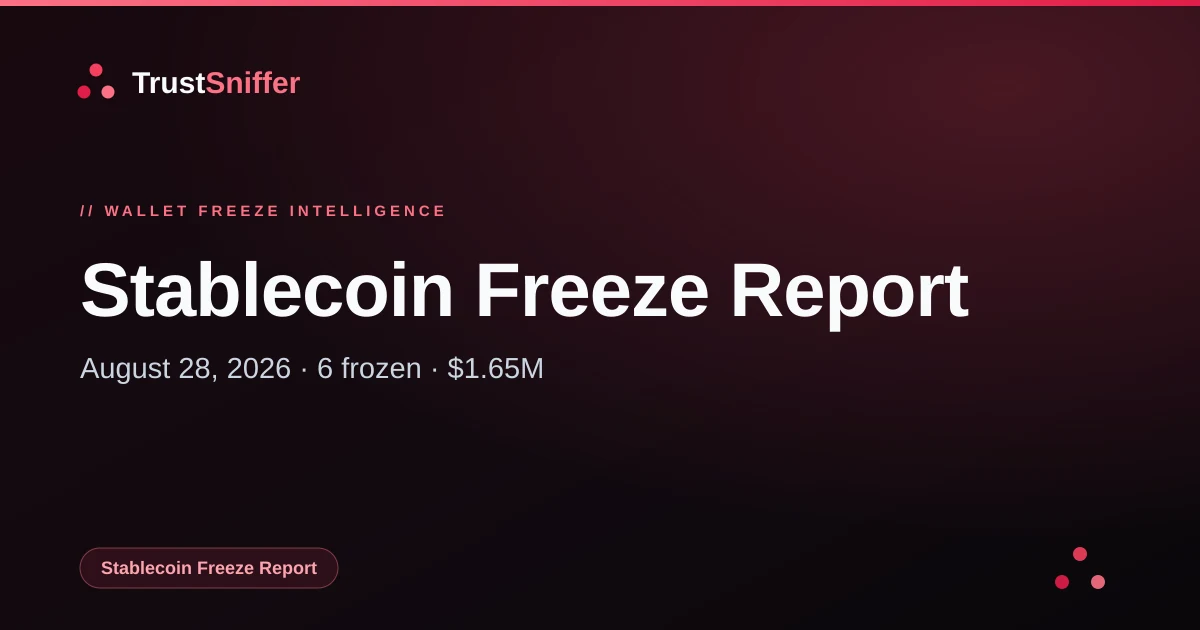
Across the networks TrustSniffer traces, issuers froze 6 addresses on August 28, 2026, removing about $1.65M in USDT and USDC from circulation. A freeze means the token issuer blacklisted the address on-chain, so the affected stablecoins can no longer be moved from it.
- Ethereum: 1 freeze, $28.4k frozen
- TRON: 5 freezes, $1.62M frozen
Largest freeze of the day
The single largest freeze on August 28, 2026 was $1.14M on TRON, on the address TG1Z4v5RPDkzZHFvXq4zqpRjvht5FBEmLt. Open its analysis page for the full risk verdict, exposure trace, and connected addresses.
Wallets frozen on August 28, 2026
Each frozen address is listed below with the amount frozen, linking to its dedicated TrustSniffer analysis (verdict, exposure trace, and connected wallets).
- TG1Z4v5RPDkzZHFvXq4zqpRjvht5FBEmLt on TRON, $1.14M frozen
- TQCpg4xz8uSv8KEhwQKXMzXSrbs1Qiyn5x on TRON, $235.1k frozen
- TScTaY3fz8ZzkBt5cF8xhJk4p4Upq32Fyb on TRON, $198.0k frozen
- TAmNsmoMMckQNb5obgx674QpqDFjVeNcFp on TRON, $49.2k frozen
- 0x6b65d61d1d7eA919c878a34B75CBB58c4603945f on Ethereum, $28.4k frozen
- TRHEywsvtW3jwhNwFi3aK3AbWydaxEtK9d on TRON, $974.75 frozen
The running picture
As of August 28, 2026, TrustSniffer's freeze index counts 10,255 addresses currently frozen by stablecoin issuers across Ethereum and TRON, holding roughly $3.52B in immobilised funds, out of 11,593 addresses ever blacklisted. Browse the full picture in the live Risk Index and the sanctions directory.
How TrustSniffer tracks freezes
Every figure here comes from TrustSniffer's own on-chain monitoring: it listens directly to the USDT and USDC issuer contracts on Ethereum and TRON and records each blacklist and un-blacklist event as it happens. Bulk imports and non-issuer flags are excluded, so this report reflects real issuer freezes only. To check an address yourself, use the free wallet-risk checker; to screen a website, use the website checker.
- Stablecoin freeze
- An on-chain action in which a token issuer (such as Tether for USDT or Circle for USDC) blacklists a specific address, preventing the affected stablecoins from being moved from it. Issuers do this in response to sanctions, law-enforcement requests, or theft. A freeze can later be reversed by the issuer.
Frequently asked questions
What does it mean when a stablecoin wallet is frozen?
How can I check a specific frozen wallet?
Which networks does this report cover?
How current is this data?
Freezes are a lagging signal: by the time an issuer blacklists an address, the funds are often already flagged as high-risk. TrustSniffer's monitoring frequently identifies an address as a freeze candidate before the issuer acts, which is why screening a counterparty in advance, rather than after a freeze, is the safer habit.
- Open the address link above for its verdict, exposure trace, and connected wallets.
- Screen a new counterparty with the free wallet-risk checker before you send funds, not after.
- If a website asked you to pay that address, run it through the website checker.
- Follow the wider trend in the live Risk Index and the sanctions directory.
If one of the addresses listed above is a counterparty you have dealt with, the blacklist applies to that address only, so your own balance is not moved. What it does tell you is something about where that money has been. Issuers act in response to sanctions, law-enforcement requests, or theft, so a blacklisted address is a signal worth taking seriously before you send anything further its way. Because the issuer controls the list, the action can also be reversed later, which is one reason the count of addresses currently blacklisted sits below the count ever blacklisted. Treat the report as a snapshot at assessment time rather than a permanent label, and check the address yourself before you rely on it.