Stablecoin freezes on September 2, 2026
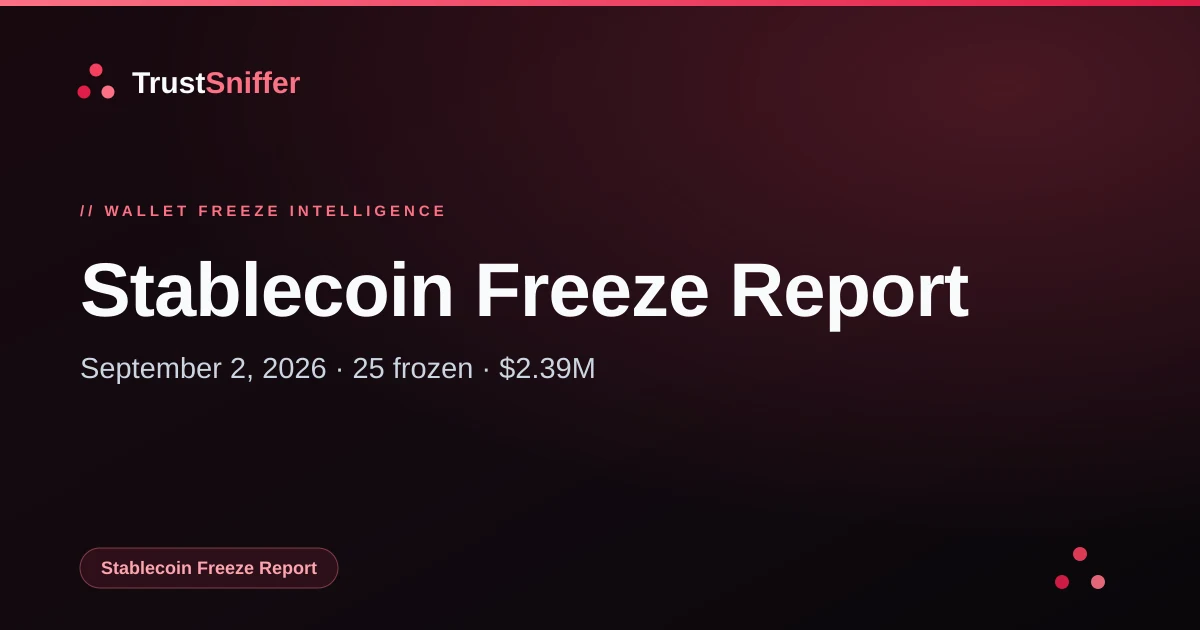
Across the networks TrustSniffer traces, issuers froze 25 addresses on September 2, 2026, removing about $2.39M in USDT and USDC from circulation. A freeze means the token issuer blacklisted the address on-chain, so the affected stablecoins can no longer be moved from it.
- Ethereum: 2 freezes, $144.9k frozen
- TRON: 23 freezes, $2.24M frozen
TRON carried most of the day's activity, with 23 of the 25 freezes and the larger share of the value, while Ethereum saw 2. The balance between the two networks can look different from one daily report to the next, so read this as a snapshot of September 2, 2026 rather than a trend.
Largest freeze of the day
The single largest freeze on September 2, 2026 was $1.39M on TRON, on the address TRwgG2VwiUjkSesTGXFoWNLbC31TE4BUkg. Open its analysis page for the full risk verdict, exposure trace, and connected addresses.
Wallets frozen on September 2, 2026
Each frozen address is listed below with the amount frozen, linking to its dedicated TrustSniffer analysis (verdict, exposure trace, and connected wallets).
- TRwgG2VwiUjkSesTGXFoWNLbC31TE4BUkg on TRON, $1.39M frozen
- TYCvbALrWwPq4idbwMiGo5ps2QgWLTESik on TRON, $186.6k frozen
- TR1VGXEkTMEzK3b79GCgKyuJifsXq4mJTG on TRON, $124.4k frozen
- TTsZLLTgJJpxM5bvxrid71yiXuGrMYqf99 on TRON, $106.9k frozen
- TRUwp2SNpfaC9rdK9QFf9Q26w2TYEL3iik on TRON, $103.1k frozen
- 0x510629AFF70c21F53AAE6ab00A4ccCBE1c636D50 on Ethereum, $97.7k frozen
- TMThnHLUnTJqzsfGcjbBwgj2Y6SMAa9JEU on TRON, $87.5k frozen
- TAArQU5KVohMmbssTr9C76AUhnYebmeXeu on TRON, $72.1k frozen
- TQdWWM2om5vSvSgruWgid6jArtkohq11qo on TRON, $50.6k frozen
- 0xe557B10c68103ea88198016D5925aA18039de5c2 on Ethereum, $47.2k frozen
- TVpidjv1BP56sSTedYeC7oEQWosdGRT4qv on TRON, $30.0k frozen
- TTa2BL6fRnD5h7uQdi3444CPiUF4hLZkkg on TRON, $17.5k frozen
- TGKbrPcmt5ogvF63GCcUDcUkWHwjTczcFp on TRON, $17.2k frozen
- TAQtmPdcUZKhFRjEZrib5J4KPpRAcbshWP on TRON, $15.8k frozen
- TT685y11dRF2gzXxQM2yG5PjMQLBeUAcSV on TRON, $10.4k frozen
- TNSLDf52f87zSs9LJjkyTLoYbEknWXuMv3 on TRON, $9.9k frozen
- TFk7avbWGSSab2RB4wBv7W4DAiTEfejJ5j on TRON, $5.2k frozen
- TWYXdwtTCZQsG5JSvz8xHiyozz5vF4uLMX on TRON, $3.7k frozen
- TTC16mbJYrsBXKRBozp2u2Zmd34WGVCBVg on TRON, $3.5k frozen
- TTDMRagghXMKoQwA8WJzbBUQJTRYBXSesj on TRON, $2.9k frozen
- TGAeuP8T1Y3aavSv3faYkZjgaB8ePzC4f4 on TRON, $2.1k frozen
- TN8oNwvp4Kv5U814SnQaLwXup1xRRsqJ7Y on TRON, $1.0k frozen
- TRVve7XKH2gKVb7wPfcJH24o4kHinuCtM4 on TRON, $192.96 frozen
- TJZqq8kMsJGgq5W7TmSJErkmkSTbXqTW9d on TRON, $8.89 frozen
- TWo3YRpyoxS6bszfrizwxTZgzeR2YWJ4z3 on TRON, $0.00 frozen
The running picture
As of September 2, 2026, TrustSniffer's freeze index counts 10,322 addresses currently frozen by stablecoin issuers across Ethereum and TRON, holding roughly $3.52B in immobilised funds, out of 11,660 addresses ever blacklisted. Browse the full picture in the live Risk Index and the sanctions directory.
Set against that running total, the 25 addresses blacklisted on September 2, 2026 are a small slice of the 10,322 that remain frozen. The gap between the 11,660 addresses ever blacklisted and the 10,322 still frozen matters too: an issuer can lift a freeze, so being blacklisted once does not mean an address stays that way forever. If you are checking an address today, what counts is its status and exposure at assessment time, not only whether it once appeared in a report like this one.
How TrustSniffer tracks freezes
Every figure here comes from TrustSniffer's own on-chain monitoring: it listens directly to the USDT and USDC issuer contracts on Ethereum and TRON and records each blacklist and un-blacklist event as it happens. Bulk imports and non-issuer flags are excluded, so this report reflects real issuer freezes only. To check an address yourself, use the free wallet-risk checker; to screen a website, use the website checker.
- Stablecoin freeze
- An on-chain action in which a token issuer (such as Tether for USDT or Circle for USDC) blacklists a specific address, preventing the affected stablecoins from being moved from it. Issuers do this in response to sanctions, law-enforcement requests, or theft. A freeze can later be reversed by the issuer.
Frequently asked questions
What does it mean when a stablecoin wallet is frozen?
How can I check a specific frozen wallet?
Which networks does this report cover?
How current is this data?
Freezes are a lagging signal: by the time an issuer blacklists an address, the funds are often already flagged as high-risk. TrustSniffer's monitoring frequently identifies an address as a freeze candidate before the issuer acts, which is why screening a counterparty in advance, rather than after a freeze, is the safer habit.
- Screen an address before you send funds to it, not after, with the free wallet checker.
- Verify any address a counterparty gives you, even if you have paid that counterparty before.
- If a wallet you deal with turns up in a list like this one, open its analysis page and look at the verdict, the exposure trace, and the connected addresses.
- Check the website behind a payment request as well, using the website checker.
- Remember that a freeze is an issuer action tied to sanctions, law enforcement, or theft, and that the evidence behind it usually existed on-chain before the blacklist event.