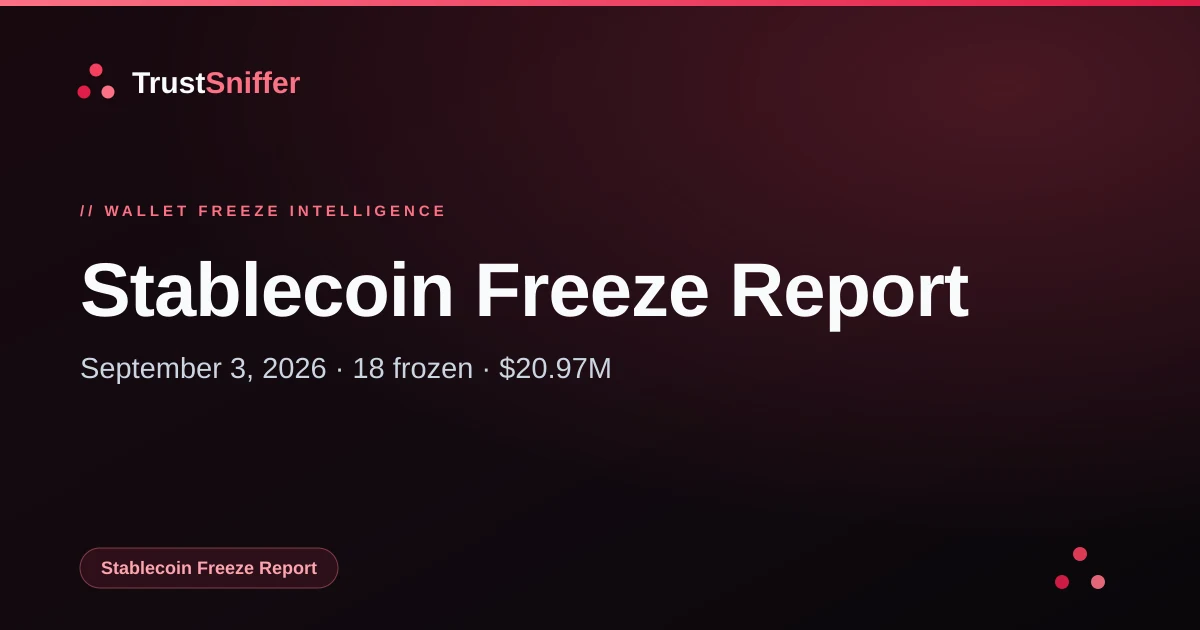
Stablecoin freezes on September 3, 2026
Across the networks TrustSniffer traces, issuers froze 18 addresses on September 3, 2026, removing about $20.97M in USDT and USDC from circulation. A freeze means the token issuer blacklisted the address on-chain, so the affected stablecoins can no longer be moved from it.
- Ethereum: 1 freeze, $73.0k frozen
- TRON: 17 freezes, $20.90M frozen
The two networks looked very different on this date. TRON carried 17 of the 18 addresses and $20.90M of the $20.97M total, while Ethereum accounted for a single address holding $73.0k. A day can therefore look heavy in value terms and still involve only a handful of addresses, which is why the amount frozen and the number of addresses are worth reading side by side rather than on their own.
Largest freeze of the day
The single largest freeze on September 3, 2026 was $6.41M on TRON, on the address TRJLDjrB2J4k4v6XuFkfzuzyZTC11evSqC. Open its analysis page for the full risk verdict, exposure trace, and connected addresses.
The day was top-heavy: this one address carried far more value than any other in the list, and the remaining addresses shared amounts that fall away quickly further down. That pattern matters if you are trying to judge a day at a glance, because a single large case can lift the headline total without saying much about the other addresses. The per-address analysis pages are where that difference becomes visible.
Wallets frozen on September 3, 2026
Each frozen address is listed below with the amount frozen, linking to its dedicated TrustSniffer analysis (verdict, exposure trace, and connected wallets).
- TRJLDjrB2J4k4v6XuFkfzuzyZTC11evSqC on TRON, $6.41M frozen
- TN9WhVRGF9BHwn2fNWF4vw7mmKzW2FzkFH on TRON, $3.14M frozen
- TYHqCicp2sqDHBbnBaPHTZKSwWAXJ2z9Q2 on TRON, $3.02M frozen
- TLoJwAy8aEbQfLEU35txd8nF2ZUtYBBWYN on TRON, $2.34M frozen
- TDJvDjsRLirx5YZvKuu78L2VadqKiowSqw on TRON, $1.39M frozen
- TFLQE7A19G98NMoxDoqKPZKBCdxwGYv5c3 on TRON, $1.22M frozen
- TYnXAFDDvD2WdcBDvbG5pmRLsiMjBZNEuk on TRON, $1.12M frozen
- TEPGTa5UQQfPuCmJJ7vKTrGx9yreA2AwmQ on TRON, $994.3k frozen
- TTQNTYU9kkJR8uT2xUqaK8a8Cy6yNqZrCL on TRON, $549.5k frozen
- TKr4t3PPxdAd4BPxyF9wsxtYf4R9hwdRhu on TRON, $324.1k frozen
- TSfW5RQXvyNo1zBugfoRCGeZKGZTNT3hhW on TRON, $200.1k frozen
- TXfpYiGyZS8CEnxJYJRCvSfAY6z7Wkb776 on TRON, $100.2k frozen
- 0xd0C08Ee812E64ccBEbfC39B320729eb7C5D2684e on Ethereum, $73.0k frozen
- TEqU3Rxk9axNqzZ1GjMwXvJhjp4voQRaTE on TRON, $43.0k frozen
- TLCZyfUoxPwmizevY7gPQrwaFgGQtTdpJb on TRON, $24.4k frozen
- TJPYUqECvnbzJXGmmZggyAaPjzsqxBpFcr on TRON, $17.0k frozen
- 6xbJxcaipu8J2vDGevWdUKywKRRFpNMjR on TRON, $0.00 frozen
- TX9eFfCEVT9LGAZcpFwP3b2fPt6U2uKrDe on TRON, $0.00 frozen
The running picture
As of September 3, 2026, TrustSniffer's freeze index counts 10,340 addresses currently frozen by stablecoin issuers across Ethereum and TRON, holding roughly $3.52B in immobilised funds, out of 11,678 addresses ever blacklisted. Browse the full picture in the live Risk Index and the sanctions directory.
Those two counts are worth reading together. The number of addresses currently frozen is lower than the number ever blacklisted, which fits how the mechanism works: an issuer can reverse a blacklist entry later, so an address can come off the list as well as go on it. A result you saw months ago is not necessarily the result you would see today, and that is the main reason to re-check an address rather than rely on an older answer.
How TrustSniffer tracks freezes
Every figure here comes from TrustSniffer's own on-chain monitoring: it listens directly to the USDT and USDC issuer contracts on Ethereum and TRON and records each blacklist and un-blacklist event as it happens. Bulk imports and non-issuer flags are excluded, so this report reflects real issuer freezes only. To check an address yourself, use the free wallet-risk checker; to screen a website, use the website checker.
- Stablecoin freeze
- An on-chain action in which a token issuer (such as Tether for USDT or Circle for USDC) blacklists a specific address, preventing the affected stablecoins from being moved from it. Issuers do this in response to sanctions, law-enforcement requests, or theft. A freeze can later be reversed by the issuer.
Frequently asked questions
What does it mean when a stablecoin wallet is frozen?
How can I check a specific frozen wallet?
Which networks does this report cover?
How current is this data?
Freezes are a lagging signal: by the time an issuer blacklists an address, the funds are often already flagged as high-risk. TrustSniffer's monitoring frequently identifies an address as a freeze candidate before the issuer acts, which is why screening a counterparty in advance, rather than after a freeze, is the safer habit.
If you are weighing up an address before sending anything, the practical order is simple. Paste the Ethereum or TRON address into the free wallet checker to see its verdict, sanctioned-exposure trace and connected addresses, look up related entries in the sanctions directory, and put the site or platform behind the request through the website checker. None of that guarantees an outcome, but it puts the questions before the transfer instead of after it.