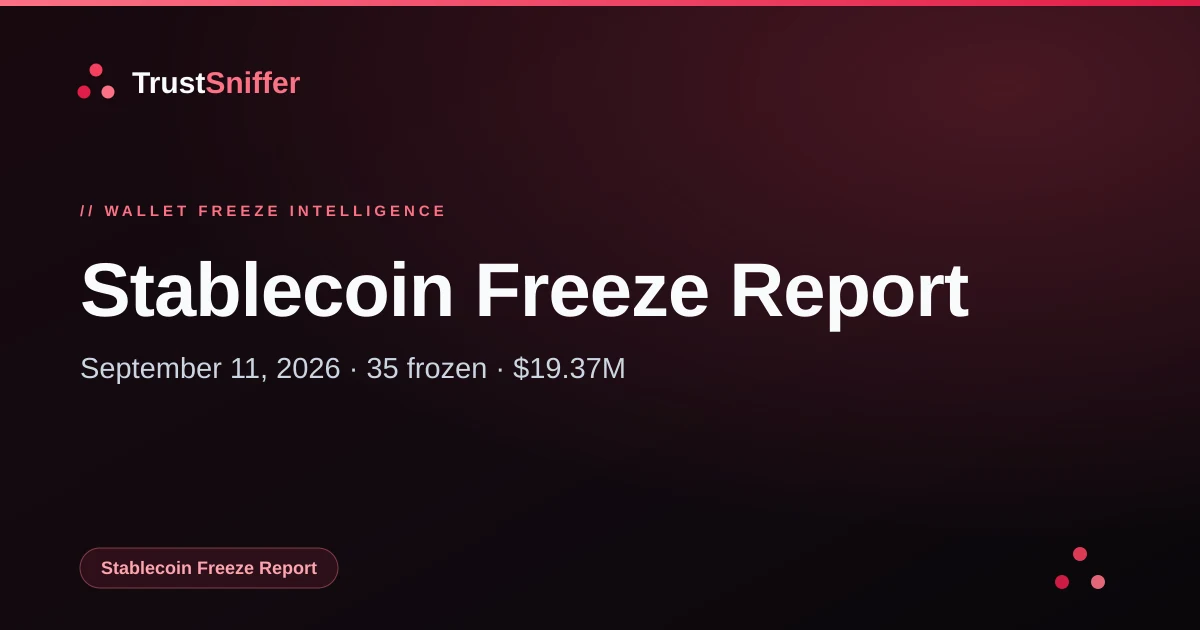
Stablecoin freezes on September 11, 2026
Across the networks TrustSniffer traces, issuers froze 35 addresses on September 11, 2026, removing about $19.37M in USDT and USDC from circulation. A freeze means the token issuer blacklisted the address on-chain, so the affected stablecoins can no longer be moved from it.
- Ethereum: 4 freezes, $19.33M frozen
- TRON: 31 freezes, $40.0k frozen
The two networks looked very different. TRON had most of the individual freezes, 31 of the 35, but they held only about $40.0k. Ethereum had just 4 freezes, yet they held $19.33M, which is almost all of the day's total. So a few large Ethereum wallets account for the dollar figure, while the TRON activity was spread across many smaller addresses.
Largest freeze of the day
The single largest freeze on September 11, 2026 was $11.83M on Ethereum, on the address 0x5183fED33E8Bc603B3b6100C46CF866ED200b66e. Open its analysis page for the full risk verdict, exposure trace, and connected addresses.
The second-largest freeze was also on Ethereum: $7.51M on 0xF13a266D9899ef08e9b1BaF972f8a7b7C5317869. Between them, these two addresses hold most of the value frozen that day. On TRON, the largest single freeze in the list was $23.3k, on TYJGDAPFPKcSFUxBWmRVFzSG67nQCCdNFj.
Wallets frozen on September 11, 2026
Each frozen address is listed below with the amount frozen, linking to its dedicated TrustSniffer analysis (verdict, exposure trace, and connected wallets).
- 0x5183fED33E8Bc603B3b6100C46CF866ED200b66e on Ethereum, $11.83M frozen
- 0xF13a266D9899ef08e9b1BaF972f8a7b7C5317869 on Ethereum, $7.51M frozen
- TYJGDAPFPKcSFUxBWmRVFzSG67nQCCdNFj on TRON, $23.3k frozen
- TYPeLaM5aaZgepzV1iAGFGUzLj5e43thUJ on TRON, $5.4k frozen
- TJKzN39qxQuoS4mUSu1uzUM7uRGQ2kBaop on TRON, $5.0k frozen
- TJ1ZcbKaqvw8f8Gbmab5GUeZnndNMha5kW on TRON, $4.6k frozen
- TWtNwiePMF4FMLSYHhNaBq4sURsoibZLSV on TRON, $871.14 frozen
- TQc3ifecyjfoFdELdkNfhTxteei8KPd3dm on TRON, $500.00 frozen
- TXJTGnPDR6rtSC77Wiv2P93XFoc92LHet7 on TRON, $92.44 frozen
- TDYhybXaH6MucixtVWP5DcW5TRVRtEFG7z on TRON, $36.10 frozen
- THh6R6ixGw4MUeAaV9Js38cLfifsEtG4HE on TRON, $29.36 frozen
- TRvArY9AD9EGBdYGMXNXcc58knfdgSNHXM on TRON, $20.00 frozen
- TRJoJYfG41XVNDLXedFQhP5iMXpDCKgoFH on TRON, $12.55 frozen
- TT6W5sjQV1B1tXfiXPACyGkGVd2P3gPSXY on TRON, $7.04 frozen
- TQvagv3d2sXfPytiSK3SxRcEgniWQHsFCD on TRON, $2.31 frozen
- TVGgdGSWmNUxCaf8eWydbbt3rZZHvUTmfn on TRON, $0.79 frozen
- TXmNDWu7zNYvJtn9pWvEkXNFknRTzPnhib on TRON, $0.70 frozen
- TZ7LmC6zBipRx6tDMavbzaF8piBpw89cNz on TRON, $0.48 frozen
- TT3Jg1jsywjYs5V3qRu34UcawKLs9PQXkU on TRON, $0.06 frozen
- TUVNGw2z3Gt8SDNukoj8GqSStKrve5i3ts on TRON, $0.06 frozen
- TQ1TSFVcSJ3yMNM4mQ4fqqN4cJrNwwetiw on TRON, $0.00 frozen
- 0xD23afebd92Fe2a8E041700219a2b38ae717e6E25 on Ethereum, $0.00 frozen
- 0xec9645BF5328eBB37b3cF0464aA86Db481c03500 on Ethereum, $0.00 frozen
- TTCqAi1yXBzpfSjb43kj4U9r7ZRwSmpnBR on TRON, $0.00 frozen
- THUJ5yYm7KtCTmqkxUuDACQS6tXyJQKChN on TRON, $0.00 frozen
- TJMYLyqdAq6o4CF66MLqrto536jwRE9U8T on TRON, $0.00 frozen
- TVy8M91CptNkAQQJC87Vxbskc2W9w1gd2E on TRON, $0.00 frozen
- TR1ZDRCUjAMktBeMSyFCGmmYjkWvRErQmJ on TRON, $0.00 frozen
- TCWg9V319hsVxGRrS2XGex3qRpB1beSje5 on TRON, $0.00 frozen
- TJdQMxrz6wjxhDNHXjgnSGYv9hdXMKBXbp on TRON, $0.00 frozen
- TKh4qfcU5co3JvdAQWXC8MoXbL1kMXbErM on TRON, $0.00 frozen
- TV6yRHFYffm7VSySqhywWoqtDoJAt1txRL on TRON, $0.00 frozen
- TDMT2ouZiATfkZhDoSzwJ6QRuiypAruFPP on TRON, $0.00 frozen
- TS5JznYR6CXJzasjkjUxYSg8SEFkWj1yqq on TRON, $0.00 frozen
- TZFaCNeX4tYmT1GfCpe3giFxH4KvM5Kz8m on TRON, $0.00 frozen
The running picture
As of September 11, 2026, TrustSniffer's freeze index counts 10,500 addresses currently frozen by stablecoin issuers across Ethereum and TRON, holding roughly $3.52B in immobilised funds, out of 11,838 addresses ever blacklisted. Browse the full picture in the live Risk Index and the sanctions directory.
How TrustSniffer tracks freezes
Every figure here comes from TrustSniffer's own on-chain monitoring: it listens directly to the USDT and USDC issuer contracts on Ethereum and TRON and records each blacklist and un-blacklist event as it happens. Bulk imports and non-issuer flags are excluded, so this report reflects real issuer freezes only. To check an address yourself, use the free wallet-risk checker; to screen a website, use the website checker.
- The issuer, such as Tether for USDT or Circle for USDC, has blacklisted the address, so the affected stablecoins can no longer be moved from it.
- Freezes are usually tied to sanctions, law-enforcement requests or theft, and they are an issuer action rather than a TrustSniffer verdict.
- A freeze can later be reversed by the issuer, so the status reflects the picture at assessment time.
- A freeze is a lagging signal. Checking a counterparty with the wallet checker before you send funds is the safer habit.
- Stablecoin freeze
- An on-chain action in which a token issuer (such as Tether for USDT or Circle for USDC) blacklists a specific address, preventing the affected stablecoins from being moved from it. Issuers do this in response to sanctions, law-enforcement requests, or theft. A freeze can later be reversed by the issuer.
Frequently asked questions
What does it mean when a stablecoin wallet is frozen?
How can I check a specific frozen wallet?
Which networks does this report cover?
How current is this data?
Freezes are a lagging signal: by the time an issuer blacklists an address, the funds are often already flagged as high-risk. TrustSniffer's monitoring frequently identifies an address as a freeze candidate before the issuer acts, which is why screening a counterparty in advance, rather than after a freeze, is the safer habit.