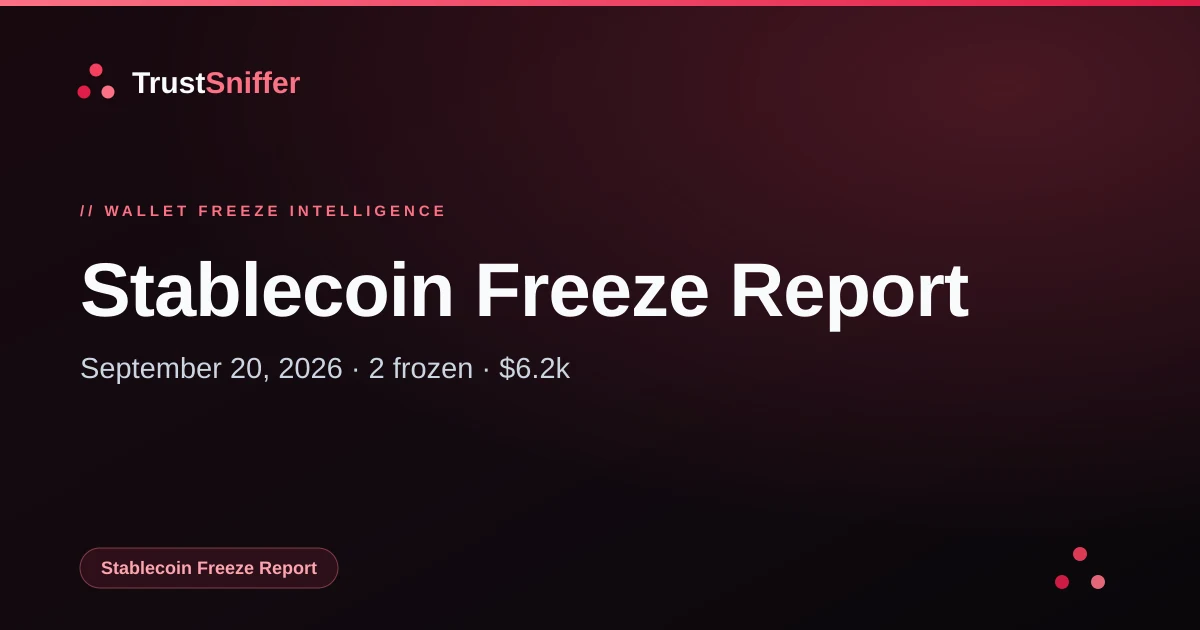
Stablecoin freezes on September 20, 2026
Across the networks TrustSniffer traces, issuers froze 2 addresses on September 20, 2026, removing about $6.2k in USDT and USDC from circulation. A freeze means the token issuer blacklisted the address on-chain, so the affected stablecoins can no longer be moved from it.
- Ethereum: 1 freeze, $6.2k frozen
- TRON: 1 freeze, $0.00 frozen
The split is worth reading closely. The Ethereum freeze accounts for the whole $6.2k reported on this date, while the TRON entry shows $0.00 frozen: that address was blacklisted without a stablecoin balance sitting on it at the time. Both count as issuer actions on the blacklist, and both stay in place unless the issuer later reverses them.
$6.2k frozen in a single Ethereum address
The single largest freeze on September 20, 2026 was $6.2k on Ethereum, on the address 0x5d54930862eb5fa92f0df8F6C9321b81121EF556. Open its analysis page for the full risk verdict, exposure trace, and connected addresses.
Wallets frozen on September 20, 2026
Each frozen address is listed below with the amount frozen, linking to its dedicated TrustSniffer analysis (verdict, exposure trace, and connected wallets).
- 0x5d54930862eb5fa92f0df8F6C9321b81121EF556 on Ethereum, $6.2k frozen
- TT5KQgALEbsx6ynDX4x1H6HFFKDPa2Kn4c on TRON, $0.00 frozen
If one of these addresses shows up in your own transaction history, its analysis page is the place to start: it carries the verdict, the exposure trace, and the connected wallets behind the freeze. You can run the same check on any other Ethereum or TRON address with the free wallet checker, and screen a site that asked you to deposit with the website checker.
10,667 addresses now frozen across Ethereum and TRON
As of September 20, 2026, TrustSniffer's freeze index counts 10,667 addresses currently frozen by stablecoin issuers across Ethereum and TRON, holding roughly $3.52B in immobilised funds, out of 12,005 addresses ever blacklisted. Browse the full picture in the live Risk Index and the sanctions directory.
Those two totals measure different things. The 10,667 count covers addresses that are blacklisted right now, while 12,005 covers every address these issuers have ever blacklisted. The two drift apart because a freeze is not always permanent: an issuer can un-blacklist an address, and TrustSniffer records those reversals as they happen, so the current count can fall as well as rise. The live Risk Index and the sanctions directory track both as they move.
- Stablecoin freeze
- An on-chain action in which a token issuer (such as Tether for USDT or Circle for USDC) blacklists a specific address, preventing the affected stablecoins from being moved from it. Issuers do this in response to sanctions, law-enforcement requests, or theft. A freeze can later be reversed by the issuer.
Frequently asked questions
What does it mean when a stablecoin wallet is frozen?
How can I check a specific frozen wallet?
Which networks does this report cover?
How current is this data?
Freezes are a lagging signal: by the time an issuer blacklists an address, the funds are often already flagged as high-risk. TrustSniffer's monitoring frequently identifies an address as a freeze candidate before the issuer acts, which is why screening a counterparty in advance, rather than after a freeze, is the safer habit.