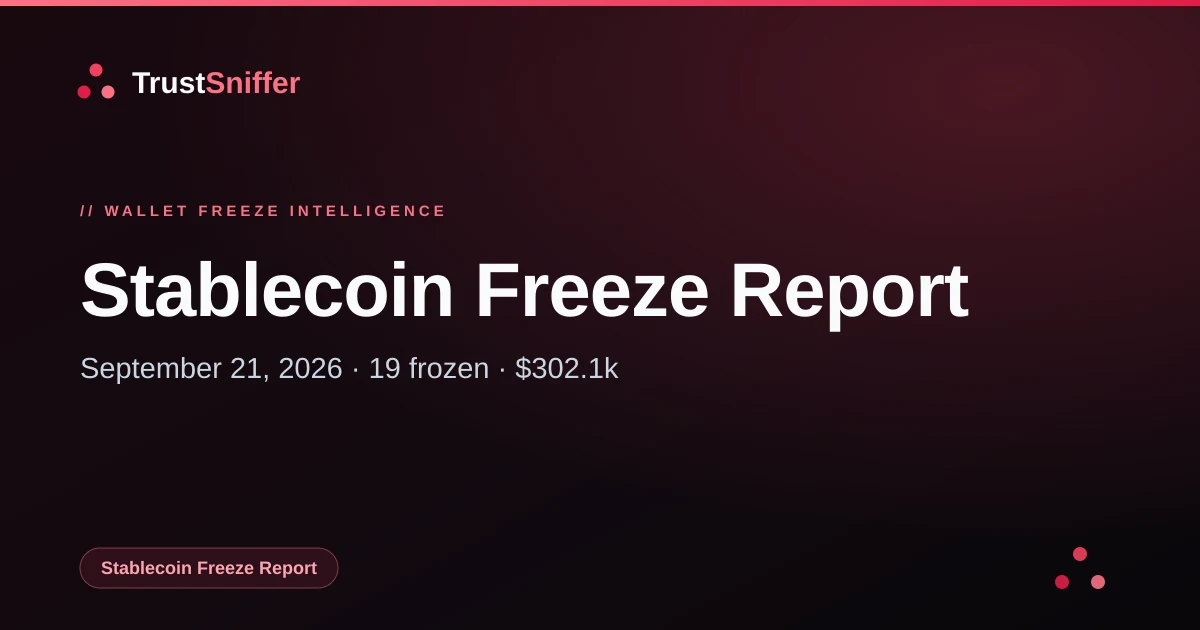
Stablecoin freezes on September 21, 2026
Across the networks TrustSniffer traces, issuers froze 19 addresses on September 21, 2026, removing about $302.1k in USDT and USDC from circulation. A freeze means the token issuer blacklisted the address on-chain, so the affected stablecoins can no longer be moved from it.
- TRON: 19 freezes, $302.1k frozen
$197.4k frozen in a single TRON address
The single largest freeze on September 21, 2026 was $197.4k on TRON, on the address TXSBVX1bmptVq6E7aiWTDu9iR4hNQKGEwz. Open its analysis page for the full risk verdict, exposure trace, and connected addresses.
Wallets frozen on September 21, 2026
Each frozen address is listed below with the amount frozen, linking to its dedicated TrustSniffer analysis (verdict, exposure trace, and connected wallets).
- TXSBVX1bmptVq6E7aiWTDu9iR4hNQKGEwz on TRON, $197.4k frozen
- TXgxqcH5z3Jtnx1URjtGER2Wivimg8HKyF on TRON, $100.2k frozen
- TDdX582zLyjqSSo8nFLRkvtBmR5vQfQ1Yu on TRON, $4.5k frozen
- TKhnxVkArUGJ9W3936vqKK2rKoFgLKMYgS on TRON, $0.00 frozen
- TX5GyBQxGxQmHc7CES3wvN8iSzjmgVFNXm on TRON, $0.00 frozen
- TLEwZLLTG9szHj1jc7pXqJtUnvUxH15pMa on TRON, $0.00 frozen
- TJs7Di3vfDoKPkXXoRPQpE5RGfZzoMdcpM on TRON, $0.00 frozen
- TGTJQkcWkeaNQaAP6CEKyy8p5YGXEC9NWA on TRON, $0.00 frozen
- TSpJcxAFvKFqcBbJSzNxVtLbaXmjC4UJ9A on TRON, $0.00 frozen
- TFdQTqSGM1P1Vc5QHDXJht1V69tdVygNFD on TRON, $0.00 frozen
- TTCBsUra6mVMkpTj8RvdBeh1VsuVy95HCw on TRON, $0.00 frozen
- TEhP14CyZAUyYkcuXpAH6Wc3xhPYeZG1h6 on TRON, $0.00 frozen
- TXYwn5sDeLuqnpvWWqn6HQHFffX1RsGAWn on TRON, $0.00 frozen
- TCfiUHxu3bCfxYK3eYnx5wvJhrahmJxEvo on TRON, $0.00 frozen
- TLjgYhERD3MzpoHTX1YBrFjq4uwu4bzKus on TRON, $0.00 frozen
- TT73VJYLz6rCq1kAJ826HtSuPApcVmYfoM on TRON, $0.00 frozen
- TDDmCGoQ2U4P6QVfBJC2jnzAixnKV9Jp5a on TRON, $0.00 frozen
- TVkEZR1LNqWHcjReYLzVZ7ifndgQpVSpzJ on TRON, $0.00 frozen
- TQ1yXy6Ud1DYzRXWP2bYWGpmSZoG2Neybb on TRON, $0.00 frozen
10,686 addresses now frozen across TRON
As of September 21, 2026, TrustSniffer's freeze index counts 10,686 addresses currently frozen by stablecoin issuers across TRON, holding roughly $3.52B in immobilised funds, out of 12,024 addresses ever blacklisted. Browse the full picture in the live Risk Index and the sanctions directory.
- Who acts: the token issuer, Tether for USDT and Circle for USDC, writing the blacklist directly on-chain.
- Why: sanctions, law-enforcement requests, or theft.
- How long: the issuer can later reverse it, so a blacklisted address will not always stay that way.
- What TrustSniffer counts: issuer blacklist and un-blacklist events only, with bulk imports and non-issuer flags excluded.
- What you get per address: an assessment page with the verdict, the exposure trace, and the connected wallets.
A freeze does not move the funds anywhere. The tokens stay at the address, but the issuer contract refuses any transfer out of it, so the balance sits where it is unless and until the issuer reverses the blacklist. Several addresses in the list above show $0.00 frozen, which means no USDT or USDC balance was recorded at that address at assessment time. If you are screening a counterparty rather than reading today's list, the free wallet-risk checker returns the same verdict, sanctioned-exposure trace, and connected addresses for any Ethereum or TRON address you paste.
What a stablecoin freeze means in practice
- Stablecoin freeze
- An on-chain action in which a token issuer (such as Tether for USDT or Circle for USDC) blacklists a specific address, preventing the affected stablecoins from being moved from it. Issuers do this in response to sanctions, law-enforcement requests, or theft. A freeze can later be reversed by the issuer.
Frequently asked questions
What does it mean when a stablecoin wallet is frozen?
How can I check a specific frozen wallet?
Which networks does this report cover?
How current is this data?
Freezes are a lagging signal: by the time an issuer blacklists an address, the funds are often already flagged as high-risk. TrustSniffer's monitoring frequently identifies an address as a freeze candidate before the issuer acts, which is why screening a counterparty in advance, rather than after a freeze, is the safer habit.