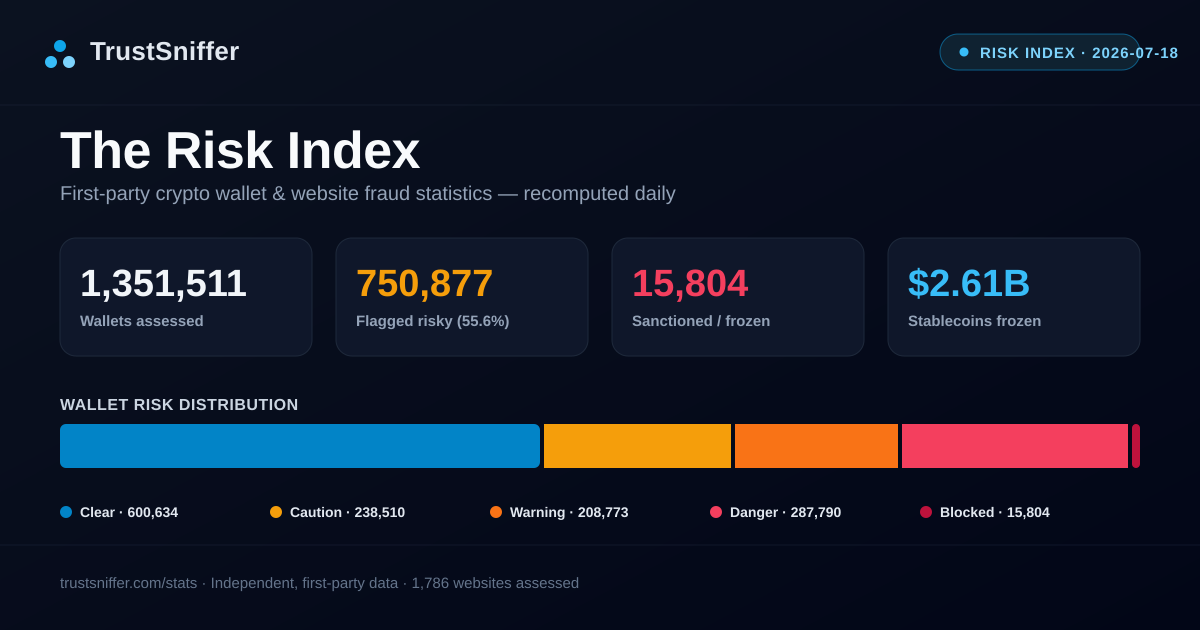
The headline numbers
- Wallets assessed: 1,351,511
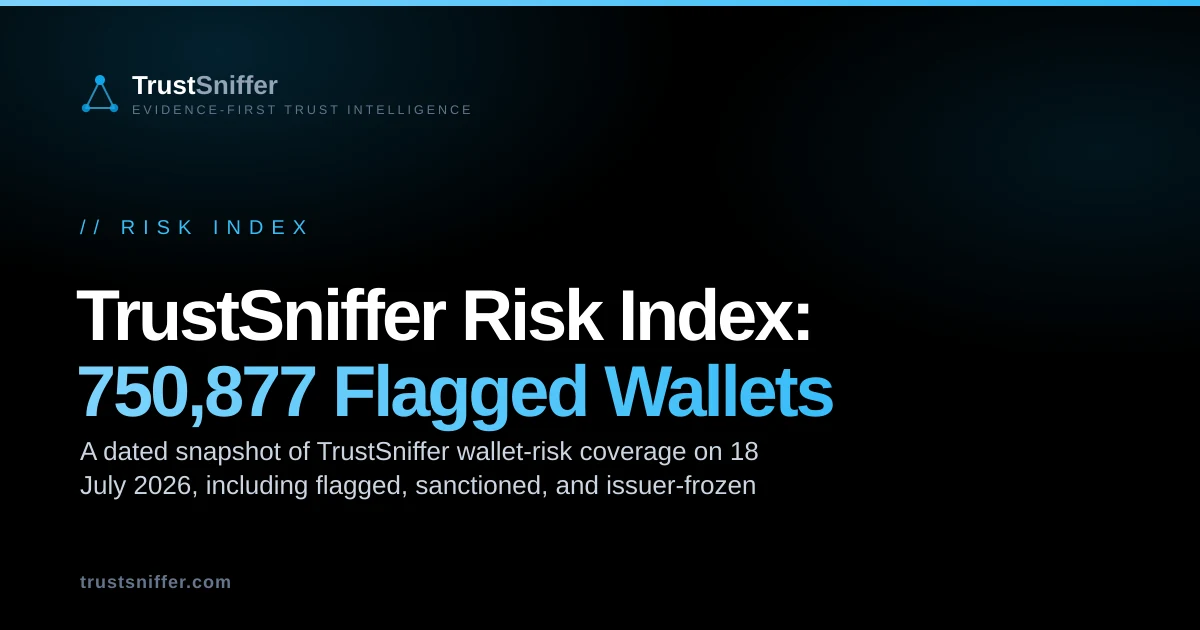
- Wallets flagged as risky: 750,877 (55.6%)
- Sanctioned / issuer-frozen (ground truth): 15,804
- Stablecoins frozen on the tracked addresses: ~$2.61 billion
- Websites assessed: 1,786
- Websites flagged as risky: 112
- Curated taint-source roots (sanctions lists, issuer freezes, reported scammers): 236
Where the wallet risk concentrates
As of 18 July 2026, just over half of the 1,351,511 wallet records in TrustSniffer's analysis archive showed some exposure, and most flagged records sat in the indirect-exposure and early-signal bands rather than the blocked band. This snapshot describes our archive, not the wider population of crypto wallets. Stored wallet verdicts use one of five bands, from Clear (no risk signals found) to Blocked (sanctioned or confirmed issuer-frozen). The band counts below are first-party figures for this date only. Screen any supported Ethereum or TRON address with the wallet checker.
- Clear — 600,634 (44.4%): no risk signals detected.
- Caution — 238,510 (17.6%): early or weak signals.
- Warning — 208,773 (15.4%): indirect exposure to tainted funds.
- Danger — 287,790 (21.3%): direct exposure to tainted funds.
- Blocked — 15,804 (1.2%): sanctioned or frozen by a stablecoin issuer.
The $2.61 billion frozen at the snapshot time
Of the blocked wallet records in this snapshot, the majority were addresses recorded as frozen by a stablecoin issuer on-chain — 8,598 on Ethereum and 7,079 on TRON. The affected tokens could not move while each recorded freeze was active. An authorized issuer may later reverse or update the status, so historical frozen-value totals should be interpreted as snapshot values. Published records can be reviewed in the sanctions directory, and current aggregates are shown on the Risk Index page.
Websites: trust is the norm, not the exception
On the web side the picture inverts: of 1,786 assessed sites, 1,153 (64.6%) earn high trust and only 112 are flagged risky (58 low-trust, 54 critical). A low flag rate is expected — we mostly assess sites people actively ask about, and the long tail of the web is ordinary. Check any domain yourself with the website checker.
What this means
Two observations stand out in this dated snapshot. First, risk signals appeared across many stored wallet records, while sanctions, recorded issuer freezes, and direct taint were concentrated in a smaller group. Second, the recorded frozen value at the snapshot time was $2.61B. That value is not necessarily cumulative or permanent: an authorized issuer may later reverse or update a freeze status. For a concrete example behind the aggregate, see our on-chain trace of the sanctioned Central Bank of Iran wallets.
Frequently asked questions
How many crypto wallets are flagged as risky right now?
How much stablecoin value is currently frozen?
What share of websites are flagged as fraudulent?
Where do these numbers come from?
- TrustSniffer Risk Index
- A dated aggregate snapshot of wallets and domains assessed by TrustSniffer; it describes dataset coverage, not population-wide prevalence.