Verdict
reading.ac.uk is moderately trusted.
Most signals looked ordinary, and some evidence was missing. Read the checks below before you pay or hand over personal details.
| What this site appears to be | Official university informational page listing subjects and services, with course/policy links, contact numbers, campus details, and social links. Standard cookie consent present. No financial investment or credential-harvesting indicators. |
|---|
Evidence status and limitations
Evidence completeness: UNKNOWN
- The real-world operator identity was not independently verified.
- Module-level completeness metadata is unavailable for this legacy report.
At a glance
The checks that decide most of this verdict.
| Malware engines | None flagged itVirusTotal | Clear |
|---|---|---|
| Google Safe Browsing | Not listedGoogle | Clear |
| Abuse reports on the host | 0 reportsAbuseIPDB; shared hosting inflates this count | Noted |
| Domain age | Not availableNo registration record was returned | Noted |
| Web archive | Never archivedNo public history of this site | Watch |
| Certificate | Encrypted connectionIssued by Sectigo Public Server Authentication CA OV R36 | Noted |
The page as captured
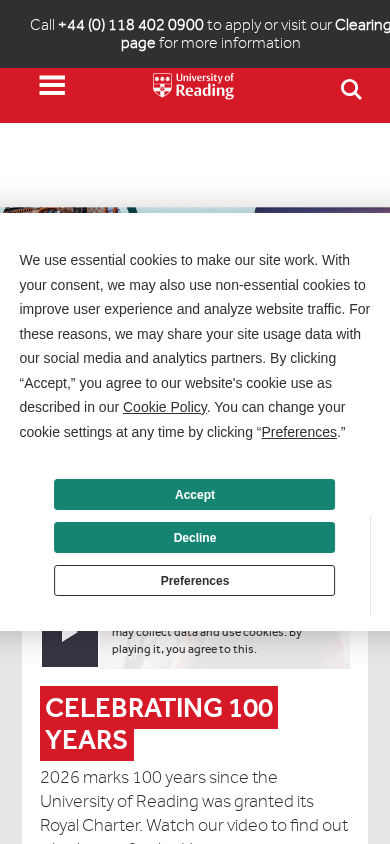
Key findings
- Automated classification: Safe for Read-Only.
- No flags from the reputation services TrustSniffer consulted at assessment time.
Full analysis
Overview
The website is the official informational presence of the University of Reading, presenting undergraduate and postgraduate courses, subject areas, admissions guidance, campus and accommodation information, research, news, and contact services. Its apparent purpose is to support higher-education recruitment, student information, and institutional communications rather than financial or commercial transactions.
Scam/Impersonation Risk
No contradictions were observed. The homepage presents a coherent university identity, extensive academic content, campus details, contact information, and links to established social platforms; the available evidence also identifies no phishing, brand-impersonation, credential-harvesting, malicious-script, or financial-solicitation indicators. The site’s apparent identity is therefore consistent with an institutional university website, although the real-world operator connection remains assessed as likely rather than independently proven. Evidence:
- Homepage: identifies “University of Reading” and lists undergraduate and postgraduate subjects, admissions pathways, and institutional services.
- Homepage and linked site pages: provide `/contact`, `/about-us`, `/study-and-life`, `/courses`, and `/clearing` sections, with campus and support information.
- Page behavior: one search form was observed, with no login form, hidden sensitive form, external password submission, wallet connection, clipboard hijacking, or cloaking detected.
- External reputation checks: 0 malicious and 0 suspicious detections, with no blacklist or phishing result recorded.
Regulatory Verification Notes
The legal and identity presentation is consistent with an academic institution: the site names the University of Reading and supplies contact, campus, course, policy, and support information. The available evidence does not establish a specific licensing or registration number on the reviewed pages; for an educational institution, this is a verification point concerning institutional status rather than evidence of deception. A separate broker-reputation dataset returned no match, which is contextual only and does not constitute a regulatory determination. Transport security and mainstream hosting provide additional technical integrity signals, while the domain’s academic `ac.uk` suffix supports the institutional context without independently proving operator identity. Evidence:
- About, contact, and course pages: identify the University of Reading and describe academic programmes, campus services, policies, and applicant support.
- Hosting infrastructure: served on AS8075, MICROSOFT-CORP-MSN-AS-BLOCK – Microsoft Corporation, US.
- Site transport encryption: TLS certificate issued by Sectigo Public Server Authentication CA OV R36, OV validation, valid to 2026-10-09T23:59:59+00:00.
- Homepage: links to Facebook, YouTube, Instagram, and Twitter, consistent with the stated institutional identity.
What to Verify Next
Before high-value or sensitive actions, the institution’s legal status should be confirmed through the relevant official higher-education or government register, and payment instructions should be checked against independently sourced university contact details. Any application, tuition, accommodation, or account workflow should remain within the institution’s official navigation and should be reviewed for consistent branding and destination details. Evidence:
- Contact page: use the published institutional contact routes as the reference point for independently confirming payment or application instructions.
- Course, admissions, and clearing pages: cross-check programme and application details against the relevant official institutional or government admissions service.
- Legal and policy pages: confirm the responsible institutional entity and applicable terms before completing a material transaction.
Summary Verdict
The website presents a moderate-trust posture with apparent institutional legitimacy and no observed scam, phishing, or impersonation contradictions. Identity evidence is strong enough to support ordinary informational use, but not sufficient to treat the real-world operator connection as independently proven for every sensitive transaction.
Infrastructure Integrity
The site is protected by a CDN/WAF layer, and the observed address belongs to Microsoft Corporation’s AS8075 edge infrastructure; no likely origin address was identified in the supplied infrastructure assessment. This reduces direct exposure of the underlying server and is a mitigating control, but protective hosting alone is not proof of legitimacy.
Closing Assessment
Ordinary browsing and routine information gathering are proportionate, while independent confirmation should precede significant payments, application submissions, or other sensitive actions.
Written analysis generated 2026-08-17 by the TrustSniffer Analysis Engine from the evidence in this report.
What the analysis found
No rule findings contributed to this verdict.
Identity verification
| Status | LIKELY |
|---|---|
| Identity score | 80/100 |
| Identity verification confidence | 80% |
- Identity verified on page
- Trusted social count=4
Identity verification measures whether the site can be independently connected to a real-world brand or person. It is separate from the classification confidence.
What TrustSniffer observed
First-party facts recorded during the assessment of reading.ac.uk.
- The request stayed on reading.ac.uk. It was not redirected to another domain. Clear
- It is hosted on MICROSOFT-CORP-MSN-AS-BLOCK, from a server in US. Noted
Domain intelligence
| Registrar | Not available |
|---|---|
| Hosting | MICROSOFT-CORP-MSN-AS-BLOCK - Microsoft Corporation, US |
| Country | US |
| Server IP | 74.177.228.14 |
| Name servers | Not available |
| SSL issuer | Sectigo Public Server Authentication CA OV R36 |
| SSL expiry | 2026-10-09 |
| Domain age | Not available (no registration date was returned) |
| Domain expiry | Not available |
| Archive first seen | Not available |
| Archive snapshots | 0 |
| Reputation | VirusTotal: 0 flagged | AbuseIPDB: 0 reports | Google Safe Browsing: 0 matches |
About this assessment
A trust score summarises the evidence TrustSniffer could collect about reading.ac.uk at assessment time. It is a starting point for your own judgement, not a guarantee: a high score means the signals were consistent with a legitimately operated site, a low or critical score means several risk patterns were present.
TrustSniffer assesses a website from the evidence it can collect at a point in time: domain registration and age, hosting and certificate, the content the site served, and third-party reputation feeds. A score is a summary of that evidence, not a guarantee and not a legal finding. There is no human rating and no user review in it. A site can change after it is assessed.