Two checks, two different questions
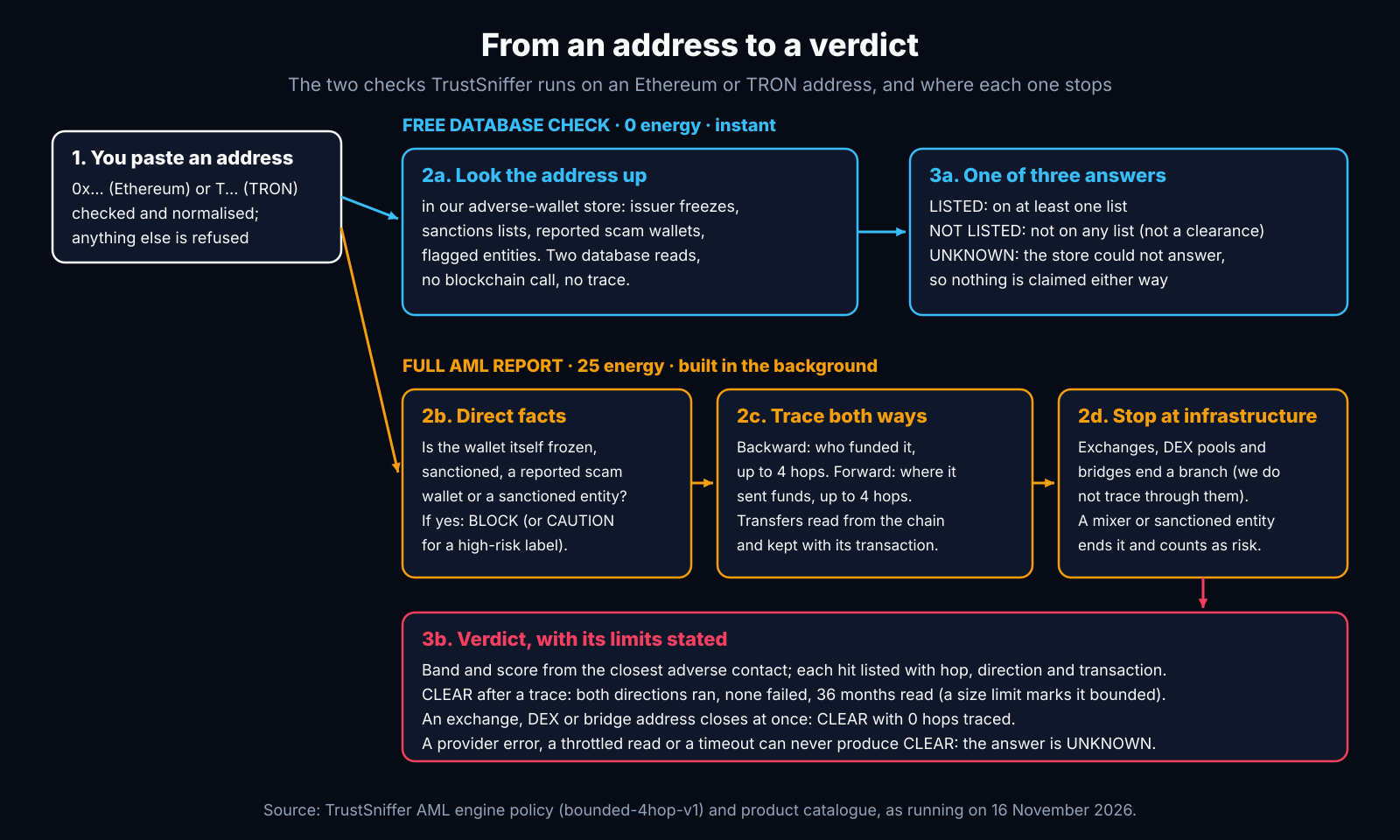
TrustSniffer checks Ethereum and TRON addresses in two ways. The free database check asks: is this exact address on a list? The full AML report asks: has money moved between this wallet and a listed address, directly or through other wallets? Each step from one wallet to the next is a hop, so a wallet that paid yours directly is one hop away and the wallet that paid it is two.
Check 1: the free database lookup
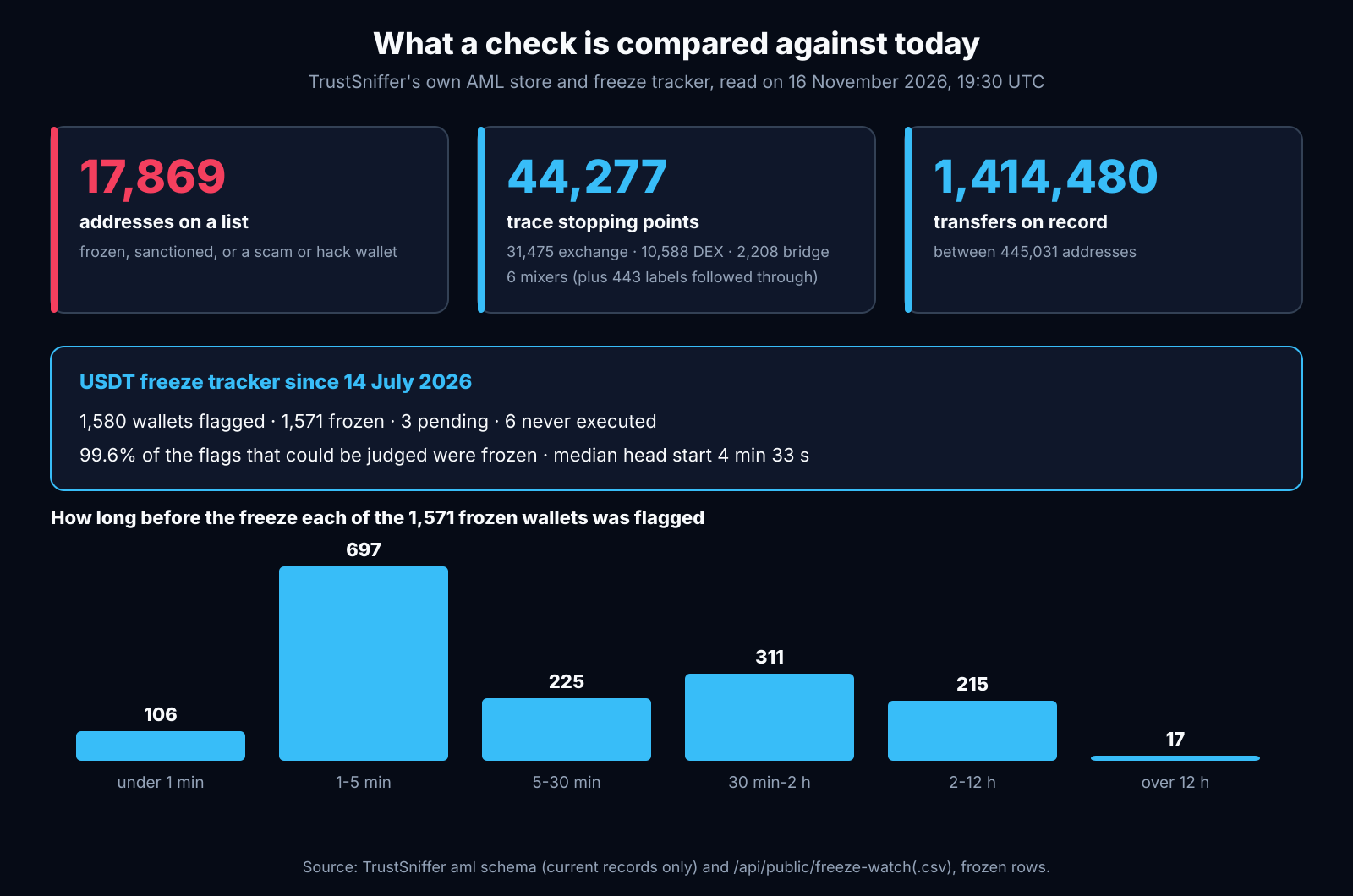
The free check makes two database reads, one for adverse records and one for flagged entities, and no call to any blockchain. On 16 November 2026 at 19:30 UTC the store behind it held 18,154 current adverse records on 17,869 distinct addresses:
- 10,761 issuer freezes, read from the USDT and USDC contracts' own freeze events: 7,493 USDT on TRON, 2,708 USDT and 437 USDC on Ethereum, 122 USDC on Polygon and 1 USDC freeze whose chain is not recorded.
- 6,172 scam, drainer and hack wallets from reporting feeds such as ScamSniffer and labelled hack funds (5,988 EVM, 184 TRON).
- 1,221 addresses on sanctions or seizure lists, synced daily from the OFAC, UK, EU and Israeli NBCTF lists that OpenSanctions republishes (1,027 TRON, 194 EVM).
It gives one of three answers. LISTED: at least one current record matches. NOT LISTED: the store was read, was shown to be loaded, and holds nothing for this address. UNKNOWN: the store could not answer, so nothing is claimed either way; that answer exists so a database outage can never reach you as a clean result. No trace runs in this check.
How current is it? The TRON listener polls for new USDT freezes every 30 seconds and the Ethereum listener follows the contracts' freeze events as they happen. A separate job copies new records into the database every 15 minutes, so the newest freeze can take up to a quarter of an hour to show. Sanctions lists, scam feeds and exchange labels refresh once a day.
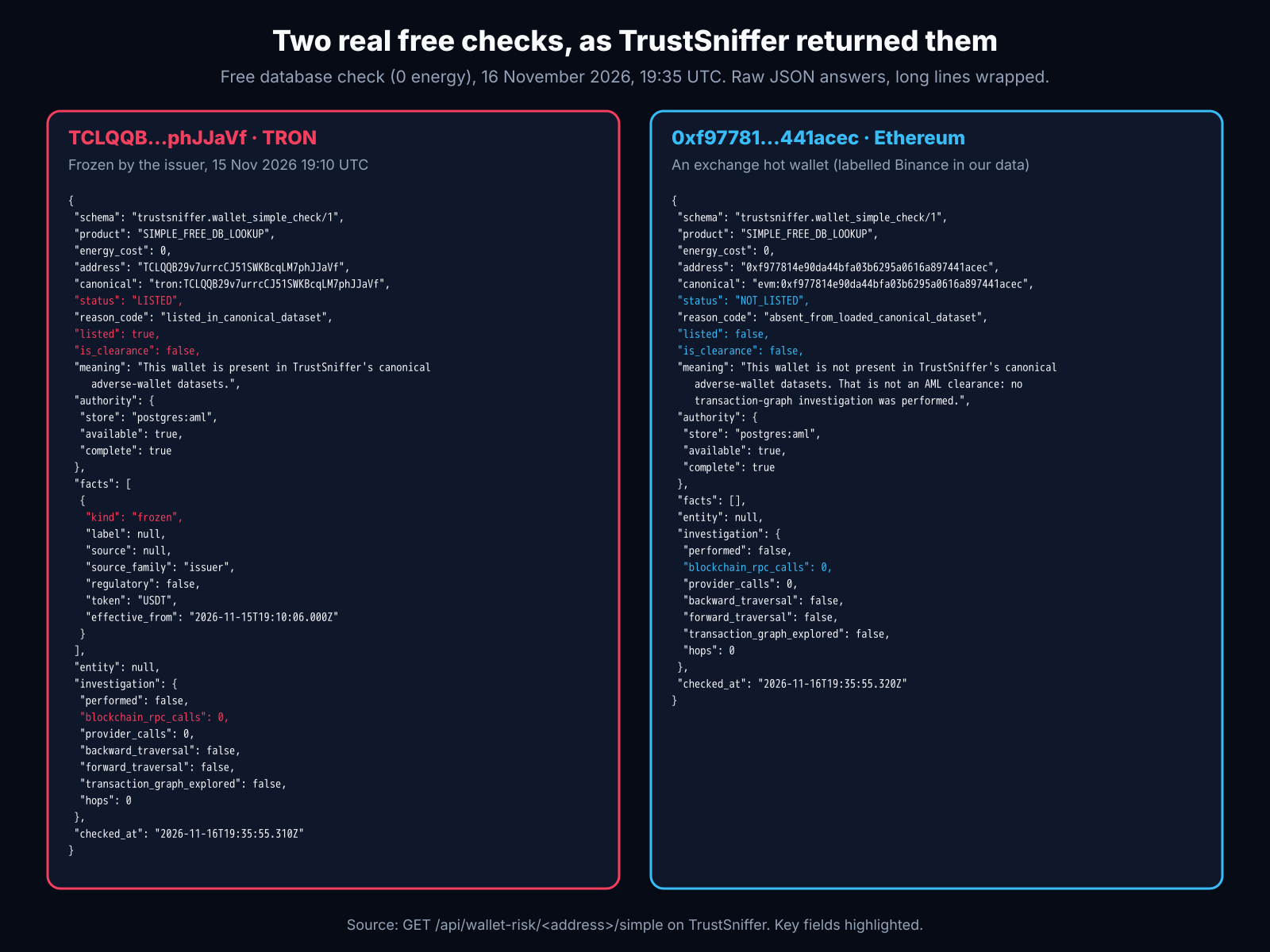
The left wallet, TCLQQB…phJJaVf, was flagged by our freeze tracker at 15:45:45 UTC on 15 November 2026, when Tether's multisig submitted a proposal to freeze it. Tether executed the freeze at 19:10:06 UTC, 3 hours 24 minutes later. The right wallet is an exchange hot wallet. It is on no list, and the answer says so without calling it safe.
That flag came from the freeze tracker: since 14 July 2026, 1,571 of its 1,580 flags became freezes, 3 are pending and 6 never executed (how many freezes came with no flag is not part of that count). Today that is 99.6%: 1,571 of the 1,577 flags that could be judged. A pending flag changes neither the free check nor the AML band; a wallet becomes a record only when the freeze happens.
The method and an earlier count (99.5%) are in how TrustSniffer sees USDT freezes coming and 99.5% of flagged USDT wallets were frozen. Fraud teams can download every published flag as CSV from /api/public/freeze-watch.csv.
Check 2: the full AML report
The full report is built in the background while the page waits. Pressing "Generate full AML report" on the website always runs a new check; opening a report someone already ran, from a link for example, is free. A build works in four steps.
- Direct facts. If the wallet itself is frozen, sanctioned, a reported scam wallet or a sanctioned entity, the band is BLOCK at 100. A wallet with a high-risk label that is not a sanction reads CAUTION at 55. Nothing found later in the trace can lower either result.
- Trace both directions. Backward: who sent money to this wallet, then who funded them, up to four hops. Forward: where this wallet sent money, up to four hops. On Ethereum the trace follows ETH and a fixed list of major tokens (USDT, USDC, DAI, WETH, WBTC and a few others); on TRON it follows TRX, USDT and USDC. On both chains it reads the last 36 months. Each transfer is kept with its transaction hash, and 1,414,480 transfers between 445,031 addresses are already on record from earlier traces.
- Stop at infrastructure. 44,277 labelled addresses are stopping points: 31,475 exchange wallets, 10,588 DEX routers and pools, 2,208 bridges and 6 mixers (443 more labelled wallets are followed through). An exchange, pool or bridge ends a branch, because it mixes thousands of users; the report records that money reached it. A mixer or a sanctioned entity also ends a branch, and is scored by its hop like a listed address.
- Score the closest adverse contact. A frozen, sanctioned or scam address, sanctioned entity or mixer one hop away scores 100 (DANGER), two hops 70 (WARN), three hops 30 and four hops 17 (both CAUTION). The report lists each hit with its hop, its direction, the transaction and the rule that classified it.
What a hop-1 link looks like in real data: on 14 November 2026 at 18:55:48 UTC, TYE9A7…ZoBfSMFo99rV sent 3,500 USDT to TCLQQB…phJJaVf in transaction 52b0c1e1…abe418e2, a transfer our database holds. The next evening Tether froze both: TYE9A7…ZoBfSMFo99rV at 19:10:03 UTC and TCLQQB…phJJaVf at 19:10:06 UTC, as the freeze tracker rows for both show. Under the scoring above, an unlisted wallet that had received from either one would sit one hop from a frozen wallet, which scores 100, DANGER. We did not run a report on such a wallet for this article, so that is the policy, not a result shown here.
We ran three full reports, on addresses that are already a public record: two wallets whose freeze is shown on the freeze tracker, and one labelled exchange wallet. Unlisted wallets with hop findings usually belong to private individuals, so we do not publish one. A freeze is the issuer's action, not proof that the owner did wrong; we show these two because their freezes are already public.
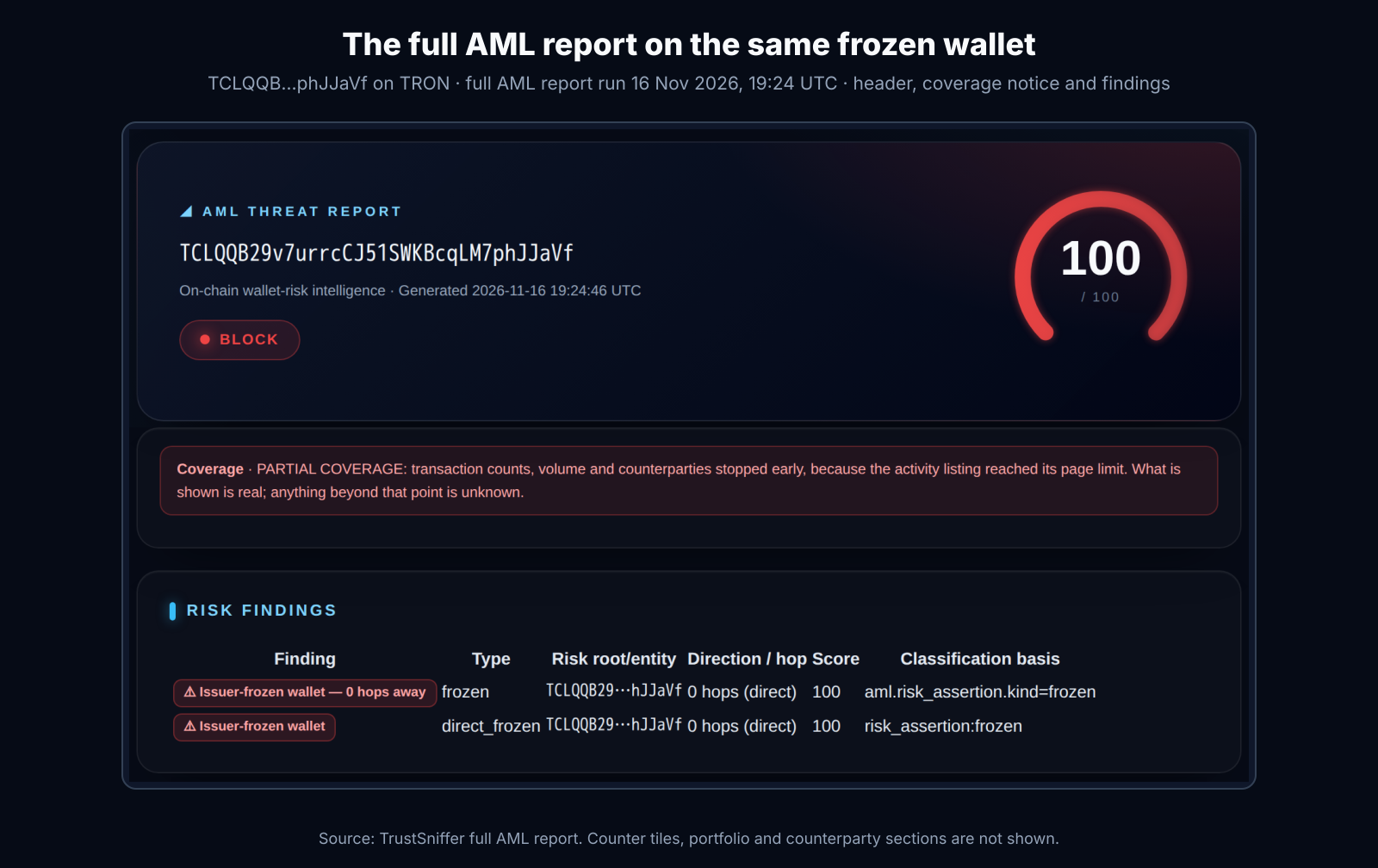
The frozen wallet. The report on TCLQQB…phJJaVf came back BLOCK at 100 from the freeze itself, the direct fact that decides the band. The trace still ran: its run log (the record of what the trace did) shows 53 addresses visited backward and 12 forward, in 26 seconds, with 62 reads from the blockchain data providers. The second frozen wallet, TS9jiZ…tmmPhL, also came back BLOCK at 100 from its own freeze. Both reports also show where its own reading stopped, with a PARTIAL COVERAGE notice: the activity summary (transaction counts, volume and counterparties), which the report reads separately from the trace, reached its page limit.
One gap we found while writing this. Neither report lists a frozen neighbour: the TCLQQB…phJJaVf report does not show the 3,500 USDT transfer from TYE9A7…ZoBfSMFo99rV, and TS9jiZ…tmmPhL has 4 frozen neighbours in our transfer records that its report does not list. The verdict is the same, since both wallets are BLOCK on their own freeze, but we have not yet established whether the trace skipped those neighbours or the report left them out. It is logged for a fix. (The report also lists the freeze itself twice, once as the verdict's basis and once as the record behind it.)
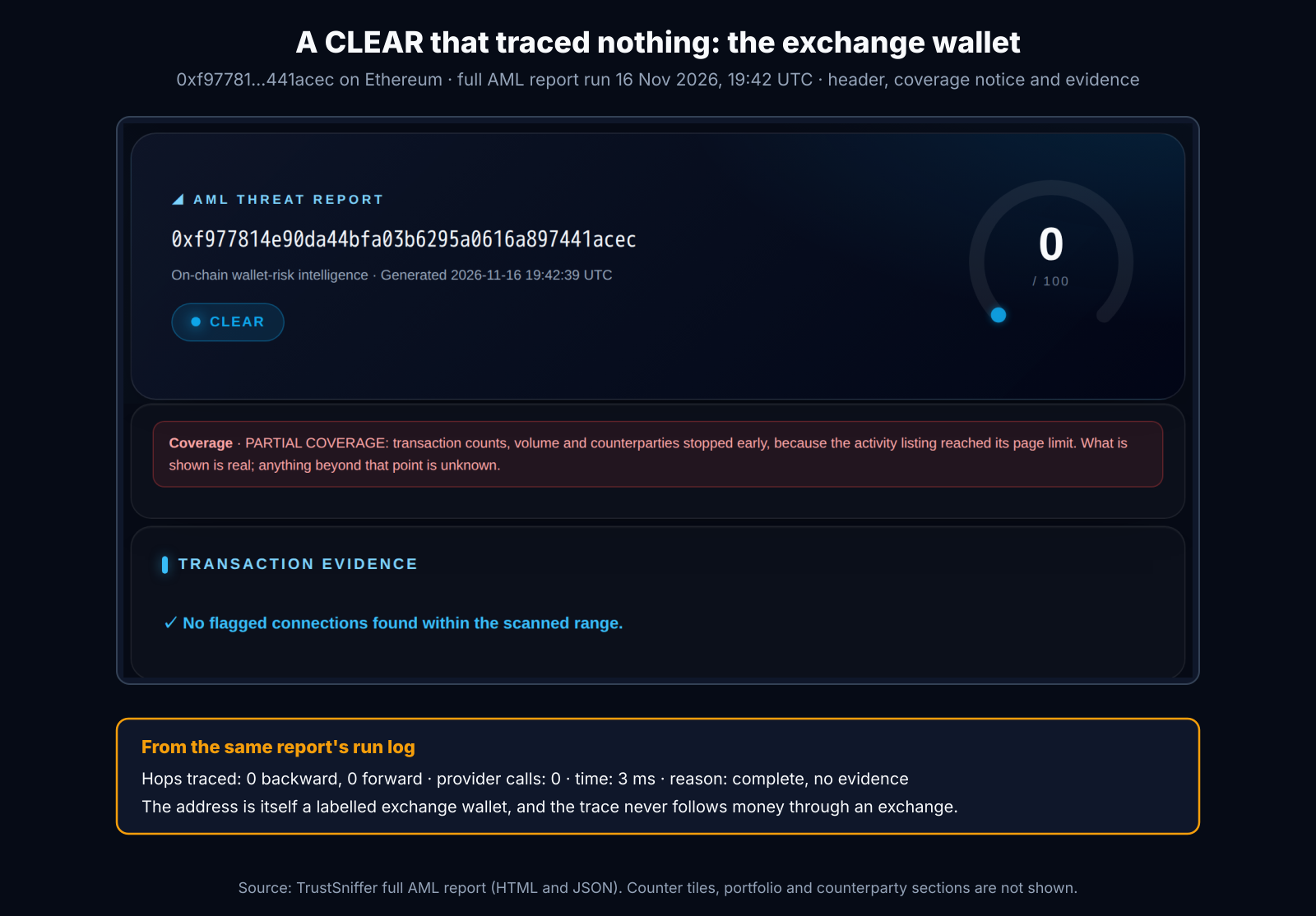
The exchange wallet. The report on 0xf97781…441acec came back CLEAR at 0 in 3 milliseconds, with no hop traced and no blockchain call made. That is by design: when the address you check is itself a labelled exchange, DEX or bridge wallet, both directions close at once, so an exchange is never scored for one of its customers. So this CLEAR does not come from a trace at all, and the report's line "No flagged connections found within the scanned range" describes a range of zero hops: it says nothing about the funds passing through that wallet. The PARTIAL COVERAGE notice on the same report again refers to the separate activity summary, not to the trace.
How to read the result
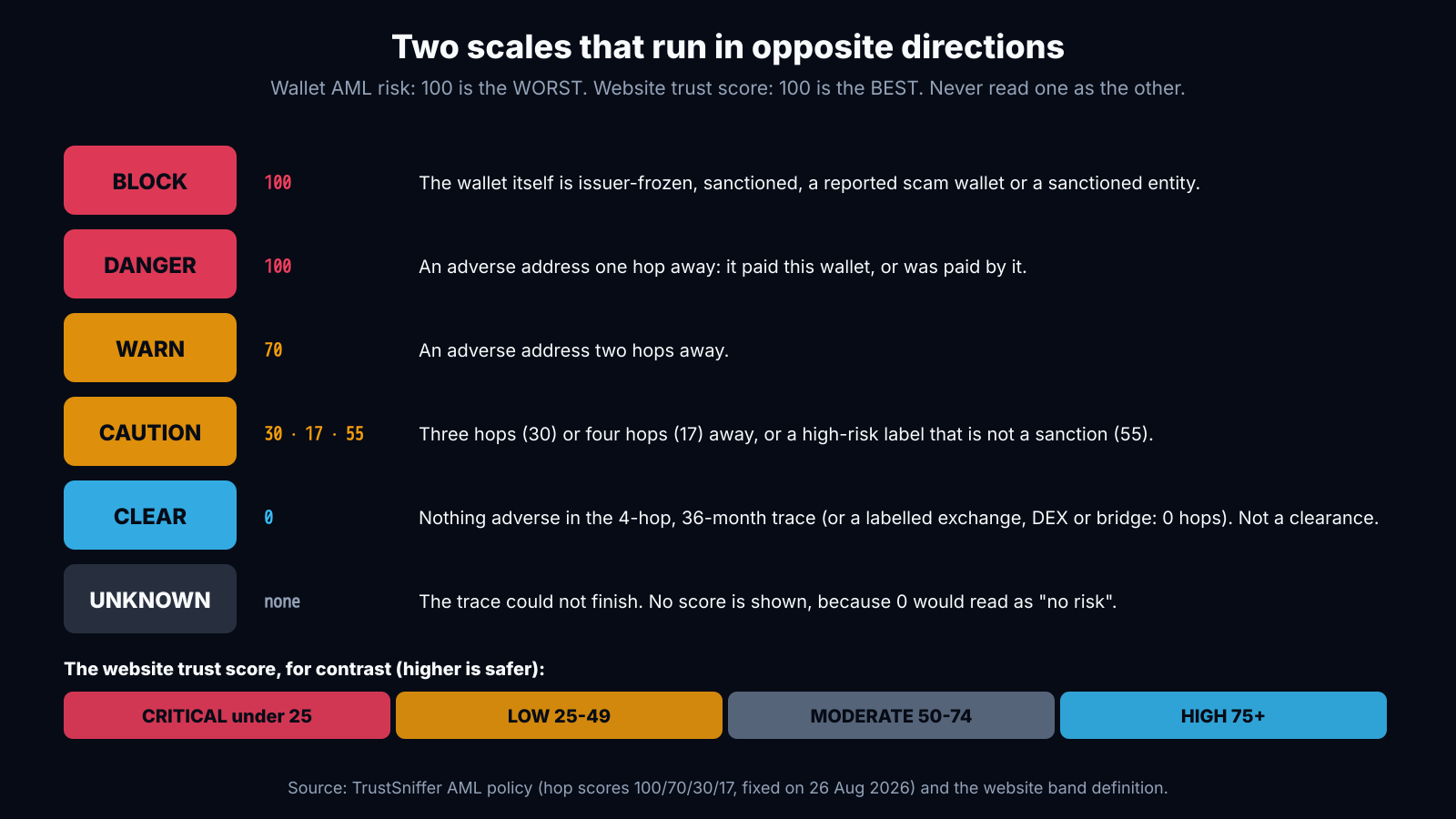
On a wallet, 100 is the worst score. On a TrustSniffer website report, 100 is the best. A wallet at 100 and a website at 100 mean opposite things, so never compare the two numbers.
- BLOCK: do not send to it or accept from it.
- DANGER or WARN: open the finding, look at the transaction and the amount, and expect an exchange to ask about funds from this source.
- CAUTION: worth reading; rarely a reason on its own to refuse a payment.
- CLEAR after a trace: both directions ran, nothing failed, the wallet's own 36-month history was read and no adverse address turned up. If the trace stopped at a size limit, the report says bounded.
- CLEAR with nothing traced: the address is itself a labelled exchange, DEX or bridge wallet, so the trace closes at once (the run log shows 0 hops). This says nothing about the funds passing through it.
- UNKNOWN: the trace could not finish, because a data provider failed, a read was throttled or the time ran out. No score is shown, because 0 would read as "no risk". Treat it as not checked.
What the check cannot see
- Other chains. The trace covers Ethereum and TRON. USDC freezes on Polygon are recorded (122 so far), so the free check can find a frozen Polygon address, but money is not traced there; Arbitrum, Optimism, Base and Avalanche are watched for USDC freezes but none is recorded yet. BNB Chain is not watched at all, so a NOT LISTED answer for an address you use on BNB Chain, or any EVM chain not named here, says nothing about that chain.
- Other tokens. Tokens outside the tracked list are not followed, which also keeps out the airdrop spam that floods busy wallets.
- Past a bridge, an exchange or a mixer. The trace stops there by design. If funds went into an exchange and came back out, the on-chain link is broken and our trace does not rebuild it.
- Off-chain facts. Who owns the wallet, what was promised in a chat, whether a trade was a scam: none of that is on chain. A new, unlisted wallet can still belong to a scammer.
How to check a wallet before you send or receive
- Paste the address into the wallet checker and read the free answer (it costs nothing). LISTED means stop. UNKNOWN means try again later.
- If the amount matters to you, or the funds are coming to you, run the full report on the address that will pay you (25 energy; a signed-in account gets 100 energy a day plus a 50-energy welcome bonus). A wallet that is not on a list can still have been paid by one that is. If it comes back DANGER or WARN, do not accept the payment until the sender explains the source, and do not pass the funds on.
- Open any finding and check the transaction it names on a block explorer. A small, old transfer four hops away is a different thing from a large one last week, one hop away.
- If you hold funds long term, add the wallet to wallet monitoring for an alert if it is frozen later or flagged ahead of a likely freeze.
- Keep the report. If an exchange later asks where a deposit came from, a dated report with its transaction hashes is the record you want.
If a deposit is already in your wallet, read can a deposit come from a sanctioned address and why a crypto wallet gets flagged high risk. If someone shows you a USDT balance as proof of payment, read a USDT ticker in your wallet proves nothing first.
For compliance teams
- API. Every account can create a personal API key.
GET /api/developer/v1/wallets/:chain/:addressreturns the AML verdict at the same energy price as the website. Partner keys add AML and ban-candidate scopes. Details on the developer page. - Each commissioned report is its own investigation, with its own id. The finished document is archived, and its PDF prints that stored document, so the file you download later is the one that was produced.
- Every report states its own scope. The JSON carries
completeness, areason_codeand a per-direction run log: hops requested and executed, addresses visited, provider calls, and why each direction stopped. Read the run log, not the band alone: the exchange wallet above reads CLEAR with 0 hops executed. A configured limit and a provider failure are recorded as different reasons, and a check that failed on our side is not charged.
Frozen and flagged wallets are browsable on the wallet hubs, reported sites and entities in the risk directory, and platform-wide totals on the Risk Index.


