Verdict
159.203.26.132 is low-trust and potentially risky.
Several risk patterns were present. Do not send money or personal details until you have verified this business another way.
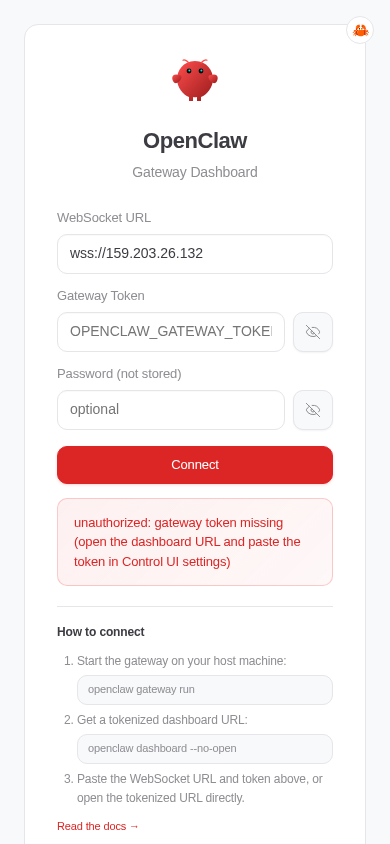
| What this site appears to be | A technical control UI for OpenClaw gateway with instructions to run a local gateway, obtain a tokenized dashboard URL, and paste a WebSocket URL and gateway token to connect. No visible forms or monetization elements. |
|---|
Evidence status and limitations
Evidence completeness: UNKNOWN
- The real-world operator identity was not independently verified.
- Module-level completeness metadata is unavailable for this legacy report.
At a glance
The checks that decide most of this verdict.
| Malware engines | 4 flagged itVirusTotal | Risk |
|---|---|---|
| Google Safe Browsing | Not listedGoogle | Clear |
| Abuse reports on the host | 0 reportsAbuseIPDB; shared hosting inflates this count | Noted |
| Domain age | Not availableNo registration record was returned | Noted |
| Web archive | Never archivedNo public history of this site | Watch |
The page as captured
Key findings
- Automated classification: Sensitive Interaction Risk.
- At least one reputation service TrustSniffer consulted had flagged this domain at assessment time.
- The operator behind the site could not be independently connected to a real-world brand or person.
Full analysis
Overview
The website is a technical control interface titled “OpenClaw Control,” presenting a gateway dashboard where visitors can enter a WebSocket URL and gateway token to connect to a locally running OpenClaw gateway; its apparent purpose is developer or systems-administration tooling rather than a commercial or financial service.
Scam/Impersonation Risk
The site’s visible content does not show brand impersonation, phishing forms, hidden forms, monetization, or other deceptive page features. However, the domain has a confirmed blacklist status, with four malicious detections recorded by external reputation checks; this is a material contradiction that outweighs the otherwise benign appearance of the control interface. The page also requests a gateway token and WebSocket connection details, creating a sensitive interaction surface even though the displayed interface states that the password is not stored. No conflicting legal identities were observed, and no suspicious contact-email anomaly was present.
- External reputation checks recorded 4 malicious detections and a confirmed blacklist status for the assessed address.
- The application dashboard displays fields for “WebSocket URL” and “Gateway Token,” together with a “Connect” control.
- The page analysis found no visible forms beyond the connection interface, no hidden forms, no wallet activity, and no external network requests during the observed interaction runs.
Regulatory Verification Notes
The available site content identifies the interface as OpenClaw Control but does not present an operator name, legal entity, licensing statement, registration number, or clearly accessible governance information. Because the service appears to be developer tooling rather than a regulated financial product, the absence of financial licensing language is not itself evidence of fraud; it remains a material identity and accountability gap for an enterprise deployment. The apparent legitimacy of the page’s technical purpose is therefore not sufficient to establish the real-world operator, particularly in light of the external blacklist finding.
- The captured page is titled “OpenClaw Control” and describes a local gateway/dashboard control function.
- The page provides a command to run a gateway locally and instructions to obtain a tokenized dashboard URL, but does not identify a responsible legal entity in the displayed content.
- The site is served from AS14061 (DigitalOcean, LLC), United States.
What to Verify Next
Before any sensitive interaction, the operator should obtain the software and documentation through an independently authenticated official channel and confirm that the assessed address is an authorized deployment. The gateway token and WebSocket endpoint should be supplied only after the endpoint, host ownership, and connection path have been validated by the responsible administrator. Any claimed organizational identity or regulatory status should be checked against the relevant corporate or sector registry rather than accepted from the site alone.
- The page instructs operators to start a local gateway and paste connection credentials into the dashboard.
- The page provides a “Read the docs” pathway but does not display independent operator or organizational verification.
- External reputation evidence conflicts with the page’s otherwise low-risk technical presentation and requires resolution before sensitive use.
Summary Verdict
The overall posture is low trust with sensitive-interaction risk. The site presents as a technically coherent utility, but its identity remains unverified and the confirmed external reputation contradiction prevents treating it as a reliable destination for credentials, authenticated access, or other sensitive activity.
Infrastructure Integrity
The website is protected by a CDN/WAF layer, and the observed address belongs to a CDN edge server rather than an independently observable origin. This reduces direct origin exposure and is a mitigating infrastructure characteristic, but it does not establish the legitimacy or safety of the service.
Closing Assessment
Enterprise users should restrict interaction to non-sensitive inspection until the deployment’s authorization, operator identity, and external reputation contradiction have been independently resolved.
Written analysis generated 2026-08-18 by the TrustSniffer Analysis Engine from the evidence in this report.
What the analysis found
1 finding contributed to this verdict, raised by analysis engine.
01 Sensitive Interaction Risk
- The analysis matched a pattern TrustSniffer treats as a direct threat to a visitor.Analysis engine
signal:direct_threat
Identity verification
| Status | UNVERIFIED |
|---|---|
| Identity score | 30/100 |
| Identity verification confidence | 50% |
- No on-site identity signals detected
Identity verification measures whether the site can be independently connected to a real-world brand or person. It is separate from the classification confidence.
What TrustSniffer observed
First-party facts recorded during the assessment of 159.203.26.132.
- The request stayed on 159.203.26.132. It was not redirected to another domain. Clear
Domain intelligence
| Registrar | Not available |
|---|---|
| Hosting | Not available |
| Country | Not available |
| Server IP | 159.203.26.132 |
| Name servers | Not available |
| SSL issuer | Not available |
| SSL expiry | Not available |
| Domain age | Not available (no registration date was returned) |
| Domain expiry | Not available |
| Archive first seen | Not available |
| Archive snapshots | 0 |
| Reputation | VirusTotal: 4 flagged | AbuseIPDB: 0 reports | Google Safe Browsing: 0 matches |
About this assessment
A trust score summarises the evidence TrustSniffer could collect about 159.203.26.132 at assessment time. It is a starting point for your own judgement, not a guarantee: a high score means the signals were consistent with a legitimately operated site, a low or critical score means several risk patterns were present.
TrustSniffer assesses a website from the evidence it can collect at a point in time: domain registration and age, hosting and certificate, the content the site served, and third-party reputation feeds. A score is a summary of that evidence, not a guarantee and not a legal finding. There is no human rating and no user review in it. A site can change after it is assessed.