Verdict
An external threat listing named this site as malicious when the evidence was captured. The business-model ceiling lowered the score from the low band into the critical band, and the threat-listing ceiling then lowered it further within the critical band. Do not pay or share personal details with this site.
fluton-testnet.firebaseapp.com shows critical-risk indicators.
- Sensitive Interaction Risk: This label is given when the overall risk is high. The captured page did not ask for a password, card number or other sensitive details; if it ever does, entering them here could be unsafe.
| How the site describes itself | A gate page asking visitors to connect a crypto wallet to access a Fluton testnet. It shows only a tagline and an X link, with no description of the service, company, or contact channels. |
|---|
Summary: No harmful behaviour was detected in the examined pages. One threat listing, from a single source, decides the score.
| Harmful behaviour observed | None detected in the examined pagesNothing harmful was seen when the pages were examined. That is not proof that none exists. | Clear |
|---|---|---|
| External threat alerts | One source, treated as decisive (a threat-intelligence feed)The page is about crypto, and the feeds TrustSniffer monitors list crypto-phishing sites and the captured page was empty or too thin to contradict the listing. Without that, one listing alone would keep the score below the moderate band and the report would be reviewed. | Risk |
| Track record | Not availableWeb-archive lookup incomplete; no registration age was returned. | Noted |
| Operator identity | Not established | Watch |
| Evidence coverage | Partial, 55%No result from: web archive and WHOIS. | Watch |
| What limits the score | Threat-listing ceiling | Watch |
How this score was reached
| Starting point | Every site starts from the same neutral base |
|---|---|
| What raised the score | In the sandbox the page contacted no outside servers; the sandbox loaded the site successfully more than once; in the sandbox the page responded to interaction normally |
| What lowered the score | The page content shows three or more warning signs that deceptive sites commonly use; A wallet sign-in behind a claim or eligibility offer on a young or borrowed address; the page has very little readable content |
| Result of the findings | The findings alone put the site in the low band |
| Business-model ceiling | Lowered it from the low band into the critical band |
| Threat-listing ceiling | Lowered it within the critical band (one listing, decisive here because the page is about crypto, and the feeds TrustSniffer monitors list crypto-phishing sites and the captured page was empty or too thin to contradict the listing; one listing alone would keep the score below the moderate band) |
| Published score | 5 |
Every site starts from the same neutral base. The findings raise or lower the score from there; floors and ceilings then apply where their conditions hold, and the regulatory and other adjustments come last. How much each finding or step weighs is part of TrustSniffer's scoring model and is not published; the bands are named, and the only number is the published score.
Evidence status and limitations
Evidence completeness: PartialThis says whether every check on the site was recorded as finished. At least one check failed or returned no result.
- One external source flagged this site (a threat-intelligence listing from a feed TrustSniffer monitors (phishing, the site itself as the source, last seen 2026-10-26)). No second source confirms it, but the listing is treated as decisive here because the page is about crypto, and the feeds TrustSniffer monitors list crypto-phishing sites and the captured page was empty or too thin to contradict the listing: the threat-listing ceiling holds the score in the critical band. Without that, one listing alone would keep the score below the moderate band and the report would be reviewed. It is from the evidence captured on 2026-11-25.
- The real-world operator identity was not independently verified.
- These checks returned no result: web archive lookup.
Pages examined: the capture read 1 page (/). The browser sandbox loaded the site 3 times to watch what it does. TrustSniffer reads a site's main pages, not every page it has.
How to read these numbers
The trust score runs from 0 to 100, higher is safer. 5/100 rates the evidence found, not the probability that the site is a scam.
Evidence coverage (55%) measures how much of TrustSniffer's evidence set this site produced: the page reading, the browser sandbox, the web archive, the registration record and the reputation services. It falls when a check returns nothing, as listed above, and it does not change the score.
At a glance
The checks that decide most of this verdict.
| What limits the score | Threat-listing ceilingA threat-intelligence feed TrustSniffer monitors listed this site itself as the source of a threat when the evidence was captured (last seen 2026-10-26), and that listing caps the score. It counts as decisive here because the page is about crypto, and the feeds TrustSniffer monitors list crypto-phishing sites and the captured page was empty or too thin to contradict the listing. Without that, one listing alone would keep the score below the moderate band and the report would be reviewed. The business-model ceiling also applies, but the score is below it. | Risk |
|---|---|---|
| Malware engines | None malicious; 1 marked it suspiciousVirusTotal | Watch |
| Google Safe Browsing | Not listedGoogle | Clear |
| Abuse reports on the CDN edge address | 0% confidenceAbuseIPDB, 3 reports; shared hosting inflates reports; this is the record of the CDN edge address, not of the server behind it, which was not observed | Noted |
| Domain age | Not availableNo registration record was returned | Noted |
| Certificate | Encrypted connectionIssued by WR3 | Noted |
| Hosted by | FASTLYNetwork registered in US | Noted |
The page as captured
Key findings
- The business-model ceiling lowered the score from the low band into the critical band, and the threat-listing ceiling then lowered it further within the critical band.
- Automated classification: Sensitive Interaction Risk.
- No security engine marked this domain as malicious and Google Safe Browsing does not list it; some engines marked it suspicious, which TrustSniffer does not count as a listing. Its hosting IP carries AbuseIPDB reports below the confidence level TrustSniffer treats as a flag; a threat-intelligence feed TrustSniffer monitors flagged the site.
- The operator behind the site could not be independently connected to a real-world brand or person.
Full analysis
Overview
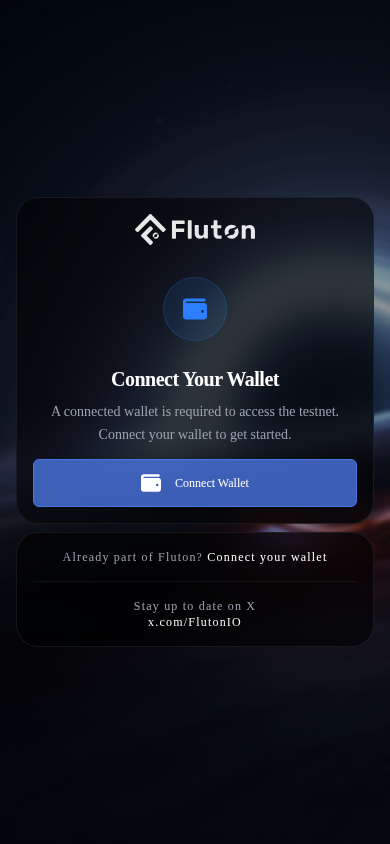
This is a single-page wallet-connection gate presented under the name Fluton, with the tagline "The universal confidentiality engine." As captured on 2026-11-25, the page asked visitors to connect a crypto wallet before they could reach a testnet. It gave no description of the service, company, team or contact route. Its only outward link led to a social media profile. The address is a subdomain on a shared Google-operated application-hosting platform, not a standalone registered domain. No product, fee or revenue model was visible, so the page's purpose could not be established from its content.
Scam/Impersonation Risk
This site carries critical risk. A threat-intelligence feed listed the address as the actor in a phishing listing, last seen on 2026-10-26. This is a single-source listing and is the only contradictory signal found. No brand impersonation was detected, and no conflicting legal identities appeared. The listing holds the score down. Its role is "actor," so the address itself is the subject of the listing, not a bystander. The page's own design fits the pattern that listing describes. A wallet connection is demanded up front. It is the only thing the page offers, and no explanation of the project, its operator or what the wallet would be used for accompanies it. The site's claim that a connected wallet is "required to access the testnet" cannot be tested from the page. Nothing on the page establishes what connecting a wallet would authorise. The address is also a tenant subdomain on a shared platform, so it carries no independent registration history of its own. Reputation checks gave a mixed picture. One antivirus engine rated the address suspicious, which is not a detection, and none rated it malicious. Google Safe Browsing did not list it. Three abuse reports exist against the shared provider address behind it. They belong to that provider's wider address and were discounted. The page's behaviour was not clean. Its scripts produced a high volume of console errors during testing, which counted against it.A console error is a technical error message that the page's own code reported inside the browser while it ran. It describes how the page is built, and on its own it is not proof that the site is harmful.
- Homepage: the only visible content was a "Connect Your Wallet" prompt stating that "A connected wallet is required to access the testnet," followed by a "Connect Wallet" button.
- Threat-intelligence listing: the address was listed as a phishing actor, last seen 2026-10-26.
- VirusTotal: 0 engines malicious and 1 suspicious. Google Safe Browsing did not list the address. AbuseIPDB held 3 reports against a shared Google LLC address, discounted as shared infrastructure.
- Browser behaviour testing: 108 console errors across 3 runs. No data was sent to other hosts, and no forms were present.
Regulatory Verification Notes
On the single page read, the site names no legal entity, company registration or licence. It also had no terms of service, no privacy notice and no contact channel on that page. The only identity signal is the name "Fluton" in the page title and tagline. This is the site's own claim and has not been independently connected to any real-world organisation or person. No licence was claimed, and no regulatory or broker record of the site was found. The page's wording, "universal confidentiality engine," describes a product, yet the page shows no features, documentation or operator. A testnet gate is also not a disclosure of how a user's wallet or data would be handled. The absence of these disclosures on the page read is a verification gap. It is not itself proof of wrongdoing, but here it sits alongside a phishing listing.
- Homepage: only "/" was read. It shows no terms, privacy, contact or legal-entity information, and no licence claim.
- Hosting: served from AS54113 (FASTLY – Fastly, Inc., US) on a tenant address of the firebaseapp.com platform.
- Transport encryption: the TLS certificate was issued by WR3 (domain-validated, DV). As captured on 2026-11-25, it was valid until 2027-01-25. A DV certificate confirms control of the address, not the identity of the operator.
What to Verify Next
Confirm through an independent route that this address belongs to the Fluton project at all. A route that does not use this page's own links works, for example project documentation or announcements reached through a separately sourced channel. Check whether the project publishes a different primary address, and whether it names this testnet address itself. Establish whether a legal entity stands behind the project, and check any entity found against the relevant company register. The social media profile linked from the page is a site-published link, so it is not independent proof of identity. Do not treat the testnet claim as established until the project's operator has been identified by other means.
- Homepage: the only outward link was to a social media profile, and no contact channels or legal-entity information appeared on the page read.
- Hosting: the address is a subdomain on a shared application-hosting platform, so the address itself says nothing about who operates it.
- Threat-intelligence listing: the address was listed as a phishing actor, last seen 2026-10-26, which makes confirming the address's connection to the project a precondition for any further engagement assessment.
Summary Verdict
The available evidence places this site at critical risk. A phishing listing naming the address as the actor is combined with a content-free wallet-connection gate. No operator, entity or purpose could be established independently. The strong limits on its score come from that listing together with the low-substance page. The site's technical hygiene does not offset them.
Infrastructure Integrity
The address resolved to two edge addresses of the Fastly content delivery network, and no origin server address was observable. A CDN is neutral for this assessment. It neither raises nor lowers trust, and it says nothing about who operates the site. Edge-only visibility also means the hosting behind the address could not be independently confirmed.
Closing Assessment
The site is at critical risk, so do not interact with it. Treat it as unsafe to use.
Written analysis generated 2026-11-25 by the TrustSniffer Analysis Engine from the evidence in this report.
What the analysis found
5 findings contributed to this verdict, raised by governance, page content and behaviour in a sandbox.
01 Governance
- TrustSniffer limits the score of a site whose operator it could not verify, according to the kind of site it appears to be; here the score is below that limit, so it does not set the score.Governance
rule:gov_business_model_cap - A threat-intelligence feed TrustSniffer monitors listed this site itself as the source of a threat when the evidence was captured (last seen 2026-10-26), and that listing caps the score. It counts as decisive here because the page is about crypto, and the feeds TrustSniffer monitors list crypto-phishing sites and the captured page was empty or too thin to contradict the listing. Without that, one listing alone would keep the score below the moderate band and the report would be reviewed.Governance
rule:gov_active_threat_listing
02 Page content
- The page content shows three or more warning signs that deceptive sites commonly use.Page content
rule:PAGE_RED_FLAGS_STRONG - The page has very little readable content.Page content
rule:PAGE_CONTENT_THIN - The page refers to crypto without naming a specific token, a weak caution signal on its own.Page content
rule:PAGE_CRYPTO_PRESENT_MILD
03 Behaviour in a sandbox
- The page produced an unusually high number of errors while it ran.Behaviour in a sandbox
rule:BEHAV_CONSOLE_ERRORS_HIGH
Related TrustSniffer guide: What Is a Crypto Wallet Drainer? How It Works
Noted, not counted
Recorded during the assessment, but not counted against the site.
- AbuseIPDB: 3 reports on hosting IP 2620:0:890::100 (FASTLY), 0% confidence. The reports are attributed to shared infrastructure, not specifically to this website.
Identity verification
| Status | UNVERIFIED |
|---|
The operator behind the site could not be connected to a real-world brand or person. What the page shows, if anything, is listed below; none of it was independently checked.
- org:Fluton
- on_site_identity
What TrustSniffer observed
First-party facts recorded during the assessment of fluton-testnet.firebaseapp.com.
- The request stayed on fluton-testnet.firebaseapp.com. It was not redirected to another domain. Clear
- It is hosted on FASTLY, a network registered in US. Noted
Domain intelligence
| Registrar | Not available |
|---|---|
| Hosting | FASTLY - Fastly, Inc. |
| Network registered in | US |
| Server IP | 2620:0:890::100 (a CDN edge address; the server behind it was not observed) |
| Name servers | Not available |
| CDN / edge network | Detected (fastly) |
| Resolved IP addresses | 2 |
| Edge IP addresses | 2 |
| Likely origin IP addresses | 0 |
| SSL issuer | WR3 |
| SSL expiry | 2027-01-25 |
| First seen (web archive) | Not available (the web archive has no record of this address; a site on firebaseapp.com has no registration of its own) |
| Domain expiry | Not available |
| Archive first seen | Not available |
| Archive snapshots | Not counted (archive lookup incomplete) |
| Reputation | VirusTotal: 0 malicious, 1 suspicious | AbuseIPDB (CDN edge address, not the host): 0% confidence, 3 reports | Google Safe Browsing: 0 matches |
About this assessment
A trust score summarises the evidence TrustSniffer could collect about fluton-testnet.firebaseapp.com at a point in time: domain registration and age, hosting and certificate, the content the site served, and third-party reputation feeds. A high score means the signals were consistent with a legitimately operated site; a low or critical score means several risk patterns were present. It is a starting point for your own judgement, not a guarantee and not a legal finding. There is no human rating and no user review in it. A site can change after it is assessed.