Verdict
jstor.org appears legitimate.
Our checks found nothing pointing to fraud. Ordinary care still applies when you pay or sign in.
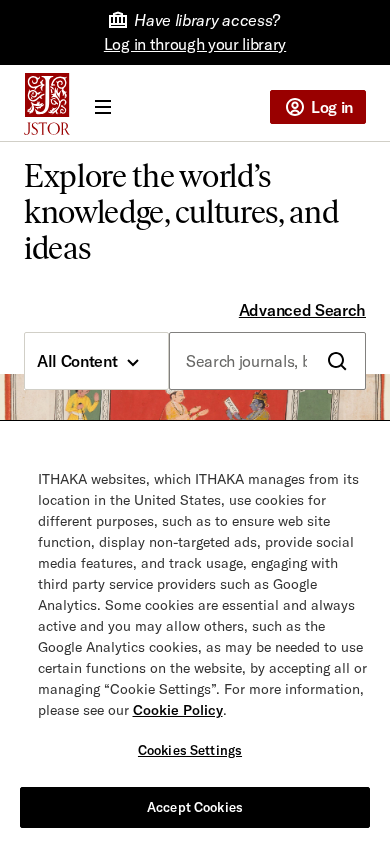
| What this site appears to be | JSTOR homepage offering search and access to scholarly content, with account login (including Google/Microsoft) and institutional link options, plus cookie and privacy information. |
|---|
Evidence status and limitations
Evidence completeness: UNKNOWN
- The real-world operator identity was not independently verified.
- Module-level completeness metadata is unavailable for this legacy report.
At a glance
The checks that decide most of this verdict.
| Malware engines | None flagged itVirusTotal | Clear |
|---|---|---|
| Google Safe Browsing | Not listedGoogle | Clear |
| Abuse reports on the host | 0 reportsAbuseIPDB; shared hosting inflates this count | Noted |
| Domain age | 31 years oldRegistered history | Clear |
| Web archive | Never archivedNo public history of this site | Watch |
| Certificate | Encrypted connectionIssued by GlobalSign Atlas R3 OV TLS CA 2026 Q2 | Noted |
The page as captured
Key findings
- Automated classification: Not Scam.
- Domain age: more than 10 years (registration continuity).
- No flags from the reputation services TrustSniffer consulted at assessment time.
- The operator behind the site could not be independently connected to a real-world brand or person.
Full analysis
Overview
JSTOR is an academic content platform that provides visitors with searchable scholarly articles, journals, books, images, and primary sources. Its apparent business model combines institutional access, individual registration, subscriptions, and nonprofit support to enable research and educational use.
Scam/Impersonation Risk
No contradictions were observed. The homepage presents a coherent academic-repository service, and its account functionality is consistent with the stated purpose: users can register, link institutional access, or authenticate through Google and Microsoft. The observed login flow showed no hidden forms, untrusted destinations, wallet activity, or brand-impersonation indicators. External reputation checks found no malicious or suspicious detections, supporting a low scam and impersonation risk assessment.
- The homepage provides scholarly search and access functions, institutional linking, registration, and standard account authentication without detected phishing or impersonation indicators.
- Behavioral inspection recorded zero hidden forms, zero password submissions to external forms, zero wallet-provider or wallet-drainer activity, and no cloaking.
- External reputation results recorded 0 malicious detections and 0 suspicious detections; the site held global traffic rank 1091.
Regulatory Verification Notes
The site presents an informational and academic-access model rather than a regulated financial service, so no financial license claim or license number was identified in the reviewed content. The homepage does provide privacy and cookie information and describes institutional and individual access arrangements, but the real-world operator identity is not independently verified by the available evidence. This is an identity-verification limitation rather than an observed contradiction; the registration record uses Network Solutions, LLC, while privacy-protected registrant details are an administrative matter.
- The domain registration artifact records creation on 1996-02-16, making the domain 30.52 years old.
- The site’s transport encryption uses an OV certificate issued by GlobalSign Atlas R3 OV TLS CA 2026 Q2, valid through 2027-02-01T19:47:36+00:00.
- The homepage identifies scholarly content, institutional access, individual registration, and privacy/cookie information; no regulated financial-service license claim is presented.
What to Verify Next
Before credential or payment interaction, an organization should independently confirm the relevant operator or merchant identity, review the applicable subscription, cancellation, and refund terms, and ensure that payment protections are available. For institutional use, the institution’s library or procurement function should confirm that the intended access route and account-linking process are official. Any applicable registration or licensing requirement should be checked against the relevant public registry rather than inferred from the site’s presentation.
- The homepage offers institutional linking and individual account registration, making independent confirmation of the intended access route an appropriate control.
- The stated commercial model includes subscriptions and institutional licensing, so billing, renewal, cancellation, and refund terms should be reviewed before payment.
- The reviewed content includes privacy and cookie information, which can be checked alongside the applicable account and payment terms.
Summary Verdict
Available evidence supports a high-trust, low-risk posture and is consistent with an established, apparently legitimate website. The classification is strong, while the connection between the website and a specific real-world operator remains unverified; legitimacy should therefore be understood as evidence-consistent rather than proven.
Infrastructure Integrity
The website is protected by Fastly CDN/WAF infrastructure and resolves through AS54113, operated by Fastly, Inc. in the United States. Four observed edge addresses are associated with that network, alongside one potential origin candidate; this architecture mitigates direct exposure of the service infrastructure but is not, by itself, proof of legitimacy.
Closing Assessment
Routine research access is proportionate to the assessed posture, while credentials or payments should be preceded by ordinary independent checks of the contracting entity, applicable terms, and available payment protections.
Written analysis generated 2026-08-17 by the TrustSniffer Analysis Engine from the evidence in this report.
What the analysis found
No rule findings contributed to this verdict.
Identity verification
| Status | UNVERIFIED |
|---|---|
| Identity score | 30/100 |
| Identity verification confidence | 25% |
- No on-site identity signals detected
Identity verification measures whether the site can be independently connected to a real-world brand or person. It is separate from the classification confidence.
What TrustSniffer observed
First-party facts recorded during the assessment of jstor.org.
- The request stayed on jstor.org. It was not redirected to another domain. Clear
- Registration is published under Network Solutions, LLC. Clear
- DNS for this domain is served by ithaka.org, across 7 name servers. Noted
- The registration is paid up to 2031-02-17. Clear
- It is hosted on FASTLY, from a server in US. Noted
Domain intelligence
| Registrar | Network Solutions, LLC |
|---|---|
| Hosting | FASTLY - Fastly, Inc., US |
| Country | US |
| Server IP | 199.232.172.152 |
| Name servers | usnjpr2ns02.ithaka.org, usmiaa1ns03.ithaka.org, usnjpr2ns04.ithaka.org, usnjpr2ns01.ithaka.org, usnyny1ns05.ithaka.org, usaeaz1ns03.ithaka.org, usaeaz1ns05.ithaka.org |
| SSL issuer | GlobalSign Atlas R3 OV TLS CA 2026 Q2 |
| SSL expiry | 2027-02-01 |
| Domain age | 30.52 years (continuous registration) |
| Domain expiry | 2031-02-17 |
| Archive first seen | Not available |
| Archive snapshots | 0 |
| Reputation | VirusTotal: 0 flagged | AbuseIPDB: 0 reports | Google Safe Browsing: 0 matches |
About this assessment
A trust score summarises the evidence TrustSniffer could collect about jstor.org at assessment time. It is a starting point for your own judgement, not a guarantee: a high score means the signals were consistent with a legitimately operated site, a low or critical score means several risk patterns were present.
TrustSniffer assesses a website from the evidence it can collect at a point in time: domain registration and age, hosting and certificate, the content the site served, and third-party reputation feeds. A score is a summary of that evidence, not a guarantee and not a legal finding. There is no human rating and no user review in it. A site can change after it is assessed.