Verdict
This assessment found strong scam indicators on the site itself. Do not pay, sign in, or share personal details with this site.
plutus-verification.pages.dev shows critical-risk indicators.
- Sensitive Interaction Risk: The overall risk is high enough that entering private details here (a password, card number or wallet recovery phrase) could be unsafe.
- Governance Risk: A registration check came back incomplete: as a site on pages.dev, this address has no registration record of its own (the platform's domain is registered, not the site). That is a gap in what could be looked up, not a sign that ownership is hidden, and it does not say who runs the site.
| How the site describes itself | A crypto wallet issue-resolution page that promises secure help through an AI chat and asks visitors to enter a 12- or 24-word seed phrase. It provides no verifiable legal entity, address, contact channel, licence, pricing, or terms, and its brand names are inconsistent. |
|---|
Summary: TrustSniffer observed hidden phishing forms and code shared with sites rated Critical on this site. A confirmed external threat alert stands. The site is young, with a short public history.
| Harmful behaviour observed | Found: hidden phishing forms and code shared with sites rated CriticalSeen by TrustSniffer in the examined pages; see "What the analysis found". | Risk |
|---|---|---|
| External threat alerts | Confirmed: VirusTotal and a threat-intelligence feedThe alert met TrustSniffer's bar for a confirmed listing when the evidence was captured. | Risk |
| Track record | Young site, 1 year oldWeb archive since 2024. | Watch |
| Operator identity | Not established | Watch |
| Evidence coverage | Complete, 75% | Clear |
| What limits the score | The findings below | Noted |
How this score was reached
| Starting point | Every site starts from the same neutral base |
|---|---|
| What lowered the score | A confirmed external listing marks this domain as malicious: at least five security engines including a leading vendor, ten engines, or Google Safe Browsing; A wallet sign-in behind a claim or eligibility offer on a young or borrowed address; the page code contained a hidden form, a pattern common to phishing pages |
| Result of the findings | The findings alone put the site in the critical band |
| Published score | 0 |
Every site starts from the same neutral base. The findings raise or lower the score from there; floors and ceilings then apply where their conditions hold, and the regulatory and other adjustments come last. How much each finding or step weighs is part of TrustSniffer's scoring model and is not published; the bands are named, and the only number is the published score.
Evidence status and limitations
Evidence completeness: CompleteThis says whether every check on the site was recorded as finished. All of them were.
- External threat sources confirmed a listing for this site when the evidence was captured (VirusTotal, a threat-intelligence listing from a feed TrustSniffer monitors (phishing, the site itself as the source, last seen 2026-10-29)). On its own it would keep the score in the critical band; the score is lower because of the other findings below.
- The real-world operator identity was not independently verified.
Pages examined: the capture read 1 page (/). The browser sandbox loaded the site 3 times to watch what it does. TrustSniffer reads a site's main pages, not every page it has.
How to read these numbers
A trust score of 0 means the risk evidence outweighed every trust signal by more than the 0 to 100 scale can show. It rates the evidence found, not the probability that the site is a scam.
Evidence coverage (75%) measures how much of TrustSniffer's evidence set this site produced: the page reading, the browser sandbox, the web archive, the registration record and the reputation services. It falls when a check returns nothing, as listed above, and it does not change the score.
At a glance
The checks that decide most of this verdict.
| What limits the score | The findings belowThe confirmed external listing ceiling and the threat-listing ceiling also apply, but the findings brought the score lower. | Watch |
|---|---|---|
| Malware engines | 8 marked it malicious, 1 suspiciousVirusTotal; Fortinet, Kaspersky among the engines that flagged it | Risk |
| Google Safe Browsing | Not listedGoogle | Clear |
| Abuse reports on the CDN edge address | 0% confidenceAbuseIPDB, 0 reports; this is the record of the CDN edge address, not of the server behind it, which was not observed | Noted |
| First seen | 2.0 years before captureWeb archive; a site on pages.dev has no registration of its own | Clear |
| Web archive | Archived since 20243 snapshots | Clear |
| Certificate | Encrypted connectionIssued by WE1 | Noted |
The page as captured
Key findings
- Automated classification: Sensitive Interaction Risk, Governance Risk.
- First seen: 1 to 3 years before capture (web archive; a site on pages.dev has no registration of its own).
- Public web-archive history exists since 2024.
- At least one reputation service TrustSniffer consulted had flagged this domain when the evidence was captured.
Full analysis
Security Alert
8 VirusTotal engines, including Fortinet, Kaspersky, marked this site as malicious; independent sources confirm a listing for this site.
Overview
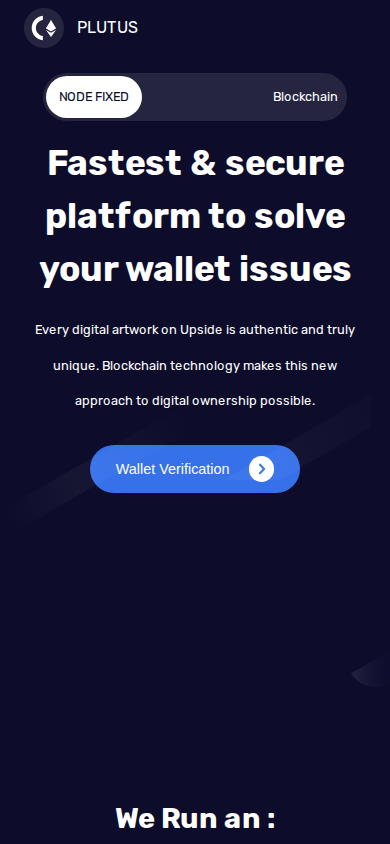
This website is a single-page crypto wallet "support" landing page that appears under the names PLUTUS and "APP TRUST FIXED". It promises fast, secure resolution of wallet problems through a chat with an "Artificial Intelligence Robot with zero Human interference". Visitors choose Bitcoin, Ethereum or Litecoin, and a "Verify your wallet" step then asks them to enter a 12- or 24-word seed phrase. The page shows no price, fee or payment flow. Its only working mechanism is the collection of wallet recovery credentials, and no service is evident behind it.
Scam/Impersonation Risk
The evidence points to critical risk, and the site's own statements conflict with what its page asks visitors to do. On the day of capture, 8 VirusTotal engines marked the site malicious and 1 marked it suspicious, including Fortinet and Kaspersky. A separate threat-intelligence listing names the site itself as the source of phishing, last seen on 29 October 2026. Google Safe Browsing did not list the site. The page's design also fits the external findings. A seed phrase gives complete control of a wallet, and a genuine support service has no reason to ask for it. The site says it is a "non-custodial" protocol, yet its verification step requests the phrase. These two statements cannot both be true. The site's own pages carry conflicting branding. The header reads PLUTUS and the 2021 copyright line reads CRAPPO. The body text states that "Every digital artwork on Upside is authentic and truly unique", which has nothing to do with wallet support. This is inconsistent branding rather than a conflict between named legal entities, since no legal entity is named. TrustSniffer's analysis also found the site sharing two code files with one other site, rated critical. This is stated only as an observation of shared infrastructure, not as evidence of who operates either site. The page's behaviour adds to the concern. As captured, it made 120 requests that sent data to other hosts, 24 of them to destinations TrustSniffer does not recognise. About 83% of its files were loaded from other domains. All of these are scored findings.
- Homepage: a "Verify your wallet" modal reading "Please enter your seed phrase to continue", with numbered fields for 12 or 24 words. It is the page's only form.
- Homepage: PLUTUS in the header, "©2021 CRAPPO" in the footer and "Upside" in the artwork text, with no named company.
- VirusTotal: 8 malicious and 1 suspicious detections as captured on 2026-11-28. A phishing listing with the site as actor was last seen 2026-10-29.
- Web archive: first seen 2024-12-12, 716 days before capture, with 3 snapshots through 2024-12-13 (a one-day span).
Regulatory Verification Notes
On the homepage, the only page read, TrustSniffer found none of the disclosures a financial-adjacent service is expected to make. These are a legal entity, a registration or licence, a regulator and terms or privacy documentation. The site claims no licence. The only identity on the page is the label "APP TRUST FIXED", and nothing independently ties it to a real-world person or company. The address is a subdomain on a free hosting platform, so the site has no domain registration of its own. This also means no registrant record can corroborate an operator. No third-party regulatory or broker information was matched. A service that asks for wallet seed phrases would be unacceptable even with full disclosures, and the gaps here add to a picture already set by the confirmed external detections.
- Homepage: no company name, registration number, regulator, terms or privacy page, contact channel or physical address on the page read.
- Hosting: served from AS13335 (Cloudflare, Inc., US), on a platform-provided address rather than an own registered domain.
- Transport encryption: a TLS certificate issued by WE1 (DV, domain-validated only), valid to 2027-02-19 as seen at capture. Encryption does not indicate the operator's intent.
What to Verify Next
Anyone who has already typed a seed phrase into this page, or any page reached from it, should treat that wallet as compromised. They should create a new wallet with a freshly generated phrase and move the remaining assets there without delay, then retire the old phrase permanently. Any help with a wallet problem should come only from the wallet provider's official channel, reached independently of this page, such as the provider's own app or a source the reader already trusts. A real provider never needs a seed phrase. The site can be reported to the hosting platform and to phishing-reporting services, so it can be reviewed and taken down.
- Homepage: the seed-phrase modal is the page's only form, so exposure arises only if the phrase was entered there.
- Homepage: the page publishes no contact channel or address, so it gives no route for checking its claims with its operator.
- Threat listing: the site is named as a phishing source in a feed last seen 2026-10-29, supported by independent engine detections.
Summary Verdict
The evidence converges on a critical risk assessment. External detections, the page's single interactive step and the absence of any identifiable operator all point the same way, and nothing observed offsets them. The site presents itself as wallet support but functions as a credential-collection page.
Infrastructure Integrity
Traffic reaches the site through a CDN edge network operated by Cloudflare. Four edge addresses were observed and no origin server was. A CDN is neutral. It says nothing in the site's favour or against it, and it does not offset the findings above. The abuse record for the host address was checked and showed no reports. That reflects the shared network address, not the site.
Closing Assessment
Do not pay, deposit, connect a wallet or share personal details with this site, and never enter a seed phrase on it. Report the address to the platform that hosts it and to phishing-reporting services, so others are not exposed.
Written analysis generated 2026-11-28 by the TrustSniffer Analysis Engine from the evidence in this report.
What the analysis found
18 findings contributed to this verdict, raised by external reputation, page content, several checks together, code shared with sites rated critical, behaviour in a sandbox, and registration and ownership.
01 External reputation
- 8 VirusTotal engines, including a leading vendor (Fortinet, Kaspersky), marked this domain as malicious when the evidence was captured, which TrustSniffer counts as a confirmed external listing.External reputation
rule:EXT_BLACKLIST_CRITICAL
02 Page content
- The page code contained a hidden form, a pattern common to phishing pages.Page content
rule:PAGE_PHISHING_HIDDEN_FORMS - The review of the page content rated it high risk.Page content
rule:PAGE_RISK_HIGH - The page shows few of the signs expected from a trustworthy operator.Page content
rule:PAGE_TRUST_QUALITY_LOW - The page content shows three or more warning signs that deceptive sites commonly use.Page content
rule:PAGE_RED_FLAGS_STRONG - The page is about crypto and names several tokens, and it is not a news, education or documentation page.Page content
rule:PAGE_CRYPTO_TOKEN_HEAVY - The page runs on a free hosting-platform address instead of a domain of its own, a setup common to short-lived phishing and claim pages.Page content
rule:PAGE_FREE_PLATFORM_ADDRESS - The browser raised a warning while loading the page.Page content
rule:PAGE_BROWSER_FLAGS_SUSPICIOUS - The page has no description for search engines, which established sites usually provide.Page content
rule:PAGE_SEO_MISSING_META
03 Several checks together
- Several independent checks pointed to risk at the same time.Several checks together
rule:HYB_MULTIPLE_MODULES_HIGH_RISK
04 Code shared with sites rated Critical
- The site runs the same code, or has code wired to the same hidden endpoint, as other sites TrustSniffer rated Critical.Code shared with sites rated Critical
rule:KIT_SHARED_WITH_CRITICAL_SITE
05 Behaviour in a sandbox
- Most of the files the page loaded (scripts, images, fonts) came from other domains. This is about where its content is hosted, not about data being sent elsewhere.Behaviour in a sandbox
rule:BEHAV_EXTERNAL_RATIO_HIGH - The page exchanged network traffic with destinations TrustSniffer does not recognise.Behaviour in a sandbox
rule:BEHAV_NONWHITELISTED_TRAFFIC - The page sent data to a destination TrustSniffer does not recognise.Behaviour in a sandbox
rule:BEHAV_NONWHITELISTED_POSTS - The page made background requests to destinations TrustSniffer does not recognise.Behaviour in a sandbox
rule:BEHAV_NONWHITELISTED_XHR - An automated reading of the page's network activity judged some requests unusual for this kind of page.Behaviour in a sandbox
06 Registration and ownership
- As a site on pages.dev, this address has no registration record of its own (the platform's domain is registered, not the site).Registration and ownership
rule:KF_WHOIS_INCOMPLETE - The security certificate only proves control of the domain, not who operates it.Registration and ownership
rule:KF_SSL_DV_ONLY
Related TrustSniffer guide: What Is Crypto Phishing and Credential Theft?
How related findings were counted
Some findings above describe the same underlying fact, and some are weak on their own. TrustSniffer counts each such group under one shared limit, so one fact is not counted several times and weak signals stay bounded.
- Third-party connections: 4 findings share one limit, because they all measure one fact: the page loads files from other hosts. The limit applied, so together they counted for less than their sum.
- Page quality: 2 findings share one limit, because each is weak evidence on its own. Together they stayed under the limit.
- Certificate and search-engine setup: 2 findings share one limit, because none of them is a sign of fraud on its own. Together they stayed under the limit.
Identity verification
| Status | UNVERIFIED |
|---|
The operator behind the site could not be connected to a real-world brand or person. What the page shows, if anything, is listed below; none of it was independently checked.
- org:APP TRUST FIXED
- on_site_identity
What TrustSniffer observed
First-party facts recorded during the assessment of plutus-verification.pages.dev.
- The request stayed on plutus-verification.pages.dev. It was not redirected to another domain. Clear
- The earliest public archive of this site is from 2024-12-12. Clear
- It is hosted on CLOUDFLARENET, a network registered in US. Noted
Code shared with other sites rated Critical
TrustSniffer found that this site serves the same distinctive code files as 1 other site it has analysed. That site is rated Critical on its own evidence.
Shared code shows that these sites were built from the same toolkit. It does not by itself show who operates them.
Related TrustSniffer guide: Five servers, 1,280 XRP and TRON drainer sites
| Shared files (SHA-256) | styles.css 53329316cd412b898d6ed8188ac421e9cbe1b1ce528c9e690cacb99f710c48c1 |
|---|---|
| reset.css ed555a279183c054222c873e78d92c40b512498e49359b6abfda36048f141988 |
Two sites are linked only by two or more shared distinctive files or one shared identifier: an endpoint written into the page's code (a Cloudflare Worker or a Telegram bot), a wallet address shown on the page (checksum-validated), a contact or an analytics ID. Common libraries, platform files, images, well-known contracts, a brand's own accounts and anything also used by a site rated Moderate or High are excluded. Contact details (Telegram, WhatsApp, phone, email) are withheld. A shared file can be checked by its SHA-256 hash.
Domain intelligence
| Registrar | Not available |
|---|---|
| Hosting | CLOUDFLARENET - Cloudflare, Inc. |
| Network registered in | US |
| Server IP | 2606:4700:310c::ac42:2f67 (a CDN edge address; the server behind it was not observed) |
| Name servers | Not available |
| CDN / edge network | Detected (cloudflare) |
| Resolved IP addresses | 4 |
| Edge IP addresses | 4 |
| Likely origin IP addresses | 0 |
| SSL issuer | WE1 |
| SSL expiry | 2027-02-19 |
| First seen (web archive) | 1.96 years before capture; a site on pages.dev has no registration of its own |
| Domain expiry | Not available |
| Archive first seen | 2024-12-12 (2.0 years before capture) |
| Archive snapshots | 3 |
| Reputation | VirusTotal: 8 malicious, 1 suspicious | AbuseIPDB (CDN edge address, not the host): 0% confidence, 0 reports | Google Safe Browsing: 0 matches |
About this assessment
A trust score summarises the evidence TrustSniffer could collect about plutus-verification.pages.dev at a point in time: domain registration and age, hosting and certificate, the content the site served, and third-party reputation feeds. A high score means the signals were consistent with a legitimately operated site; a low or critical score means several risk patterns were present. It is a starting point for your own judgement, not a guarantee and not a legal finding. There is no human rating and no user review in it. A site can change after it is assessed.