What we found
When TrustSniffer analysed these addresses on 4 November 2026, eleven showed the shop: a login page, or for six of them the inside of the shop behind a warning pop-up. Two answered "not found" at their front page, yet the shop's files still loaded from their usual paths on the same addresses. What the eleven show is a shop for stolen payment card data: card numbers with their security codes (CVV), and "fullz", the complete identity records sold alongside them. The login pages carry it in their names and titles (the title of authorize.rest reads "Cvv Authorize Shop | Fullz High Credit Score"); a visit to the six that show the inside of the shop loads its own shell, with its warning pop-up and the country picker of its card catalogue, but no listings, which sit behind the login. None names a company, a postal address or a legal owner; the only contacts offered are a messenger channel and an onion link, blurred here. Twelve scored 0 out of 100 and authorizecvv.com scored 10, which puts all 13 in our Critical band, each on the evidence found on its own page.
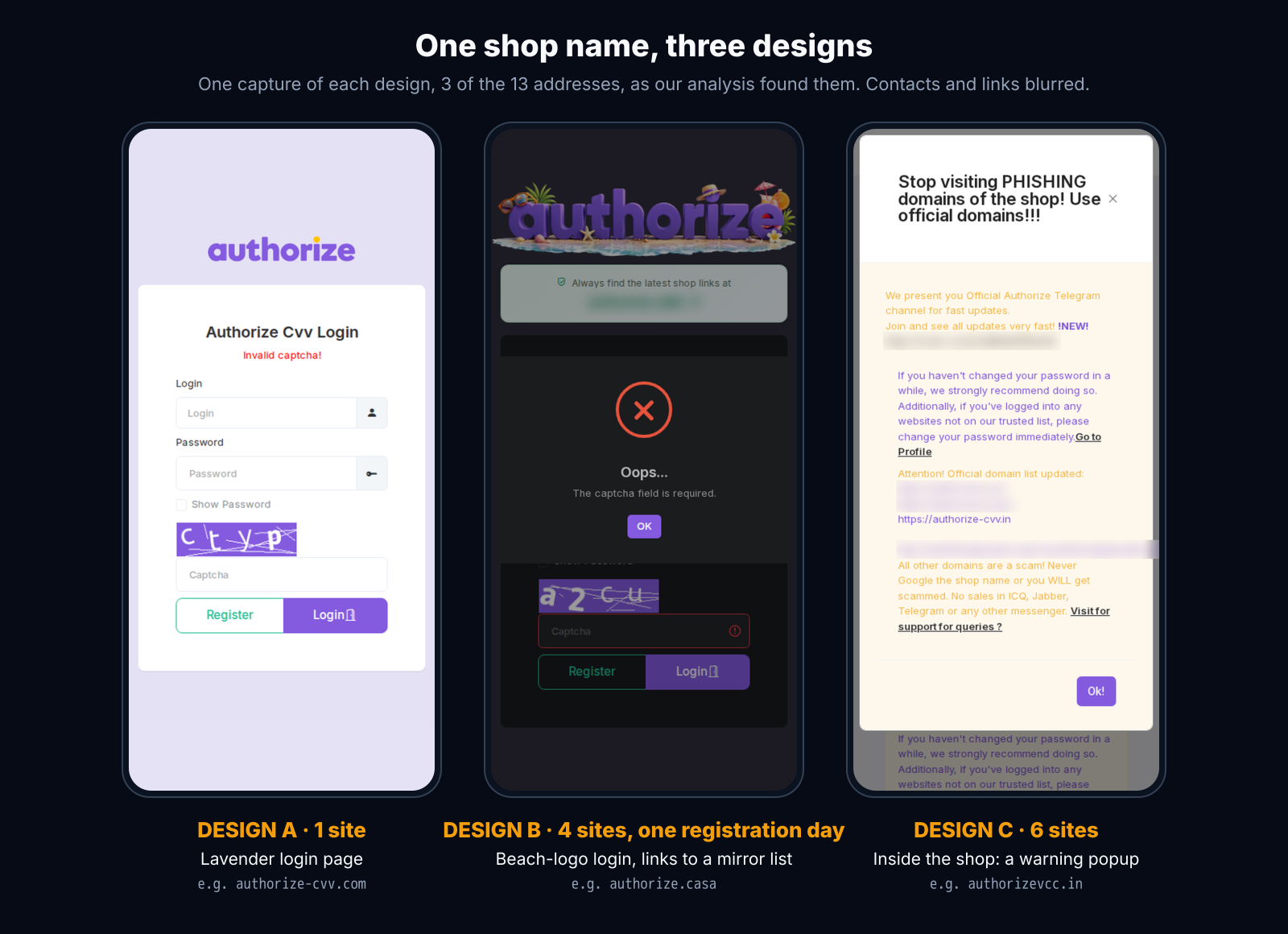
They do not all look alike, which is part of why the link is easy to miss. The addresses use three designs: a plain lavender login page, a beach-themed login page that points visitors to a list of "latest shop links", and the inside of the shop itself, opened by a warning pop-up.
Thirteen spellings of one name
Every address is a variation on "authorize" and "cvv": a different ending, a hyphen, a swapped letter. Three are look-alike spellings: in authorlzecvv.cc an "l" stands in for the "i", and authorizevcc.in and authorizevcc.io turn "cvv" into "vcc". Whether they were registered to catch mistyped visits, the evidence does not say. The name also echoes Authorize.Net, a real payment company; we found nothing that links these shops to it. Grouped by what they showed us:
- Design C, the shop with its warning pop-up (6): authorize-cvv.in, authorizevcc.in, authorisecvv.com, authorizedcvv.in, authorizevcc.io, authorizecvv.shop
- Design A, the lavender login (1): authorize-cvv.com
- Answered "not found" but still served the shop's files (2): authorizecvv.com, authorlzecvv.cc
- Design B, the beach-logo login, a group of its own (4): authorize.casa, authorize.cash, authorize.credit, authorize.rest
The registration trail
Each report carries the domain's public registration record. Read together, the dates are not spread out the way unrelated sites would be. They arrive in batches.
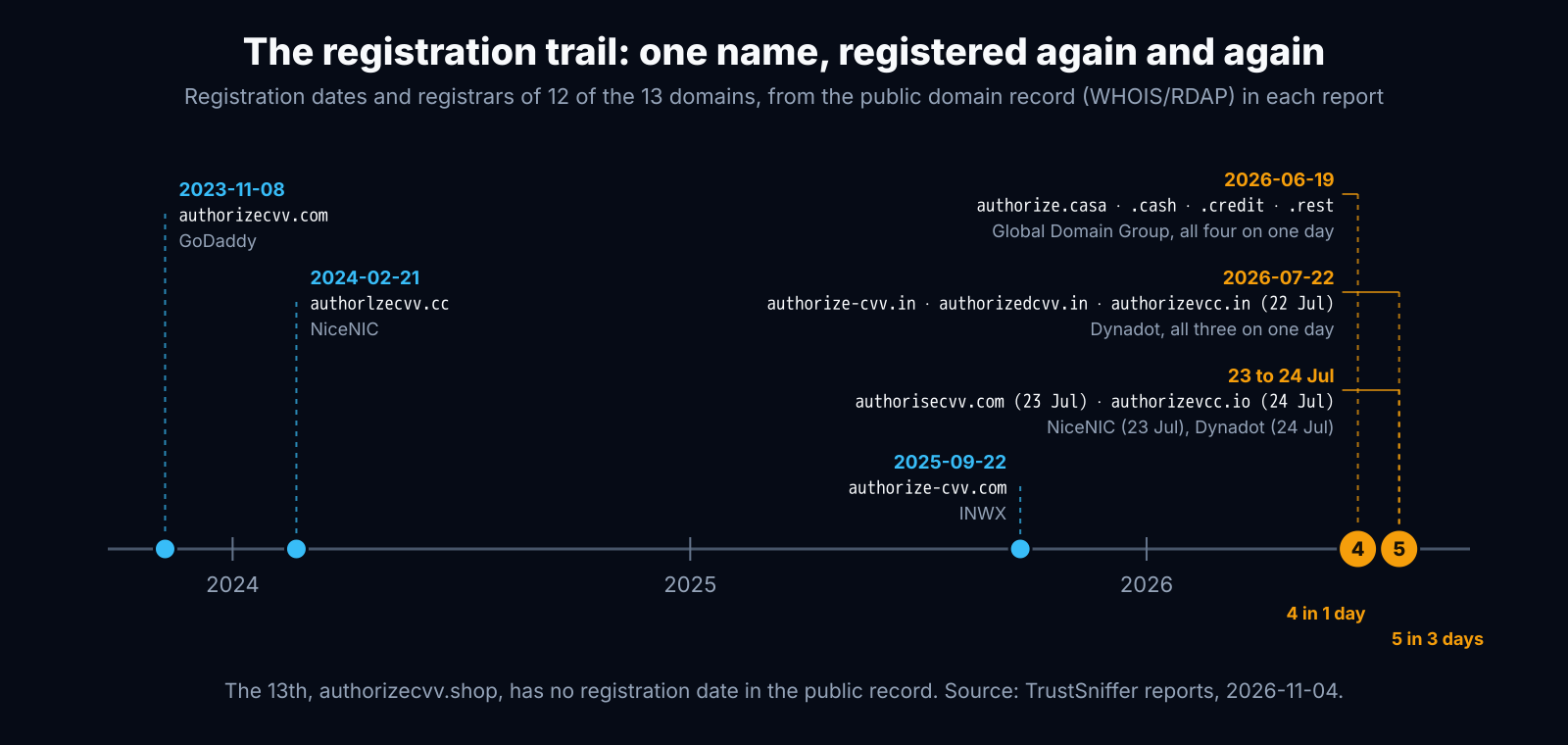
- The oldest is authorizecvv.com, registered on 8 November 2023 with GoDaddy. Its typo twin authorlzecvv.cc came on 21 February 2024, with NiceNIC.
- The first hyphenated form, authorize-cvv.com, was registered on 22 September 2025 with INWX.
- On one day, 19 June 2026, one registrar took four domains: authorize.casa, authorize.cash, authorize.credit and authorize.rest, all with Global Domain Group. These are the four Design B sites.
- Five more arrived in three days: authorize-cvv.in, authorizedcvv.in and authorizevcc.in with Dynadot on 22 July 2026, authorisecvv.com with NiceNIC on 23 July and authorizevcc.io with Dynadot on 24 July.
Four domains with one registrar on one day were most likely bought together. What the record does not give is a person: none of these registrations names one, and we would not publish a name if it did. All 13 also answer through Cloudflare, according to the hosting record in each report (see authorize.casa for one), so the record names Cloudflare's network, never the server that holds the shop.
The files they share, byte for byte
Our analysis records the files each site serves from its own address and fingerprints them with SHA-256, a hash that changes completely if a single byte changes. Two sites that serve a file with the same hash serve the same file. This is where the nine come together, and where the other four part ways.
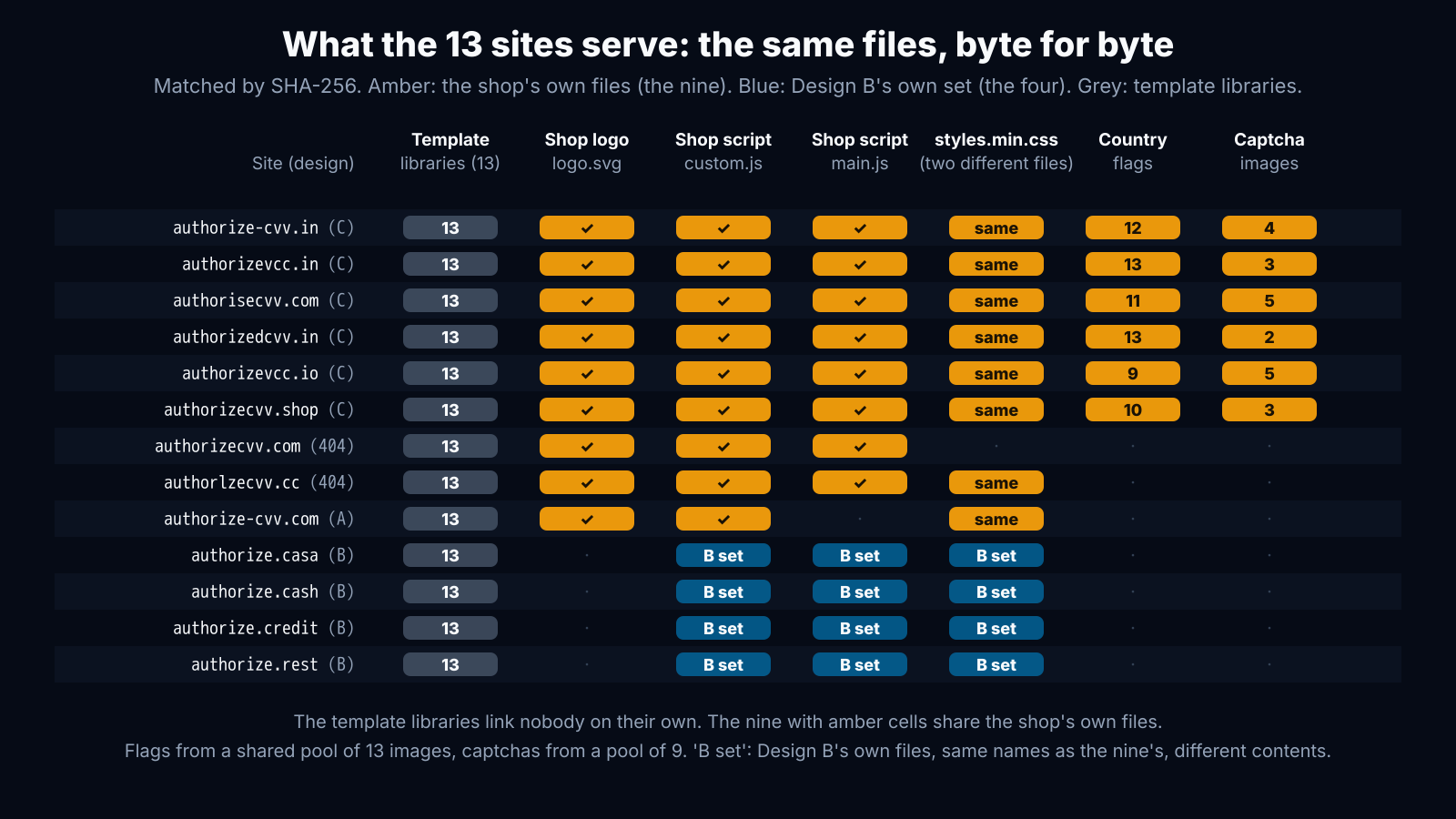
All 13 serve the same 13 library files: menus, charts, pop-up dialogs and colour pickers from a commercial admin-dashboard template. Anyone who buys that template gets the same files, so they link nobody on their own, and our analysis ignores them when it draws a network. The shop's own material is a different matter. Nine sites serve the same custom script and the same logo. Eight serve the same stylesheet (all but authorizecvv.com) and eight a second identical script (all but authorize-cvv.com). The six Design C sites also serve 9 to 13 of the same country-flag images each, the country picker of the card catalogue, and 2 to 5 of the same captcha images.
The four Design B sites share none of those shop files. They share three distinctive files of their own instead, a stylesheet, a custom.js and a main.js with the same names as the nine's but different contents, so our analysis lists them as a group of four. What ties them to the nine is the name and the template: all 13 serve the same 13 template files, while the separate "authorized" group below shares just one library file with the nine, too little to count under our rule. Counting Design B in the family is a judgement on that evidence, weaker than a shared shop file.
That is the rule behind every network we publish: two sites are linked only by two or more distinctive files like these, or by one identifier written into their pages, and files that also turn up on sites we do not rate as risky are ignored. The Risk Index explains the trust bands behind every score here. For a fraud or security team holding a copy of one of the shop's files, the hashes are:
custom.js        adf64f59a8ffa1cfcb9a837bf595796b624eac1fc6870a91bda55060f565cb24  (9 sites)
logo.svg         9904dc47bc9a5272933cedc2fa0b589481d89bb91106ffcb17d4209f173f4ab1  (9 sites)
main.js          16697db49ca2f8d437eba02a05eedf61df917ee4f57c8e9903ffde235a3db252  (8 sites)
styles.min.css   50171cf89baf10628e96fd1fef7d835ed6e3c16e3829300fc66003dbc604d424  (8 sites)
styles.min.css   314b6dcbfa4580bbfe81d3b0ce4a6f894fc7a0f46449c3f6aeaff510fb6c8ea6  (the 4 Design B sites)
custom.js        285a7d712b3daee2dcb7193d08cf8ec4168e80d8d370091a6f60e7ae9802d416  (the 4 Design B sites)
main.js          5c04e7816955a33fc65caae85435f7ad5e91db35894fbaf31ee109a740002031  (the 4 Design B sites)
A shop that warns its customers about phishing
The six Design C sites open on a pop-up headed "Stop visiting PHISHING domains of the shop! Use official domains!!!". It names three addresses as the shop's official ones, plus an onion link (the blurred lines in the first figure). One of them, authorize-cvv.in, is among the nine, so the other five Design C sites send their own visitors to a member of the same network: a direct link, written on the page. The shop itself sits behind that pop-up: the flag images in the third figure are its catalogue's country picker, and the captcha images come from its login. The other two "official" addresses are not ones we have analysed. We recorded the same pop-up, with the same list, on all six. The pop-up adds that "all other domains are a scam" and tells buyers not to search for the shop by name.
Read plainly, the shop claims that copies of it are in circulation and asks its buyers to trust its own list. Nobody looking from the outside, buyers included, can tell an original from a copy, and we cannot either. What the files, the pop-up and the registrations show is one brand and one shop build spread across many addresses, whoever holds each one.
Two more groups of card shops
Our analysis found two more groups of stolen-card shops that share no distinctive file with these 13, so we treat them as separate. Each has its own evidence on its reports.
- Six "authorized" sites that share files with one another: authorized.best, authorized.casa, authorized.cash, authorized.rest, authorizedcvv.io and authorizedcvv.pro. The four on .best, .casa, .cash and .rest were registered on 11 September 2026 with Spaceship, the other two on 30 July 2026 with Dynadot. Despite the similar name, authorizedcvv.in belongs to the nine, not to this group.
- Three sites, cardingshop.ru, cvv2.su and cvv4you.su, that share files and one Matomo analytics account hosted on a domain we have not analysed.
- All six and all three are rated Critical, with scores between 0 and 10.
What to do with this
If you work in fraud prevention or security, the addresses and hashes above are a starting point for blocklists. New addresses in this family and the related "authorized" groups follow two patterns you can match: "authorize", "authorise" or "authorized" followed by "cvv" or "vcc", or the bare word "authorize" or "authorized" on a cheap ending such as .in, .io, .cc, .casa, .cash, .credit, .rest, .best, .pro or .shop, often with one letter changed. The bare-word pattern also catches legitimate names, Authorize.Net's among them, so treat a match as a domain to review before blocking it. To get a site taken down, report it to Cloudflare's abuse service and to the registrar named in its public record (for these, GoDaddy, NiceNIC, INWX, Global Domain Group and Dynadot; authorizecvv.shop publishes no registrar, so only the Cloudflare route applies), linking the evidence on its TrustSniffer report, and share the indicators with law enforcement or your national CERT. The flag and captcha files, which have no single hash, are listed with theirs under "Shared files" on each Design C report.
If you think your card is among those for sale, call your card issuer, ask for a replacement card and watch your statements. You do not need proof that your details are listed. Do not visit, register or pay on one of these shops to check: the listings sit behind its login, there is no removal service, and paying a fraud shop helps it.
To check any address that looks like one of these, run it through the website checker. Every report we publish, these included, is in the scam directory, and new threats appear on the threat radar.


