Verdict
An external threat listing named this site as malicious when the evidence was captured. Do not pay or share personal details with this site.
solcard-en.web.app shows critical-risk indicators.
- Sensitive Interaction Risk: This label is given when the overall risk is high. The captured page did not ask for a password, card number or other sensitive details; if it ever does, entering them here could be unsafe.
- Governance Risk: The governance checks raised a concern: the business-model ceiling (at most 50) applies, but the score is below it; a threat-intelligence listing limits the score; as a site on web.app, this address has no registration record of its own (the platform's domain is registered, not the site). The findings below give the detail.
| How the site describes itself | SolCard sells a crypto-funded Visa prepaid card, topped up with SOL and spent via Apple Pay or Google Pay. It charges a 5% top-up fee and promotes the $SOLC token as backing. No legal entity, licence, regulator, or physical address is disclosed, so the financial top-up flow lacks verifiable proof. |
|---|
Evidence status and limitations
Evidence completeness: PartialThis says whether every check on the site was recorded as finished. At least one check failed or returned no result.
- The evidence was captured on 2026-11-13 and re-scored on 2026-11-16. The certificate, the registration age and the page content describe the site as it was on 2026-11-13.
- One external source flagged this site when the evidence was captured (a threat-intelligence listing from a feed TrustSniffer monitors (phishing, the site itself as the source, last seen 2026-10-26)). No second source confirms it. The alert is from the evidence captured on 2026-11-13; it was not re-queried for this version and is treated as unconfirmed. On its own the alert would limit the score to at most 49; the threat-listing ceiling holds it at 5, because the listing names the site itself as the source.
- The real-world operator identity was not independently verified.
- These checks returned no result: web archive lookup.
How to read these numbers
The trust score runs from 0 to 100, higher is safer. 5/100 rates the evidence found, not the probability that the site is a scam.
Evidence confidence (55%) measures how much of TrustSniffer's evidence set this site produced: the page reading, the browser sandbox, the web archive, the registration record and the reputation services. It falls when a check returns nothing, as listed above, and it does not change the score.
At a glance
The checks that decide most of this verdict.
| What limits the score | Threat-listing ceilingA threat-intelligence feed TrustSniffer monitors listed this site itself as the source of a threat when the evidence was captured (last seen 2026-10-26), and that listing caps the score. The business-model ceiling (at most 50) and the unconfirmed alert ceiling (at most 49) also apply, but the score is below them. | Risk |
|---|---|---|
| Malware engines | None malicious; 1 marked it suspiciousVirusTotal | Watch |
| Google Safe Browsing | Not listedGoogle | Clear |
| Abuse reports on the CDN edge address | 1% confidenceAbuseIPDB, 3 reports; shared hosting inflates reports; this is the record of the CDN edge address, not of the server behind it, which was not observed | Noted |
| Domain age | Not availableNo registration record was returned | Noted |
| Certificate | Encrypted connectionIssued by WR3 | Noted |
| Hosted by | FASTLYNetwork registered in US | Noted |
The page as captured
Key findings
- Automated classification: Sensitive Interaction Risk, Governance Risk.
- No security engine marked this domain as malicious and Google Safe Browsing does not list it; some engines marked it suspicious, which TrustSniffer does not count as a listing. Its hosting IP carries AbuseIPDB reports below the confidence level TrustSniffer treats as a flag.
- The operator behind the site could not be independently connected to a real-world brand or person.
Full analysis
Overview
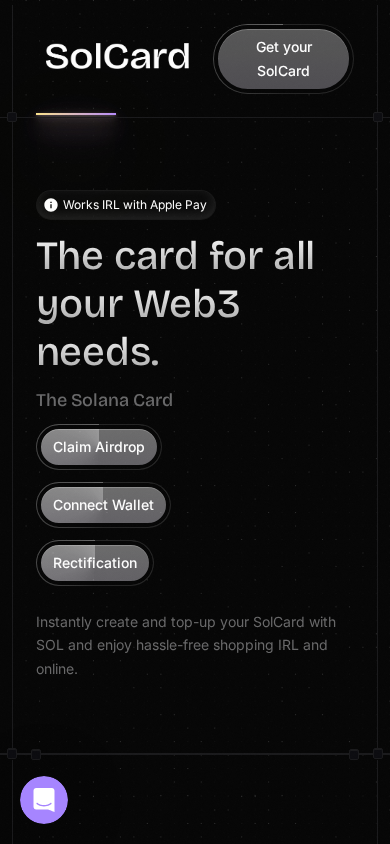
SolCard presents itself as the "Solana Card", a crypto-funded Visa prepaid card that users top up with SOL and spend in shops through Apple Pay or Google Pay. The single landing page promotes instant issuance, a "Claim Airdrop" button, a "Connect Wallet" prompt and a companion token called $SOLC. It appears to earn its revenue from top-up and foreign-currency fees on balances that users hand over to the operator.
Scam/Impersonation Risk
This is the decisive section of the report, and it carries critical risk. A threat-intelligence feed lists this address as the actor in phishing activity, last seen on 26 October 2026. That listing is what holds the assessment at its lowest band. No brand impersonation was detected, and no conflicting legal identities appear on the pages read. The risk therefore comes from the phishing listing, reinforced by the site's own presentation. The homepage asks visitors to move crypto value onto a card balance that the operator controls, and it offers no proof of who holds those funds. It says the card is "fully backed" by its own $SOLC token but discloses no reserve, audit or backing mechanism. It also pairs an airdrop claim with a wallet-connection prompt, a combination the behavioural analysis flagged as suspicious. The site says it "doesn't collect any user info", yet it also says live support for a higher limit requires KYC. It advertises "150M+ supported merchants" while its own FAQ concedes the card does not work everywhere. The operator is hosted on a free platform subdomain, which gives no independent link to a real-world business. Browser testing also recorded a large page-structure change after interaction and an unusually high share of synthetic responses.
- Homepage: it promotes "Claim Airdrop" and "Connect Wallet" and states that the card is "fully backed by it's token: $SOLC", with no reserve or audit shown.
- Homepage: it states "SolCard doesn't collect any user info" while saying support for higher limits requires KYC, and it claims "150M+ supported merchants" next to a FAQ admitting the card is not universally accepted.
- Threat-intelligence listing: the address was listed as a phishing actor, last seen 2026-10-26, and the capture was taken on 2026-11-13.
- Security engines: one engine rated the address suspicious and none rated it malicious, and Google Safe Browsing had no listing. This was a single weak signal, and the listing above is what keeps the score down.
Regulatory Verification Notes
For a payment and remittance product, a visitor expects to find a named legal entity, a registration or licence, a named regulator, clear fees, and terms or privacy information. On the home page, the only page read, fees and a Terms of Use link are present. The 5% top-up fee, a 2% non-USD purchase fee and refunds through a dashboard are disclosed. On the pages read, no legal entity, no registration or licence number and no regulator are named, and no physical address is given. The site cites "regulatory restrictions" as the reason for a $10,000 monthly top-up limit but does not say which regulator or licence imposes it. The only contact routes found were a contact form and a Telegram community, and the site tells users to consult Telegram members for "previous experience reports". Real-world identity is unverified. The brand name on the page cannot be tied to any accountable company. No third-party broker or regulatory reputation record exists for this site, so nothing here amounts to a licensing verdict.
- Homepage: it lists a 5% top-up fee and a 2% non-USD purchase fee, and it links to Terms of Use.
- Homepage: it names no company, licence, regulator or address, and cites "regulatory restrictions" for a $10,000 monthly cap.
- Hosting record: the site is served from AS54113 (Fastly, Inc., US) on a web.app platform subdomain, so it has no registration of its own.
- Transport encryption: the TLS certificate was issued by WR3 (DV, domain validation only) and was valid to 2027-01-25. It confirms an encrypted connection and says nothing about who operates the site.
What to Verify Next
Any prospective user should first establish who actually issues the Visa card. That means identifying the card issuer or program manager and checking that issuer's own records with the relevant financial regulator, using details found outside the site. The $10,000 monthly limit should be matched against a named regulator and licence. The reserve, audit or custody arrangement behind the claimed $SOLC backing should be confirmed from independent documentation. Support channels should be confirmed through an independent route, not the community links on the page, and the Terms of Use should be read for who holds user funds and how refunds are settled.
- Homepage: it says refunds are requested "through the dashboard", with no refund terms or custodian named on the page.
- Homepage: it mentions live support with KYC for higher limits but does not say who performs that verification.
- Homepage: it states that the card is "fully backed" by $SOLC and names no reserve, audit or custodian.
Summary Verdict
The assessment is critical risk. A current threat-intelligence listing for phishing, together with a custodial financial offer that has no verifiable operator, leaves nothing that could support a trusted classification. Real-world identity could not be tied to the brand. The supporting technical findings are routine for any hosted page and do not change the outcome.
Infrastructure Integrity
The site is served through Fastly's content-delivery network, and both observed addresses are edge servers, so the origin host was not observable. This is treated as neutral: it neither supports nor weakens the assessment. The host address's abuse record was checked. It shows three reports, which attach to the provider's shared address and not to this site specifically, so they are not weighed against the site.
Closing Assessment
The site should not be used for any financial purpose. That means no topping up, no wallet connection, no airdrop claim and no funds placed on the card. If funds have already been sent to it, the user should contact the wallet provider and a local fraud-reporting body promptly. Browsing the page read-only is the only interaction in line with the assessment.
Written analysis generated 2026-11-16 by the TrustSniffer Analysis Engine from the evidence in this report.
What the analysis found
9 findings contributed to this verdict, raised by governance, page content, behaviour in a sandbox, and registration and ownership.
01 Governance
- TrustSniffer limits the score of a site whose operator it could not verify, according to the kind of site it appears to be (this one reads as a payment or money-transfer service on its own pages); here that limit is at most 50, and the score is below it, so it does not set the score.Governance
rule:gov_business_model_cap - A threat-intelligence feed TrustSniffer monitors listed this site itself as the source of a threat when the evidence was captured (last seen 2026-10-26), and that listing caps the score.Governance
rule:gov_active_threat_listing
02 Page content
- The page shows few of the signs expected from a trustworthy operator.Page content
rule:PAGE_TRUST_QUALITY_LOW - The page content shows three or more warning signs that deceptive sites commonly use.Page content
rule:PAGE_RED_FLAGS_STRONG - The browser raised a warning while loading the page.Page content
rule:PAGE_BROWSER_FLAGS_SUSPICIOUS - The page has no description for search engines, which established sites usually provide.Page content
rule:PAGE_SEO_MISSING_META - The page carries none of the structured previews for search and social sharing that established sites usually provide.Page content
rule:PAGE_SEO_NO_STRUCTURED
03 Behaviour in a sandbox
- The structure of the page changed sharply during the sandbox session.Behaviour in a sandbox
rule:BEHAV_DOM_DENSITY_SPIKE - Many of the responses the page received looked generated rather than served normally.Behaviour in a sandbox
rule:BEHAV_SYNTHETIC_RESPONSES_HIGH
04 Registration and ownership
- As a site on web.app, this address has no registration record of its own (the platform's domain is registered, not the site).Registration and ownership
rule:KF_WHOIS_INCOMPLETE
How related findings were counted
Some findings above describe the same underlying fact, and some are weak on their own. TrustSniffer counts each such group under one shared limit, so one fact is not counted several times and weak signals stay bounded.
- Page quality: 2 findings share one limit, because each is weak evidence on its own. Together they stayed under the limit.
- Certificate and search-engine setup: 2 findings share one limit, because none of them is a sign of fraud on its own. Together they stayed under the limit.
Noted, not counted
Recorded during the assessment, but not counted against the site.
- AbuseIPDB: 3 reports on hosting IP 2620:0:890::100 (FASTLY), 1% confidence. The reports are attributed to shared infrastructure, not specifically to this website.
Identity verification
| Status | UNVERIFIED |
|---|
The operator behind the site could not be connected to a real-world brand or person. What the page shows, if anything, is listed below; none of it was independently checked.
- org:SolCard
- contact:form
- on_site_identity
What TrustSniffer observed
First-party facts recorded during the assessment of solcard-en.web.app.
- The request stayed on solcard-en.web.app. It was not redirected to another domain. Clear
- It is hosted on FASTLY, a network registered in US. Noted
Code shared with other sites rated Critical
TrustSniffer found that this site serves the same distinctive code files as 9 other sites it has analysed. All 9 are rated Critical on their own evidence.
Shared code shows that these sites were built from the same toolkit. It does not by itself show who operates them.
- blockswalletschain.web.app (Critical)
- coisynctechresolve.pages.dev (Critical)
- decentralizedapp.pages.dev (Critical)
- decentralizedapps.pages.dev (Critical)
- fixalgo.pages.dev (Critical)
- iost-net.web.app (Critical)
- kinetiq-en.firebaseapp.com (Critical)
- kinetiq-en.web.app (Critical)
- polymarket-en.firebaseapp.com (Critical)
| Shared files (SHA-256) | main.css 39ba049d03abe5def80830ba38d0f2b432dd7374cac67ffd3c800d9bcc551164 (10 sites) |
|---|---|
| walletpage.css 7f27584b0c891c2340eae90868b94b543d1a9d149bc9c6e9407d127320f57b98 (10 sites) | |
| jquery3.6.0.min.js ce9d07500ad91ec2b524c270764ec4c9a33e78320d8d374ec400ede488f6251b (3 sites) | |
| index.css f5d9810298c6009cdf9fbbbbf0c695180feb4a8960b8e9116b412a648eaf61cf (3 sites) |
Two sites are linked only by two or more shared distinctive files or one shared identifier: an endpoint written into the page's code (a Cloudflare Worker or a Telegram bot), a wallet address shown on the page (checksum-validated), a contact or an analytics ID. Common libraries, platform files, images, well-known contracts, a brand's own accounts and anything also used by a site rated Moderate or High are excluded. Contact details (Telegram, WhatsApp, phone, email) are withheld. A shared file can be checked by its SHA-256 hash.
Domain intelligence
| Registrar | Not available |
|---|---|
| Hosting | FASTLY - Fastly, Inc. |
| Network registered in | US |
| Server IP | 2620:0:890::100 (a CDN edge address; the server behind it was not observed) |
| Name servers | Not available |
| CDN / edge network | Detected (fastly) |
| Resolved IP addresses | 2 |
| Edge IP addresses | 2 |
| Likely origin IP addresses | 0 |
| SSL issuer | WR3 |
| SSL expiry | 2027-01-25 |
| First seen (web archive) | Not available (the web archive has no record of this address; a site on web.app has no registration of its own) |
| Domain expiry | Not available |
| Archive first seen | Not available |
| Archive snapshots | Not counted (archive lookup incomplete) |
| Reputation | VirusTotal: 0 malicious, 1 suspicious | AbuseIPDB (CDN edge address, not the host): 1% confidence, 3 reports | Google Safe Browsing: 0 matches |
About this assessment
A trust score summarises the evidence TrustSniffer could collect about solcard-en.web.app at a point in time: domain registration and age, hosting and certificate, the content the site served, and third-party reputation feeds. A high score means the signals were consistent with a legitimately operated site; a low or critical score means several risk patterns were present. It is a starting point for your own judgement, not a guarantee and not a legal finding. There is no human rating and no user review in it. A site can change after it is assessed.